The Jakarta Post
Please Update your browser
Your browser is out of date, and may not be compatible with our website. A list of the most popular web browsers can be found below.
Just click on the icons to get to the download page.


Popular Reads
Top Results
No results found. Please check your search term and try again
Can't find what you're looking for?
View all search results
Popular Reads
Top Results
No results found. Please check your search term and try again
Can't find what you're looking for?
View all search resultsBJ Habibie’s status in Indonesian history
One of the criteria for becoming a national hero is not having committed treason against the nation. Was BJ Habibie excluded because of this issue?
Change text size
Gift Premium Articles
to Anyone
Share the best of The Jakarta Post with friends, family, or colleagues. As a subscriber, you can gift 3 to 5 articles each month that anyone can read—no subscription needed!
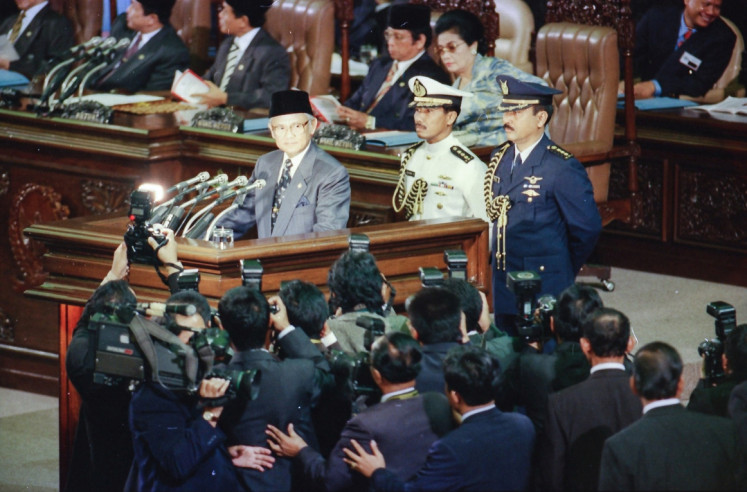
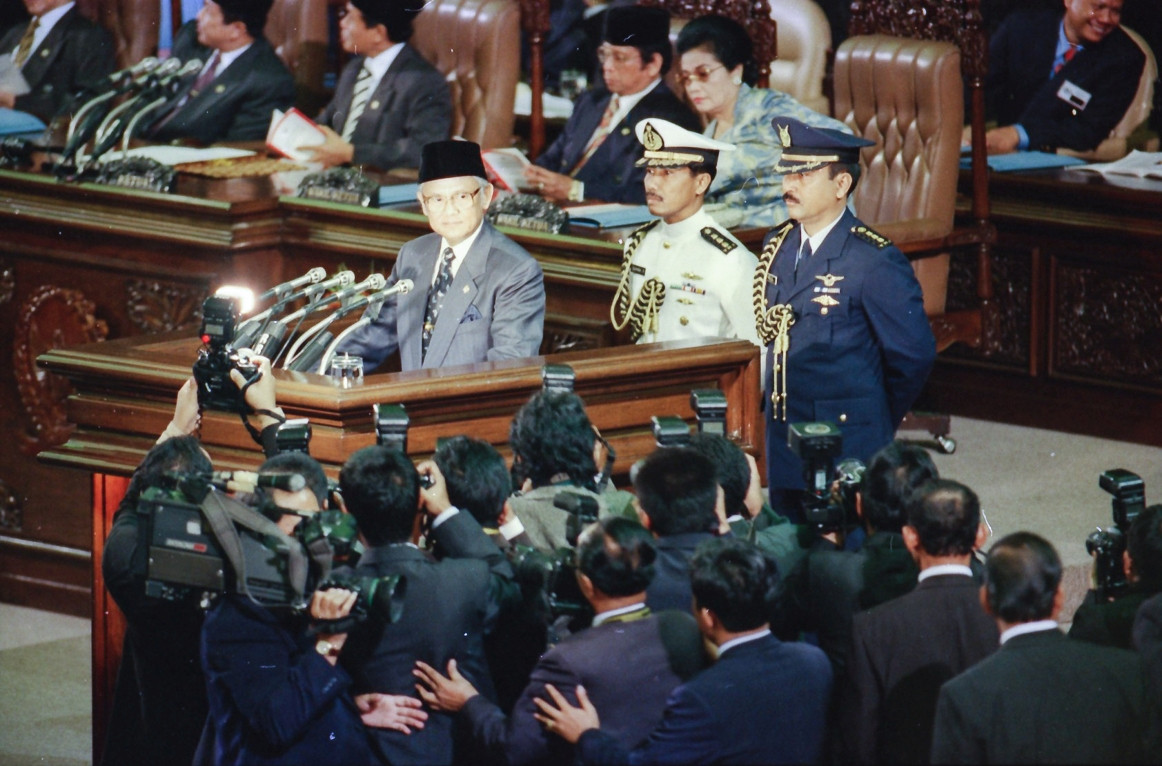 President B.J. Habibie addresses the House of Representatives on Aug. 15, 1998, where he called for military reform and a new democratic paradigm during the early days of the Reform Era. (The Jakarta Post Archive/Bayu Ismoyo)
O
n Nov. 10, 2025, Soeharto and Abdurrahman “Gus Dur” Wahid, Indonesia’s second and fourth president, respectively, were designated national heroes following proposals made as early as 2010.
It appears the third president was overlooked. One of the criteria for becoming a national hero is not having committed treason against the nation. Was BJ Habibie excluded because of this issue - specifically, the perception that he allowed Timor-Leste to break away from Indonesia?
This brings to mind the national figure M. Natsir, who passed away in 1993. At the time, there were proposals to designate him a national hero, but the idea and subsequent efforts faced opposition from the Indonesian Military (TNI). They believed Natsir had been involved in the 1958 PRRI (Revolutionary Government of the Republic of Indonesia) rebellion; from the military's perspective, a rebel was unworthy of being named a hero.
This opposition persisted for over a decade, yet Natsir was ultimately named a national hero in 2009. How did this come about? Could BJ Habibie follow a similar trajectory as Natsir?
Prior to 2009, social affairs minister Bachtiar Chamsyah - who was also the chairman of the United Development Party (PPP) - was frequently asked by constituents when Natsir would be named a national hero, given the TNI's objection to him as a rebel.
Usman Pelly, a colleague of Bachtiar in Medan, suggested informing the TNI that it was Natsir who had pioneered the concept of "NKRI harga mati" (the Unitary State of the Republic of Indonesia as a non-negotiable imperative) - a slogan later adopted by the military. This was historically evidenced by Natsir’s 1950 "Natsir Integral Motion," which led to the dissolution of the various states within the United States of Indonesia and their merger into the Unitary State of the Republic of Indonesia. This helped soften the military's stance.

Habibie served as president for only one year and five months, beginning on May 21, 1998. This brief tenure makes it difficult to evaluate his presidency in the same way as those of his two predecessors, who governed for decades.