The Jakarta Post
Please Update your browser
Your browser is out of date, and may not be compatible with our website. A list of the most popular web browsers can be found below.
Just click on the icons to get to the download page.


Popular Reads
Top Results
No results found. Please check your search term and try again
Can't find what you're looking for?
View all search results
Popular Reads
Top Results
No results found. Please check your search term and try again
Can't find what you're looking for?
View all search resultsPrabowo braces for a 2029 showdown with Jokowi
If the latest cabinet reshuffle says anything about their relationship, it is safe to say it is going downhill and that they are in for another political showdown.
Change text size
Gift Premium Articles
to Anyone
Share the best of The Jakarta Post with friends, family, or colleagues. As a subscriber, you can gift 3 to 5 articles each month that anyone can read—no subscription needed!
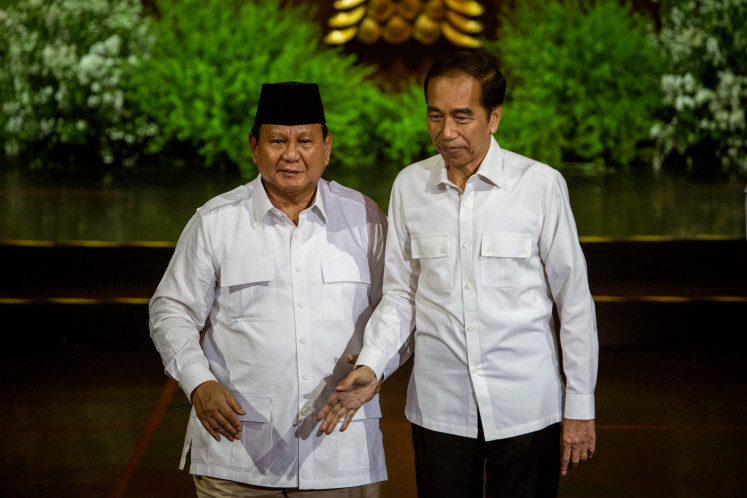
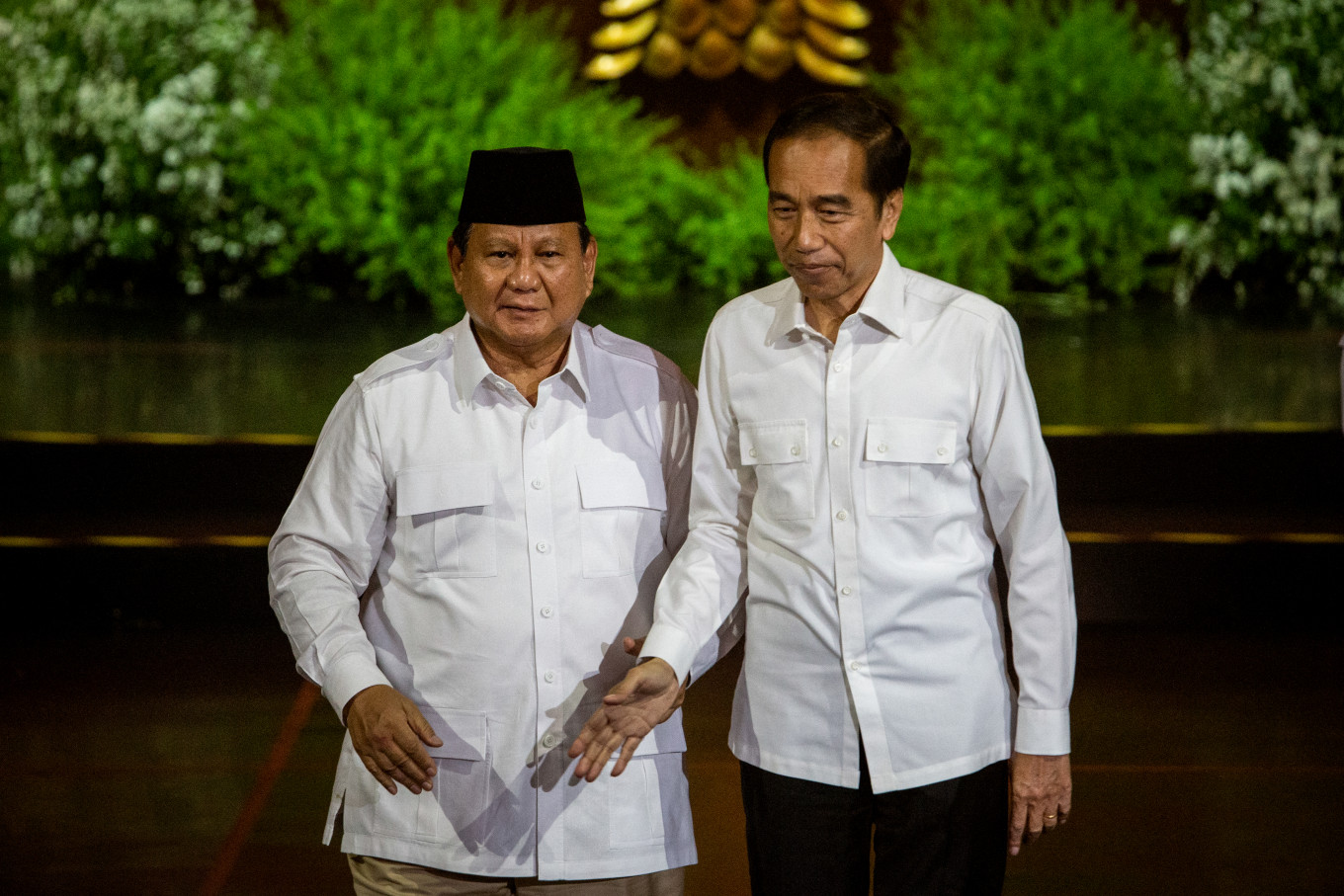 President Prabowo Subianto (left), who also chairs the Gerindra Party, and former president Joko “Jokowi“ Widodo pose on stage during the party's 17th anniversary in Bogor, West Java, on Feb. 15, 2025. (AFP/Aditya Aji)
O
n Oct. 1, just weeks before marking his second year in office, President Prabowo Subianto announced his largest and most consequential cabinet reshuffle, affecting 10 ministries and six state institutions. This political move is widely seen as Prabowo’s attempt to consolidate power before entering his third year.
The reshuffle followed the firing of former finance minister Purbaya Sadewa in September. He was replaced by his own deputy, Suahasil Nazara, a University of Indonesia economist. The brash, often controversial finance minister was shown the door after reports of conflicts between him and Prabowo’s ex-army colleagues at the Finance Ministry over a major personnel reshuffle. There were also tensions with Danantara chief executive officer Rosan Roslani over Purbaya’s request to use the state asset fund’s profits to plug the budget deficit.
The latest Cabinet shake-up, which caught many by surprise, also saw technocrats appointed to strategic posts, including the Foreign Ministry, with deputy foreign minister Armanatha Nasir, a career diplomat, replacing Prabowo’s protégé, Sugiono.
The reshuffle appears to have been primarily aimed at tightening Prabowo’s grip on power and weakening potential rivals ahead of the next presidential election. But it may also signal the growing rivalry and the increasing likelihood of another power contest between Indonesia’s two major political powerhouses, former election rivals President Prabowo and his predecessor, Joko ‘Jokowi’ Widodo.
Prabowo and Jokowi, who fought each other bitterly in the 2014 and 2019 presidential elections, have repeatedly downplayed speculation about a latent rivalry between them, insisting instead that the strong alliance they forged ahead of the 2024 presidential election remains strong.
Prabowo cemented that alliance by choosing Jokowi’s eldest son, Gibran Rakabuming Raka, as his vice-presidential candidate, and retaining many of Jokowi’s allies and political appointees in his huge Red and White Cabinet.

Their political maneuverings, however, suggest otherwise. If the latest cabinet reshuffle says anything about their relationship, it is safe to say it is going downhill and that they are in for another political showdown.
Prabowo’s most consequential political decision was to replace National Police chief Gen. Listyo Sigit Prabowo with former Banten police chief and National Narcotics Agency head Gen. Suyudi Aryo Seto. Listyo has now been reassigned as Presidential Chief of Staff, replacing Gen. (ret.) Dudung Abdurrahman, who now serves as Coordinating Minister for Political and Security Affairs.
Listyo is a close ally of Jokowi. He served as Central Java’s Surakarta police chief when Jokowi was Surakarta mayor. After Jokowi was elected president, he was initially appointed as Jokowi’s adjutant but later tapped to lead the National Police. Jokowi’s ties to Listyo could be said to symbolize the former’s deep influence within the police force, sometimes described as Jokowi’s "brown army" (referencing the color of police uniforms).
Listyo’s removal is thus seen as a big blow to Jokowi. According to Tempo, the police under Listyo helped facilitate Jokowi’s campaign tours or safari politik in the regions. This explains why Prabowo rushed to remove Listyo after keeping him in the post for so long, and why he ordered the new police chief, Suyudi, to overhaul and restructure, that is, purge, police personnel.
In fact, Suyudi ordered a major shake-up of the police force very soon after his appointment. He replaced more than a dozen senior officers and regional police chiefs appointed by Listyo, and in just 12 days, he has reshuffled as many as 450 police officials.
As well as Listyo, Prabowo also removed another Jokowi loyalist, Pratikno, from a strategic cabinet position. Prabowo reassigned his Sugiono to replace Pratikno as Coordinating Minister for Human Development and Culture.
Pratikno now serves as the head of the Presidential Advisory Council (Wantimpres). This role is far less strategic than his previous post, in which he had oversight of Prabowo’s key populist programs, including the controversial free nutritious meal program.
Despite his attempts to weaken Jokowi’s loyalists, Prabowo’s maneuvering appears calibrated to still keep some of Jokowi’s camp close and avoid direct confrontation. His promotion of Golkar Party Chair and Energy and Mineral Resources Minister Bahlil Lahadalia, a Jokowi ally, to Coordinating Downstreaming and Energy Transition Minister is clearly intended to keep Golkar, the second-largest party in parliament, in Prabowo’s big-tent coalition.
Perhaps not coincidentally, the Cabinet reshuffle came as members of the Jokowi dynasty faced intense public scrutiny over their educational credentials, which puts their credibility and eligibility as election contenders in serious question.
For years, Jokowi’s detractors have questioned the authenticity of his college diploma, alleging that the former president never completed his undergraduate studies at Gadjah Mada University. The school diploma witch-hunt now targets his oldest son, Gibran, who has been accused of failing to complete his secondary education abroad.
On Oct. 6, the Constitutional Court ruled that it found no evidence that Gibran had a valid high school diploma. This sparked fresh calls for Gibran’s impeachment and raised questions about his eligibility to contest the 2029 presidential election.
After the Court ruling, Jokowi reportedly shifted his rhetoric on Gibran’s election prospects. When asked whether the Prabowo-Gibran administration would survive its first term, Jokowi said, “pemilu masih jauh” (the election is still far away). This marks a departure from his previously rehearsed response, which emphasized his firm support for the Prabowo-Gibran government continuing into its second term.
Two years after leaving the presidency, Jokowi remains firmly in the political spotlight. In October 2025, he officially joined the Indonesian Solidarity Party (PSI), now led by his youngest son, Kaesang Pangarep. The party has branded itself as “Jokowi’s party”, and Jokowi has campaigned for it in a clear attempt to bolster his family’s political bargaining power ahead of the 2029 general elections, which are about 26 months away.
It is worth noting that the rivalry between Prabowo and Jokowi does not seem to be personal, or at least not driven mainly by personal grudges between the two former election rivals.
But Jokowi remains popular, making him a political force to reckon with. Meanwhile, Prabowo’s state-led capitalism and militarization have privileged many native or pribumi capitalists leading state-owned firms, but disadvantaged many major ethnic Chinese capitalists (also known as cukong) who lead the private sector.
Many social interests politically and economically ostracized by Prabowo’s policies, including some big capitalists and certain factions within the police force, thus now feel they must rely on Jokowi for their survival. In other words, structural factors may push or enable the Jokowi dynasty to confront Prabowo.
While Jokowi and PSI remain part of Prabowo’s ruling coalition, Jokowi’s maneuverings suggest his political family is open to taking on Prabowo in 2029. Prabowo’s latest Cabinet reshuffle suggests that the President is well aware of that threat.
---
The writer is editor of Indonesia at Melbourne, an associate director at the Centre for Indonesian Law, Islam and Society (CILIS), and a visiting fellow at ISEAS-Yusof Ishak Institute. This article is republished under a Creative Commons license.