The Jakarta Post
Please Update your browser
Your browser is out of date, and may not be compatible with our website. A list of the most popular web browsers can be found below.
Just click on the icons to get to the download page.


Popular Reads
Top Results
No results found. Please check your search term and try again
Can't find what you're looking for?
View all search results
Popular Reads
Top Results
No results found. Please check your search term and try again
Can't find what you're looking for?
View all search resultsForeign proxy labeling as a pretext for silencing dissent
When foreign debt is celebrated as statesmanship but foreign grants to civic watchdogs are branded as treason, "national sovereignty" becomes a convenient weapon to silence dissent.
Change text size
Gift Premium Articles
to Anyone
Share the best of The Jakarta Post with friends, family, or colleagues. As a subscriber, you can gift 3 to 5 articles each month that anyone can read—no subscription needed!
 Set as preferred source
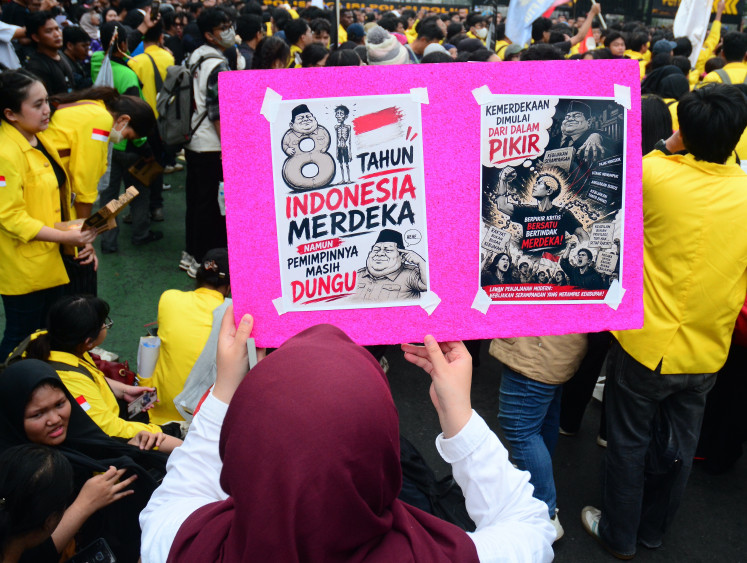
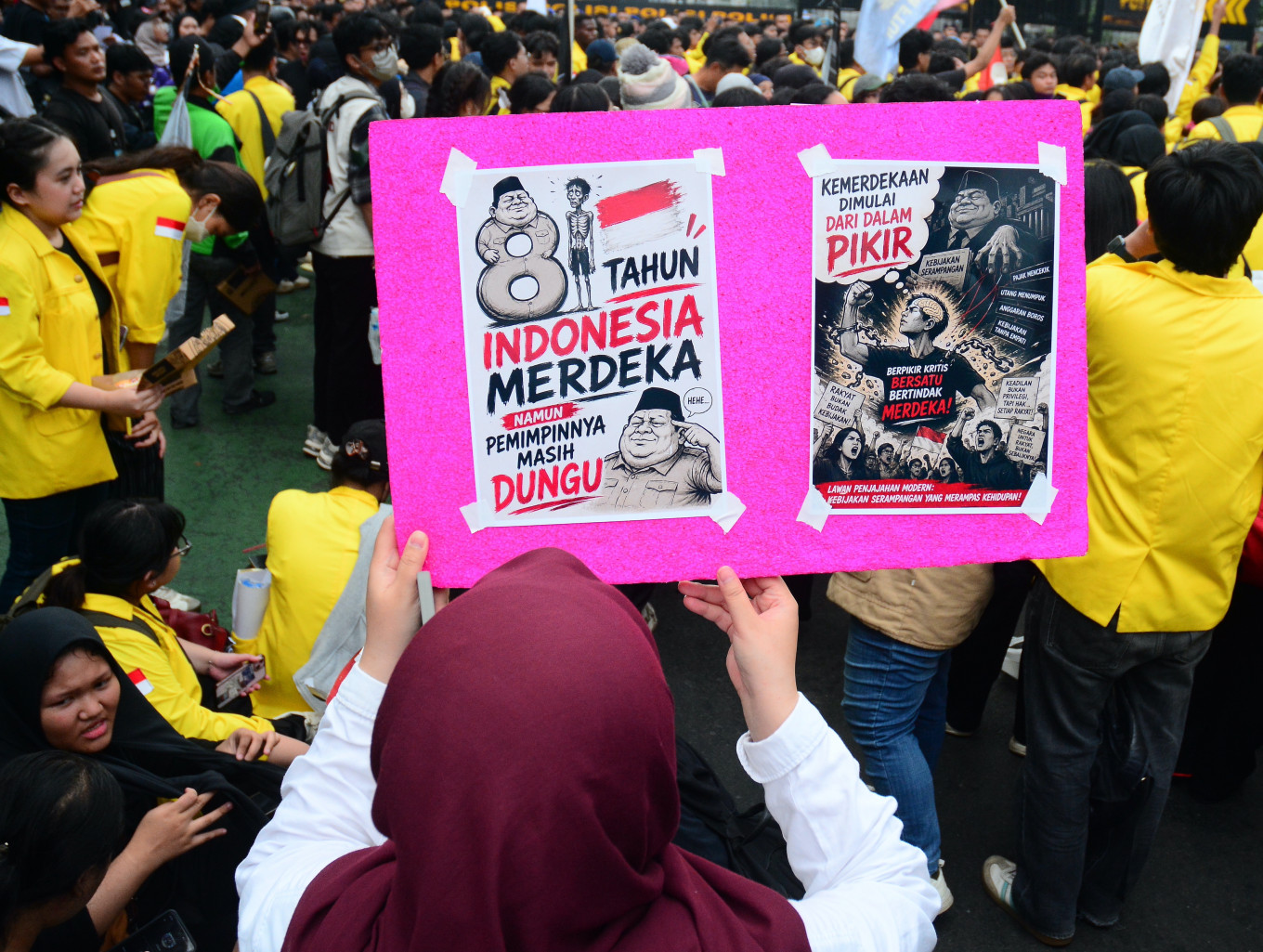 A woman holds a poster with caricatures criticizing government officials after 81 years of Indonesian independence on Aug. 18, 2026, during a protest on Jl. Thamrin in Central Jakarta against government policies, including state budget spending, the free nutritious meal program, the military’s expanded role in civilian affairs and corruption eradication efforts. (JP/Iqro Rinaldi)
O
n Sept. 28, a group calling itself the Youth Coalition Against Foreign Proxies (KOPAAS) rallied outside the Jakarta headquarters of the Indonesian Forum for the Environment (WALHI), demanding an immediate audit of the group's foreign funding and its dissolution.
The protest came on the heels of a joint petition by WALHI and local coastal communities calling for the cancellation of a national strategic project (PSN) aimed at revitalizing fishponds along the northern coast of West Java, an initiative they contend was drafted without meaningful public participation and threatens the livelihoods of traditional fishers.
The chronology is telling. Within days, a dispute over land tenure, mangrove conservation and community livelihoods was deliberately recast into a battle over who pays WALHI’s bills. This pivot neatly shifts the burden of accountability away from the officials who designed the project and onto the citizens challenging it.
It is an ad hominem maneuver elevated to institutional policy: Dismiss the critique by discrediting the critic, and the underlying evidence never requires an answer. Questions regarding environmental degradation, mangrove clearance and displacement vanish from the discourse, replaced by an ideological loyalty test no critic can ever satisfy.
The narrative also collapses under its own logic. If foreign funding inherently denotes disloyalty, the primary culprit would be the state itself. According to Bank Indonesia, public external debt stood at US$218.4 billion as of July.
The National Development Planning Agency (Bappenas) maintains the "Blue Book", a pipeline of medium-term foreign loans that, in its revised 2025-2029 cycle, lists 117 projects valued at $29.18 billion. More than $5 billion of that is earmarked for food self-sufficiency, the very rationale invoked to justify the contested fishpond project. Concurrently, the Maritime Affairs and Fisheries Ministry, which oversees the initiative, is modernizing fishing vessels using loans secured from the British government.

These arrangements are heralded as sound governance, and no state agency is branded a foreign proxy for executing them.