The Jakarta Post
Please Update your browser
Your browser is out of date, and may not be compatible with our website. A list of the most popular web browsers can be found below.
Just click on the icons to get to the download page.


Popular Reads
Top Results
No results found. Please check your search term and try again
Can't find what you're looking for?
View all search results
Popular Reads
Top Results
No results found. Please check your search term and try again
Can't find what you're looking for?
View all search resultsTranslating the tagline ‘Police alongside community’ into actions
As sweeping new powers meet persistent allegations of abuse, Indonesia’s new police chief faces a defining test: turn a modest community slogan into real accountability, or let the "no viral, no justice" reality endure.
Change text size
Gift Premium Articles
to Anyone
Share the best of The Jakarta Post with friends, family, or colleagues. As a subscriber, you can gift 3 to 5 articles each month that anyone can read—no subscription needed!
 Set as preferred source
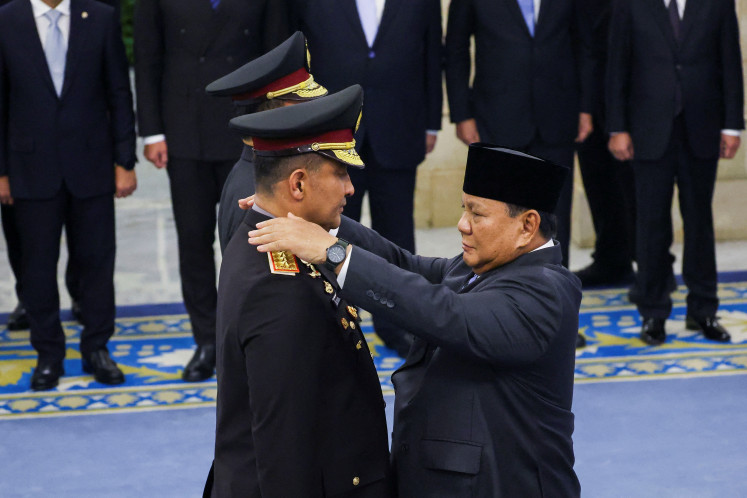
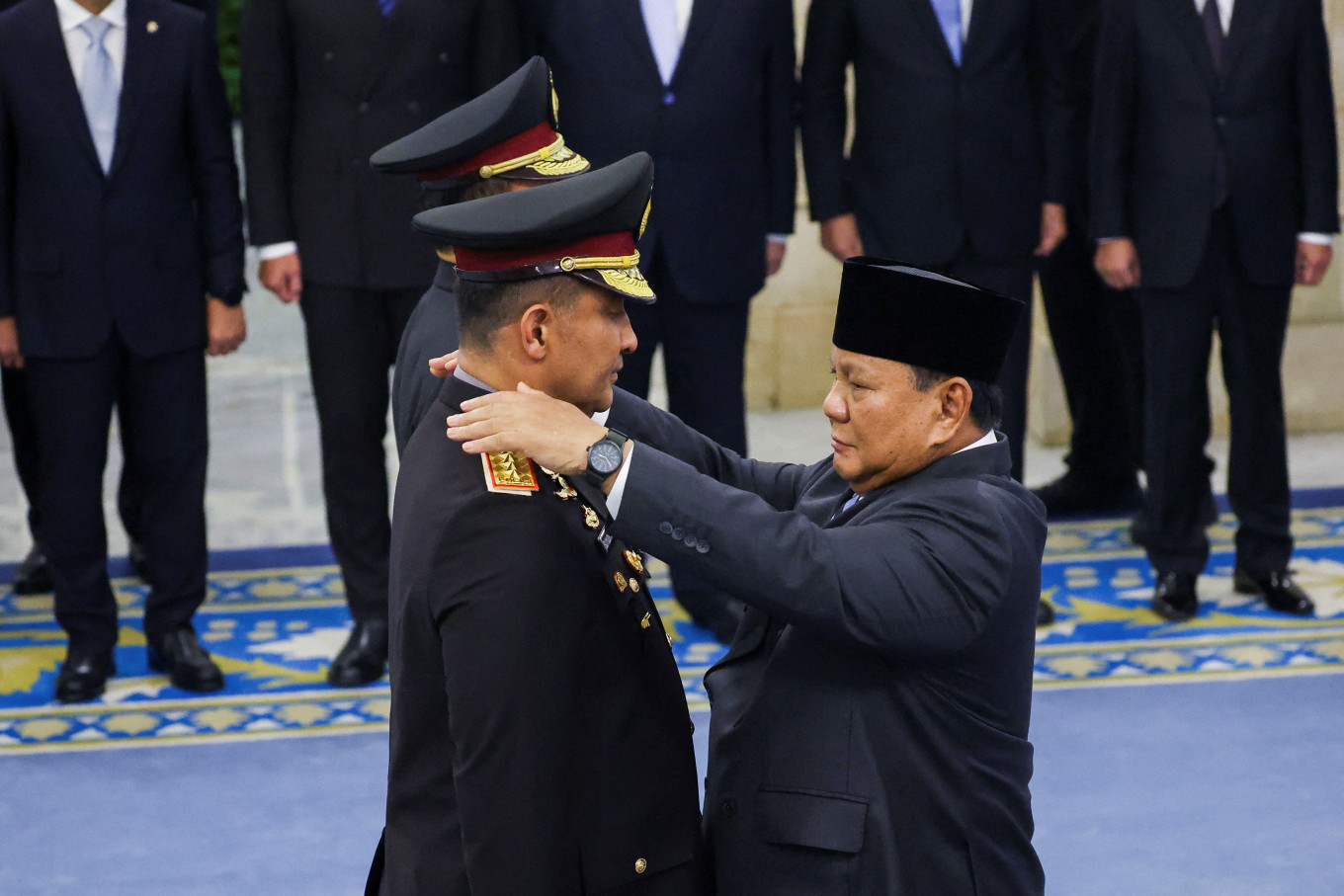 President Prabowo Subianto (right) attaches rank insignia on Oct. 1, 2026, to the uniform of newly appointed National Police Chief Suyudi Ario Seto (left) during his inauguration at the State Palace in Central Jakarta. (Reuters/Ajeng Dinar Ulfiana)
I
ndonesia welcomed a new National Police chief on Oct. 1, with Gen. Suyudi Ario Seto succeeding Gen. Listyo Sigit Prabowo, the longest-serving chief in the history of the Bhayangkara corps. Rather than adopting bombastic slogans, Suyudi introduced a simple vision: "The National Police alongside the community."
In today’s climate of digitalization and information transparency, compounded by increasingly multifaceted challenges, the new chief must project strength both internally, by consolidating the organization and externally, by deepening collaboration with other state institutions and civil society. He must remain independent and steadfast in upholding the dignity of the National Police as a frontline agency for law enforcement and human rights protection.
The challenges confronting the force are substantial. Data on complaints filed with the National Commission on Human Rights (Komnas HAM) shows that the National Police remains the most frequently reported institution, particularly concerning alleged violations of the right to justice. Komnas HAM received 771 such complaints in 2023, 751 in 2024, and 805 in 2025.
Beyond mere administrative and procedural grievances, the public’s complaints center on alleged violations of due process. These include arbitrary arrests and detentions, failure to provide suspects with legal counsel, discriminatory investigative practices, coercion or violence during interrogations to extract confessions and the use of excessive force against public demonstrations.
Fulfilling the right to justice is the bedrock of a society governed by the rule of law. Within this framework, the police occupy a pivotal position in the criminal justice system. They serve as the entry point, operating alongside the state prosecutor's office, legal counsel, the district courts, the Supreme Court and correctional institutions under the Immigration and Corrections Ministry.
The high volume of public complaints is inextricably tied to the vast and sweeping authority vested in the force. Under Law No. 5/2026, the third amendment to Police Law No. 2/2002, the police hold extensive mandates ranging from public order maintenance and crime suppression to cyber operations and public administrative services.

Moreover, the police wield additional statutory powers across various legal instruments. For example, Law No. 20/2025 on the Criminal Procedure Code (KUHAP) designates the police as the lead investigative agency with the authority to coordinate other specialized investigators.