The Jakarta Post
Please Update your browser
Your browser is out of date, and may not be compatible with our website. A list of the most popular web browsers can be found below.
Just click on the icons to get to the download page.


Popular Reads
Top Results
No results found. Please check your search term and try again
Can't find what you're looking for?
View all search results
Popular Reads
Top Results
No results found. Please check your search term and try again
Can't find what you're looking for?
View all search resultsDoes inclusive finance really need stablecoins?
Some 1.3 billion adults — more than half of them women — remain excluded from the formal financial system, and lower-income consumers still struggle to find and access the financial products and services they need.
Change text size
Gift Premium Articles
to Anyone
Share the best of The Jakarta Post with friends, family, or colleagues. As a subscriber, you can gift 3 to 5 articles each month that anyone can read—no subscription needed!
 Set as preferred source
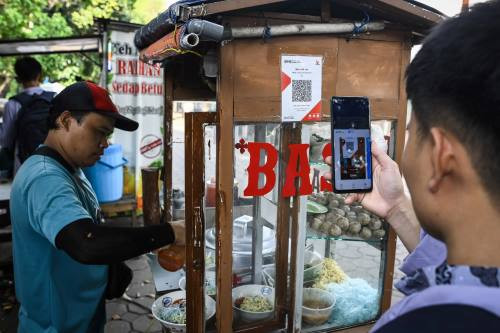
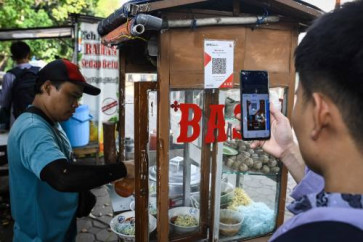
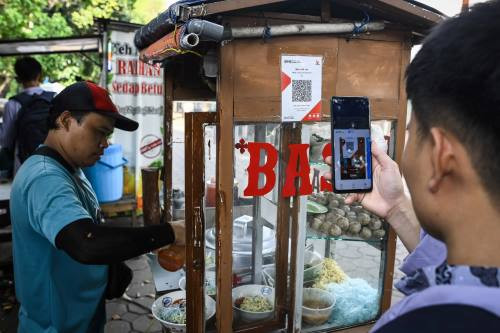 A customer scans a QRIS code to pay for a bowl of bakso (meatball soup) on Oct. 17, 2024, in Tangerang, Banten. (Antara/Sulthony Hasanuddin)
M
uch progress has been made on financial inclusion over the last 15 years, with account ownership in low- and middle-income countries surging from 42 percent in 2011 to 75 percent today. This largely reflects the rise of new banking models, such as mobile money, which have lowered both costs and technological barriers substantially, especially by enabling people to access their accounts using basic mobile phones.
But 1.3 billion adults — more than half of them women — remain excluded from the formal financial system, and lower-income consumers still struggle to find and access the financial products and services they need.
Stablecoins are being touted as the technology that will finally bring the world’s unbanked poor into the financial system. But the hype is unwarranted.
Everyday domestic payments are the cornerstone of financial inclusion, and money and bank accounts linked through an inclusive instant payment system are clearly superior to stablecoins for this purpose. Both options offer 24-hour access and instant low-cost financial transfers. But traditional accounts can be accessed through regular phones using simple messages, whereas stablecoins require a smartphone or internet-connected computer, not to mention a much higher level of digital literacy. For a woman farmer in northern Kenya, who has a basic phone and no data connection, stablecoins are no solution.
Data support this assertion, showing that the vast majority of stablecoin transactions are limited to uses like cryptocurrency purchases. Even where governments have pushed hard to launch their own digital currencies, such as in China and Nigeria, there has been little uptake, because people see no advantage in adopting them. For some, digital currencies might even represent a disadvantage: stablecoins transmit risk from payer to payee in a way that instant payment systems do not, partly because their value on traded markets can differ from their face value.
Some argue that stablecoins are better for cross-border payments. They point out that remittances sent in the form of a dollar-backed stablecoin could reach, say, Kampala from anywhere else in the world in seconds and at low cost. But the recipient would still need to convert the stablecoin into Ugandan shillings, and the market for doing so is a fraction of the size of the market banks and money-transfer operators draw on, with worse exchange rates. As a result, money-transfer operators like Wise or Remitly generally offer better value end-to-end; they are certainly easier to access for most low-income recipients.

Cross-border bank transfers are still slower and more expensive than such operators (and stablecoins), but this can be addressed by linking domestic instant-payment systems, as envisioned in the G20 Roadmap for Cross-Border Payments. This approach is already being implemented in some regions: the Nexus payment system, for example, links India, Malaysia, the Philippines, Singapore and Thailand.