The Jakarta Post
Please Update your browser
Your browser is out of date, and may not be compatible with our website. A list of the most popular web browsers can be found below.
Just click on the icons to get to the download page.


Popular Reads
Top Results
No results found. Please check your search term and try again
Can't find what you're looking for?
View all search results
Popular Reads
Top Results
No results found. Please check your search term and try again
Can't find what you're looking for?
View all search resultsUnblurring the boundary of civil-military relations
Clear legal limits, accountability and safeguards are needed to ensure exceptional assistance does not become an administrative norm.
Change text size
Gift Premium Articles
to Anyone
Share the best of The Jakarta Post with friends, family, or colleagues. As a subscriber, you can gift 3 to 5 articles each month that anyone can read—no subscription needed!
 Set as preferred source
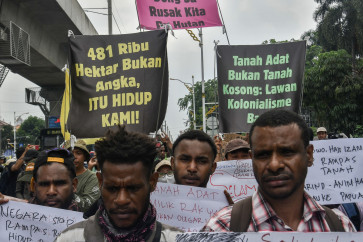
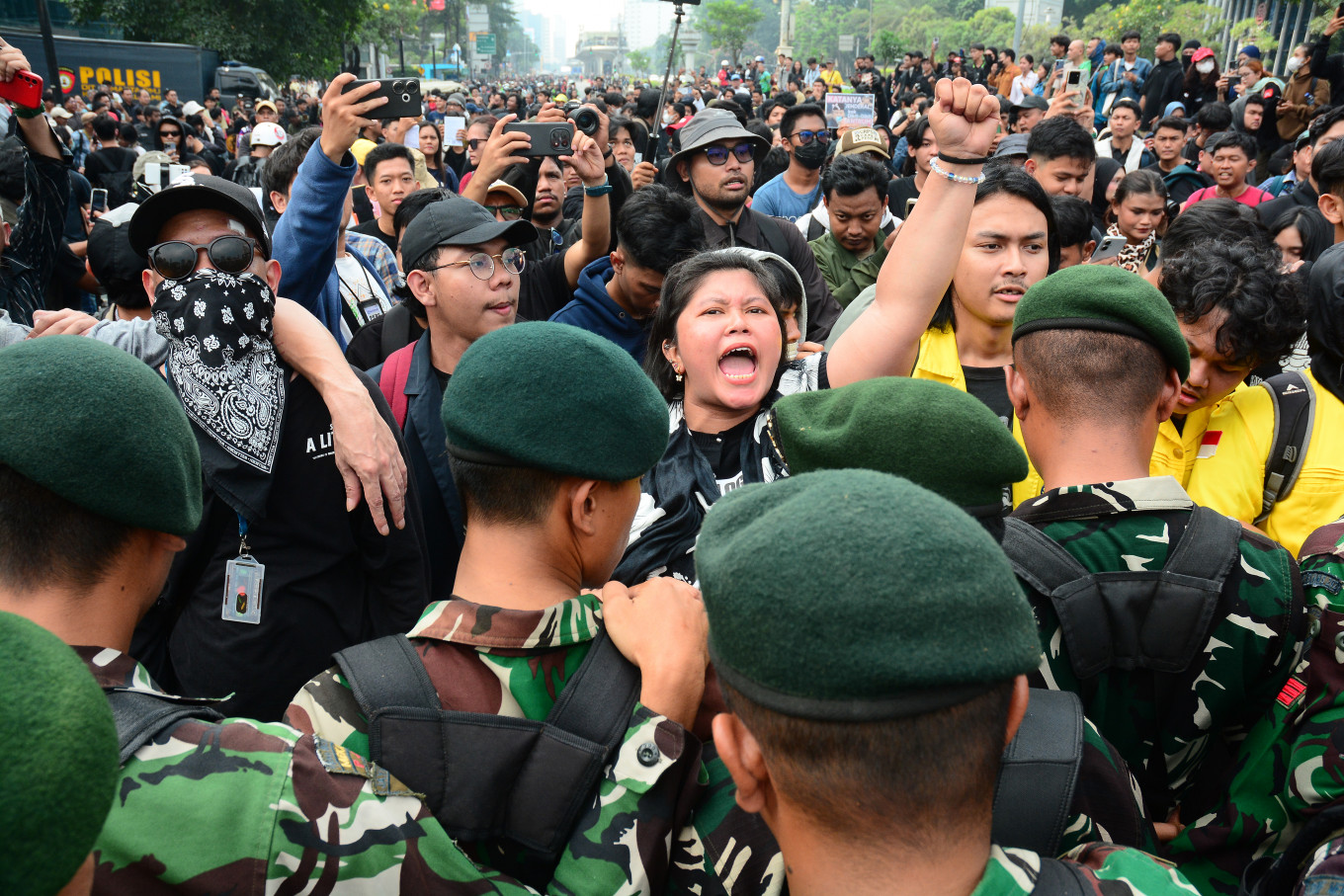 Protesters react after Indonesian military personnel blocked a road during a student protest in Jakarta, on June 12, 2026. (JP/Iqro Rinaldi)
A
n article in a notable Indonesian media outlet has drawn timely attention to hyper-militarization in civilian programs. Yet the underlying problem is more fundamental than using military values as a benchmark for civilian professionalism. Rather, what was once an exceptional practice has become an acceptable, business-as-usual administrative norm.
The People's Consultative Assembly’s (MPR) decree (TAP), TAP MPR No.VI/2000 on the separation of the armed forces and the National Police, provides a strong foundation for this context and indicates the direction of security-sector reform during the Reform Era with the amendment of the 1945 Constitution.
In its considerations, the socio-political role embedded in the dual function of the armed forces caused deviations in the roles and functions of the military and the National Police, stagnating democratic development in national, state and social life. However, the decree did not prohibit military involvement. Instead, it framed a new context of democratic control over the military.
Civil-military studies generally do not consider domestic areas of civilian governance the military's primary domain. However, in Military Institutions and Coercion in the Developing Nations, Morris Janowitz noted that newly independent and post-colonial countries, including Indonesia, allowed military officers to take control of national leadership partly because they were among the most educated groups, with specialized skills and managerial abilities.
This reasoning resonates with General Abdul Haris Nasution's Jalan Tengah (middle way), which envisaged military participation in state governance to encourage nation-building and bureaucratic efficiency. It later developed into Doktrin Kekaryaan, the foundation of the dual functions (dwi fungsi) of the Indonesian Military (TNI).
The military’s expanded role was inseparable from the state’s condition and the capabilities of civilian institutions at the time. Indonesia now has a far more developed and institutionalized civilian bureaucracy, with greater specialization and expertise than in the 1950s and 1960s.

Janowitz argued that the military’s role as an agent of modernisation was grossly exaggerated, in that military institutions' ability to perform administrative and technical functions declined as the scope and complexity of their involvement expanded. He argued that military institutions faced inherent professional and personnel limitations when required to manage broad sectors of the regulatory administration, the economy and other functions demanding highly specialized civilian administrative expertise. In short, military capability could not substitute for civilian administrative capability.