The Jakarta Post
Please Update your browser
Your browser is out of date, and may not be compatible with our website. A list of the most popular web browsers can be found below.
Just click on the icons to get to the download page.


Popular Reads
Top Results
No results found. Please check your search term and try again
Can't find what you're looking for?
View all search results
Popular Reads
Top Results
No results found. Please check your search term and try again
Can't find what you're looking for?
View all search resultsIndonesia’s AI data center ambition needs a resource rule book
Indonesia is racing to become Asia’s next AI data center powerhouse, but without strict resource safeguards, the boom risks draining the nation’s power grid, water supply and local communities.
Change text size
Gift Premium Articles
to Anyone
Share the best of The Jakarta Post with friends, family, or colleagues. As a subscriber, you can gift 3 to 5 articles each month that anyone can read—no subscription needed!
 Set as preferred source
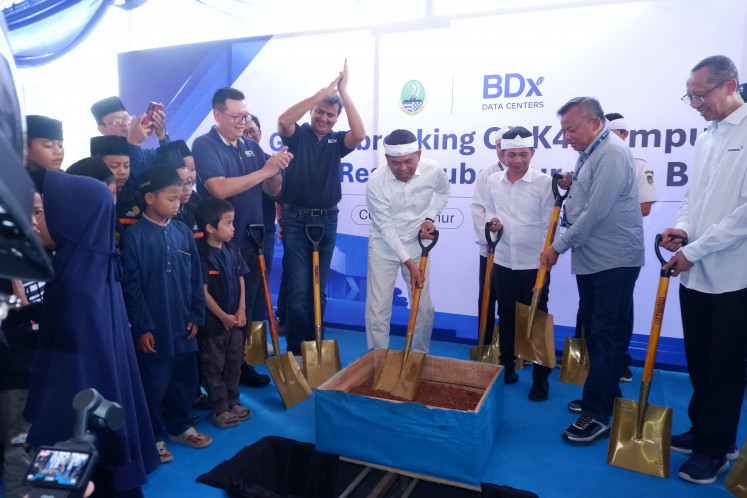
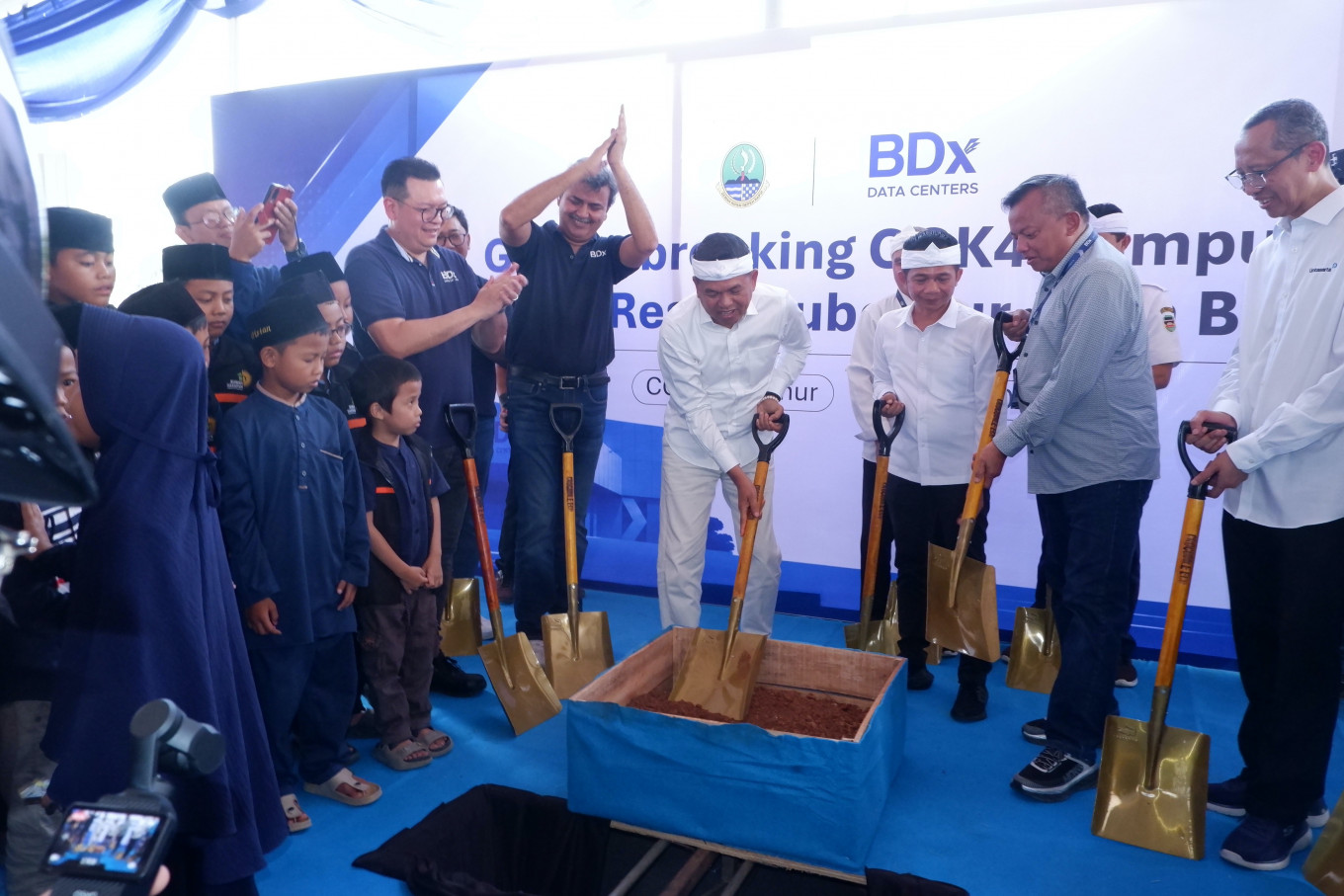 West Java Governor Dedi Mulyadi (fourth right), scoops a shovelful of soil on July 28, 2026, at the groundbreaking ceremony for Singapore-based BDx Data Centers’ CGK4 artificial intelligence campus in Jatiluhur, West Java, accompanied by BDx Data Centers CEO Mayank Srivastava (fifth right) and BDx Indonesia CEO Agus Hartono Wijaya (sixth right) as well as local leaders and community representatives. (BDx Indonesia/-)
O
n Sept. 22, Singapore-based BDx broke ground on a planned 640-megawatt (MW) artificial intelligence data center campus in Jatiluhur, West Java. The company reported securing 845 megavolt-amperes of grid capacity, with its initial 120 MW facility scheduled to go online in early 2027.
Separately, CoreWeave announced three local facilities totaling 360 MW of contracted power. Meanwhile, the government continues to incentivize development outside Java under the 2026-2030 digital infrastructure road map led by the National Development Planning Agency (Bappenas).
Indonesia is no longer deciding whether to enter the data center market; it is already in it. The real decision is whether to scale into a regional AI hub, and on whose terms.
Expanding into AI-grade infrastructure introduces systemic demands that extend well beyond direct investment yields: regulatory readiness, grid decarbonization commitments, local technical capacity and the unintended side effects of a resource-heavy industry.
The ambition to become an Asian digital hub is credible. Expanding domestic compute capacity lowers latency, strengthens digital sovereignty and directly underpins enterprise cloud adoption, academic research and indigenous AI development. It can also catalyze capital inflows, cultivate specialized technical labor and mature domestic supply chains.
Stella Christie, the second deputy higher education minister, is right to highlight the country’s substantial renewable energy potential as an engine for sustainable economic growth. Yet theoretical capacity is not the same as clean, reliable power delivered at competitive rates to an operational site.

Given prevailing geopolitical and supply chain realities, the government must look beyond headline resource potential and address operational bottlenecks.