The Jakarta Post
Please Update your browser
Your browser is out of date, and may not be compatible with our website. A list of the most popular web browsers can be found below.
Just click on the icons to get to the download page.


Popular Reads
Top Results
No results found. Please check your search term and try again
Can't find what you're looking for?
View all search results
Popular Reads
Top Results
No results found. Please check your search term and try again
Can't find what you're looking for?
View all search resultsJustice in the choking haze
The class-action lawsuit is a clear warning that the government must abandon its reactive posture and commit to proactive, structural mitigation before the crisis spirals out of control.
Change text size
Gift Premium Articles
to Anyone
Share the best of The Jakarta Post with friends, family, or colleagues. As a subscriber, you can gift 3 to 5 articles each month that anyone can read—no subscription needed!
 Set as preferred source
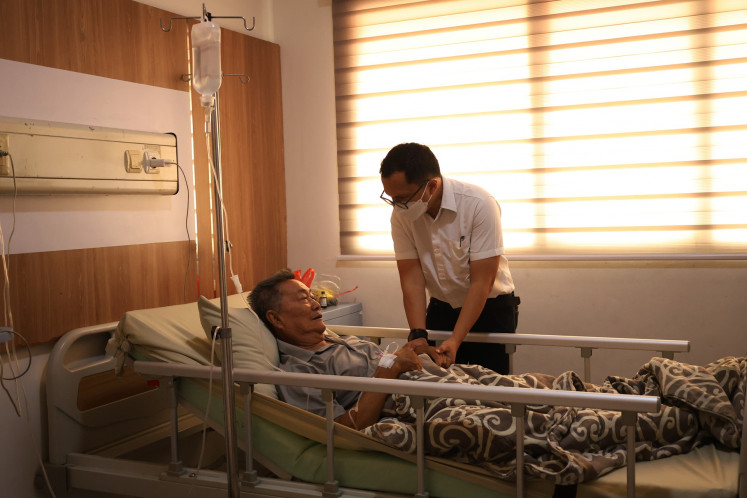
 A pulmonologist (right) checks the condition of a pneumonia patient at the Bhayangkara Anton Soedjarwo Hospital in Pontianak, West Kalimantan, on Aug. 28, 2026. (Antara/Jessica Wuysang)
E
arlier this year, the meteorological agency, policy think tanks and environmental organizations issued an unambiguous alert: a potent El Niño threatened to supercharge forest and peatland blazes across Kalimantan and Sumatra. They urged authorities to double down mitigation efforts well before the anomalous dry spell peaked.
Unfortunately, those warnings fell on deaf ears as evident in the minimum anticipatory measures. Today, uncontrollable infernos continue to scour the islands deep into the dry season, and President Prabowo Subianto’s administration faces a class-action lawsuit for systemic negligence in preventing the catastrophic fires in West Kalimantan.
Filed by a coalition of civil society and indigenous community organizations, including the local chapter of the Indigenous Peoples Alliance of the Archipelago (AMAN) and a regional Catholic youth group, the suit demands decisive state intervention.
West Kalimantan has become an epicenter of this year’s crisis, with nearly 40,000 hectares of forest and carbon-dense peatland already reduced to ash. Because the blazes have long outstripped provincial emergency capacities, the plaintiffs are seeking a court order compelling Jakarta to designate the crisis a national disaster, a move that would release vital emergency state funding and resources.
With the opening hearing scheduled for next week, immediate judicial relief remains out of reach for residents left to endure the ongoing disaster.
Legal battles over recurring fires are familiar terrain in Indonesia. In 2016, activists in Central Kalimantan brought a citizen lawsuit against the administration of Joko “Jokowi” Widodo following the historic haze disaster of 2015. A lower court ruled decisively in their favor the following year, placing direct culpability on the president, key cabinet ministers and regional leaders for failing to safeguard public health and forest ecosystems.

The court mandated state compensation, medical care for victims, and stringent, participatory prevention frameworks. While the Supreme Court upheld the decision in 2019, the ruling was overturned on judicial review in 2022, underscoring just how protracted and resistant to accountability the state apparatus can be.