The Jakarta Post
Please Update your browser
Your browser is out of date, and may not be compatible with our website. A list of the most popular web browsers can be found below.
Just click on the icons to get to the download page.


Popular Reads
Top Results
No results found. Please check your search term and try again
Can't find what you're looking for?
View all search results
Popular Reads
Top Results
No results found. Please check your search term and try again
Can't find what you're looking for?
View all search resultsWelcoming KRI Sriwijaya
Indonesia has commissioned its first aircraft carrier, but turning the aging Italian warship into a drone-bearing force multiplier will demand steep investments in crew, escorts and maintenance to avoid a costly white elephant.
Change text size
Gift Premium Articles
to Anyone
Share the best of The Jakarta Post with friends, family, or colleagues. As a subscriber, you can gift 3 to 5 articles each month that anyone can read—no subscription needed!
 Set as preferred source
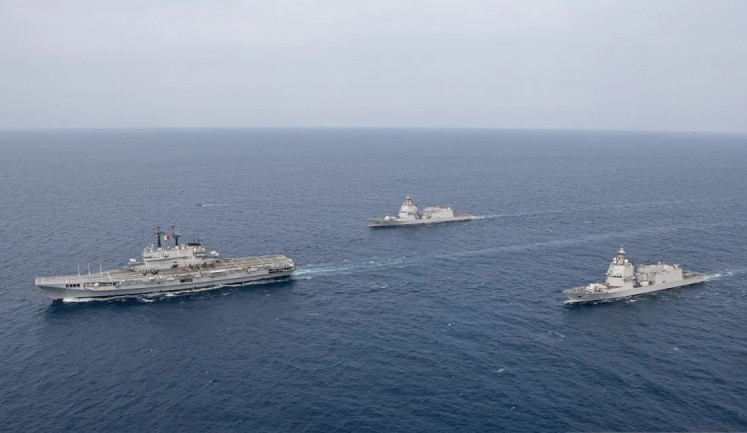
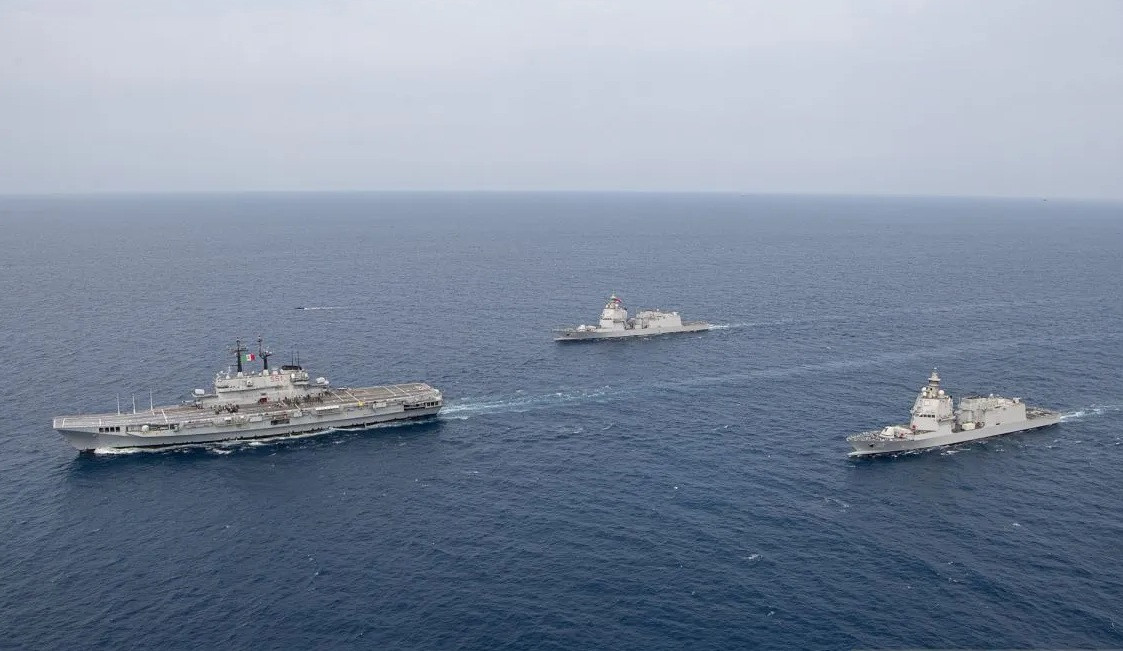 The newly acquired aircraft carrier Giuseppe Garibaldi (left), now the KRI Sriwijaya, is accompanied by the KRI Brawijaya (center) and the KRI Prabu Siliwangi as they sail past Bangka waters on Sept. 17, 2026. (Antara/M Risyal Hidayat)
T
he decommissioned Italian aircraft carrier ITS Giuseppe GaribThe decommissioned Italian aircraft carrier ITS Giuseppe Garibaldi was officially transferred to the Indonesian Navy and renamed the KRI Sriwijaya during a full naval ceremony on Thursday. The commissioning puts an end to years of debate over whether an archipelagic nation requires a flattop, marking the historic arrival of the first aircraft carrier in the Indonesian fleet.
The challenge now shifts from acquisition to operationalization. We have to ensure this asset is effectively utilized rather than allowed to languish as an expensive white elephant.
The term "aircraft carrier" typically conjures images of expeditionary strike warfare designed to project lethal force far beyond national waters. Yet Indonesia is neither an expansionist power nor driven by ambitions of overseas hegemony. Moreover, the vessel's original air-combat configuration cannot be directly replicated.
While the Garibaldi operated McDonnell Douglas AV-8B Harrier II short take-off and vertical landing (STOVL) strike fighters and utility helicopters under the Marina Militare, the Harrier is out of production. Its sole Western successor, the Lockheed Martin F-35B Lightning II, remains entirely out of reach due to technical hurdles and Washington’s geopolitical calculations.
Consequently, the Navy is pivoting toward an adaptive doctrine. Navy chief of staff Adm. Muhammad Ali has repeatedly emphasized that the carrier will primarily support military operations other than war (MOOTW), particularly humanitarian assistance and disaster response (HADR) missions. Situated directly along the Pacific Ring of Fire and confronting intensifying climate-induced emergencies, Indonesia requires maritime assets that can serve as rapid-response hubs. Helicopters, prized for their speed and versatility, will form the core of this disaster-mitigation capability.
Even prior to this acquisition, Indonesia had demonstrated power-projection capabilities through non-lethal, humanitarian deployments, utilizing its five landing platform docks (LPDs) and three dedicated hospital ships to project medical aid to Egypt and the South Pacific. The Sriwijaya will significantly expand this envelope.

Crucially, the carrier’s mission profile will not be purely defensive or humanitarian. Jakarta plans to field a modern, unmanned air wing by deploying Turkish unmanned combat aerial vehicles (UCAVs), having procured 12 Turkish Aerospace Industries (TAI) Anka and 60 Baykar Bayraktar TB-3 naval drones.