The Jakarta Post
Please Update your browser
Your browser is out of date, and may not be compatible with our website. A list of the most popular web browsers can be found below.
Just click on the icons to get to the download page.


Popular Reads
Top Results
No results found. Please check your search term and try again
Can't find what you're looking for?
View all search results
Popular Reads
Top Results
No results found. Please check your search term and try again
Can't find what you're looking for?
View all search resultsFederalism and the middle way of decentralization
To survive in an unstable world, Indonesia must master the delicate art of the middle way: keeping a firm hand at the center while fixing the fractured, graft-prone machinery of regional autonomy.
Change text size
Gift Premium Articles
to Anyone
Share the best of The Jakarta Post with friends, family, or colleagues. As a subscriber, you can gift 3 to 5 articles each month that anyone can read—no subscription needed!
 Set as preferred source
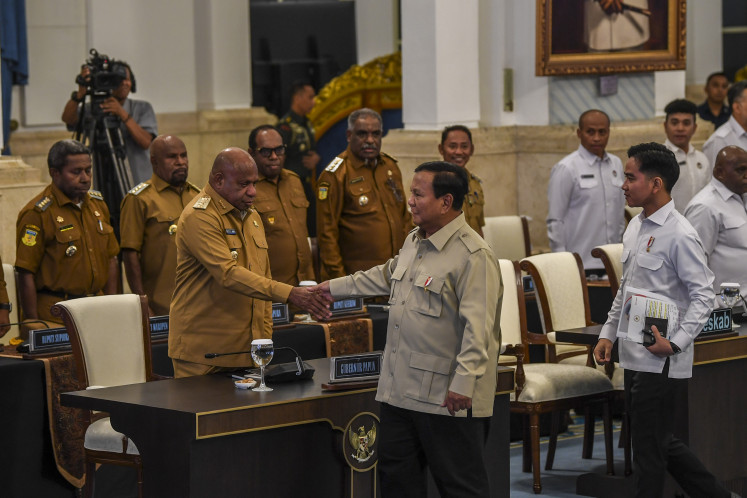
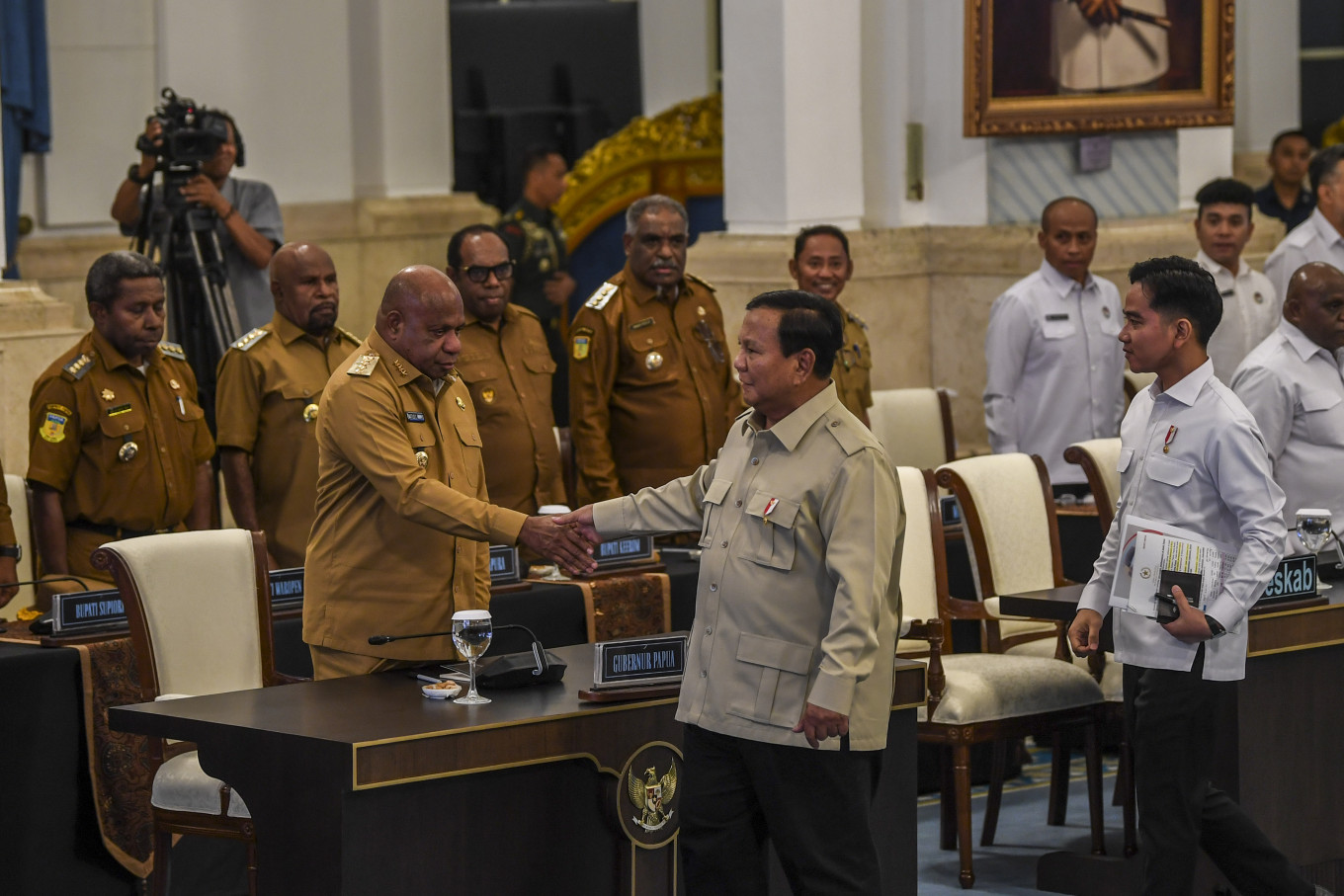 President Prabowo Subianto (center), accompanied by Vice President Gibran Rakabuming Raka (right), shakes hands with Papua Governor Mathius Fakhiri (left) on Dec. 16, 2025, prior to a meeting with 46 regional leaders from Papua along with 10 executive committee members of the Acceleration of Papua’s Special Autonomy Development at the State Palace in Central Jakarta. (Antara/Galih Pradipta)
T
he debate over the form and structure of the state is a foundational discourse in political science and constitutional law. Every nation confronts a strategic choice between concentrating authority in the national executive or dispersing it broadly across constituent regions. Far from being a mere administrative arrangement, this institutional design represents a deliberate geopolitical strategy to preserve territorial integrity while advancing public welfare.
Conceptually, a unitary system vests sovereignty fully and indivisibly in the central government. In Modern Political Constitutions (1963), C.F. Strong observes that the primary characteristic of a unitary state is the supremacy of the national parliament, absent any constitutionally divided sovereignty with regional entities.
The virtue of this model lies in bureaucratic efficiency, legal uniformity and a cohesive national defense that few other state structures can replicate. Centralized authority ensures that strategic national policies can be executed swiftly, unencumbered by protracted intergovernmental negotiations.
Yet behind this structural firmness lies an inherent vulnerability: the alienation of the periphery. When decision-making is concentrated solely in the capital, local aspirations are routinely sidelined, compounding regional economic disparities.
In Political Order in Changing Societies (1968), Samuel P. Huntington cautions that unrepresented local demands within an overly centralist structure can quickly become a volatile source of political instability, ultimately imperiling national integration.
Conversely, a federal system provides a constitutionally entrenched division of power. In Federal Government (1963), K.C. Wheare defines the federal principle as an arrangement in which general and regional governments are coordinate and independent within their respective spheres.

This architecture grants substantial autonomy to regions to govern their domestic affairs, thereby accommodating cultural, ethnic and geographical diversity.