The Jakarta Post
Please Update your browser
Your browser is out of date, and may not be compatible with our website. A list of the most popular web browsers can be found below.
Just click on the icons to get to the download page.


Popular Reads
Top Results
No results found. Please check your search term and try again
Can't find what you're looking for?
View all search results
Popular Reads
Top Results
No results found. Please check your search term and try again
Can't find what you're looking for?
View all search resultsMalaysia’s election drums, political sums
Can Malaysia's UMNO pressure Prime Minister Anwar Ibrahim into calling for an early election?
Change text size
Gift Premium Articles
to Anyone
Share the best of The Jakarta Post with friends, family, or colleagues. As a subscriber, you can gift 3 to 5 articles each month that anyone can read—no subscription needed!
 Set as preferred source
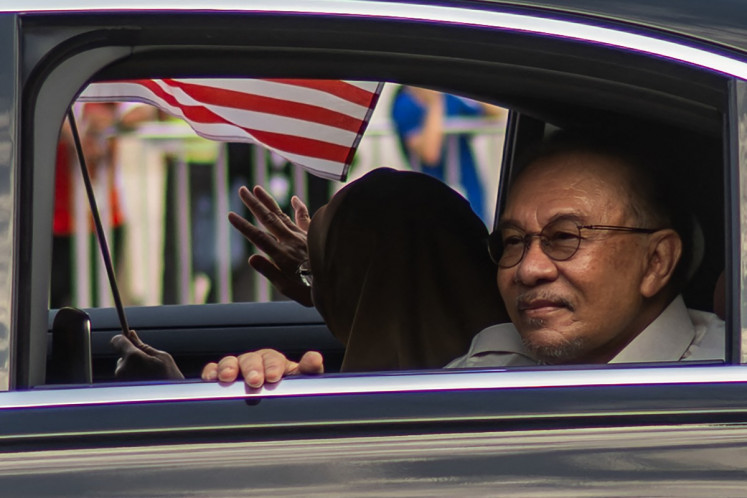
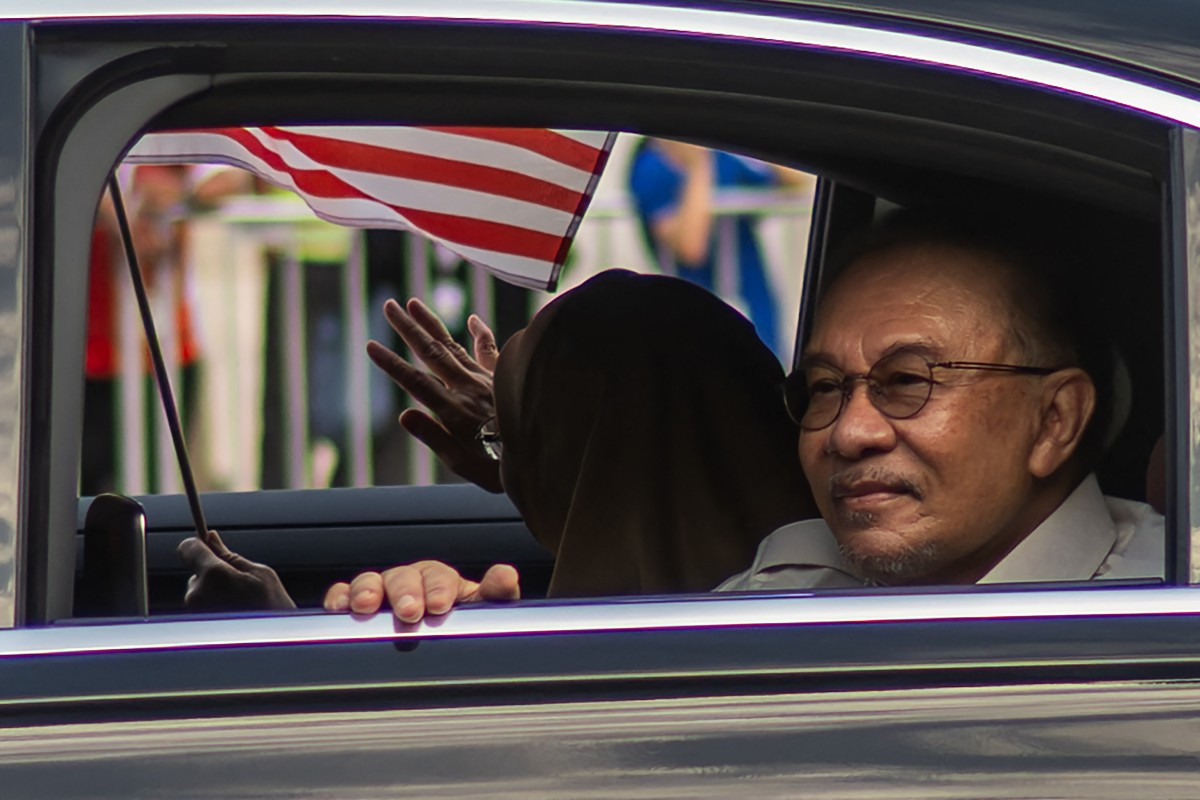 Malaysia’s Prime Minister Anwar Ibrahim (right) and his wife Wan Azizah Wan Ismail arrive during the 69th National Day celebrations in Malaysia's administrative capital Putrajaya on Aug. 31, 2026. (AFP/Mohd Rasfan)
I
nside the World Trade Centre Kuala Lumpur, Malaysia, the message echoing through the political party UMNO General Assembly was loud and clear. The party wants a snap general election, and it wants it as soon as possible.
Setting the tone in his policy address, party president Ahmad Zahid Hamidi told the packed Dewan Merdeka that the time has come for the 16th General Election (GE16) because it is what the people want.
Anchoring the urgency of an early election on UMNO’s broader political ambition, Ahmad Zahid stressed that the gelombang biru (blue wave, referring to Barisan Nasional’s blue flag) must serve a higher purpose than just keeping them in a power-sharing seat, framing GE16 as the moment to reclaim the mandate to lead.
Signaling a total, unyielding commitment to an electoral showdown, he invoked the Malay idiom “Alang-alang menyeluk pekasam, biar sampai ke pangkal lengan” (since you’ve already reached into the jar of pickled fish, you might as well go all the way up to your elbow), prompting thousands of delegates to erupt into a synchronized roar of “Menang!” (victory).
This call was punctuated by a sharp critique of the administration’s economic management. Taking direct aim at policy flip-flops, i.e., taxation and the handling of fuel quotas, Ahmad Zahid zeroed in on “Guru” (teacher), whom he did not identify.
Pointing to public frustrations over shifting economic policies, he told the roaring crowd, “There is no such thing as a hybrid system […] hey Guru, listen to what the people are saying”, before adding, “Who did this? Guru. Enough, Guru. We can do better than what the Guru has done”.

It was a masterclass in political theater, but translating floor-thumping rhetoric into an actual election requires navigating a minefield of parliamentary numbers.
The conventional wisdom in political circles is that Prime Minister Anwar Ibrahim will want to serve out a full parliamentary term. A full term lasts five years, meaning GE16 does not constitutionally need to be called until late 2027.
Can UMNO pressure the prime minister into calling for an early election? To answer that, let’s look at the political math of the unity government in the 222-seat Dewan Rakyat:
Pakatan Harapan has 76 seats (led by Anwar with PKR, DAP and Amanah), Barisan Nasional has 30 seats (led by Ahmad Zahid with UMNO, MCA, MIC, and PBRS), Gabungan Parti Sarawak (GPS) 23 seats (led by Tan Sri Abang Johari Openg with PBB, SUPP, PRS and PDP), Gabungan Rakyat Sabah (GRS) seven seats (led by Datuk Seri Hajiji Noor with PGRS, PBS, Upko, and other parties), Warisan has three seats (led by Shafie Apdal), and small parties and aligned independents have 11 seats (among Parti KDM, PBM, Star, and six former Bersatu MPs), a total of 150 seats.
The simple majority threshold in the Dewan Rakyat is 112 seats. But with three PKR politicians having quit as MPs to be with Bersama, parliament now stands at 219 seats, meaning a simple majority is 110 seats. Mathematically, Anwar’s government commands a comfortable two-thirds-plus cushion well above that mark.
If Barisan Nasional’s 30 MPs pull out of the unity government, the math breaks down as follows: Total government bloc before Barisan’s exit: 150 seats. Minus Barisan’s 30 seats = 120 seats remaining.
With 120 seats left on the government bench against a simple majority requirement of 110, the administration technically clings on by 10 seats.
UMNO cannot collapse the government. It will need other coalitions, parties or independents to join it do so. Also, there is a possibility that Bersatu, which used to have 31 MPs but now has only six loyal MPs, including party president Tan Sri Muhyiddin Yassin, could support Anwar’s government. And will the PKR MPs who, in their hearts, are with Bersama still support the Prime Minister?
So what is the point of UMNO quitting the government?
My friend Shahbudin Husin, a former political journalist and author of several books on Anwar, posted about the matter on Facebook earlier this week.
Even if a pullout does not cause an immediate mathematical collapse, it would instantly cripple the administration by forcing seven UMNO ministers and one PBRS minister to resign, Shahbudin observed. He argued that by creating institutional paralysis, other parties may take the same action to trigger an early general election.
He contended that leaving the government is the ultimate litmus test for UMNO’s credibility; without a clean break, public skepticism will linger over Ahmad Zahid’s push for Malay unity alongside PAS and Perikatan Nasional.
“Stepping out of the administration is the only way to prove genuine sincerity in wanting a change of government, clear up the awkward contradiction of opposing the Prime Minister from within his own Cabinet, and ignite true grassroots momentum,” Shahbudin wrote.
What Shahbudin did not write is that the longer the unity government exists, the more UMNO and Barisan leaders will find themselves in the crosshairs, as seen with high-profile charges leveled against figures like former prime minister Ismail Sabri Yaakob, former Tabung Haji chairman Abdul Azeez Abdul Rahim, and MIC deputy president M. Saravanan.
I have been told: “More to come”.
If UMNO is not careful, especially with its aggressive push for an early election at its AGM, Guru might teach it a political lesson.
---
The writer is an editor at The Star.