The Jakarta Post
Please Update your browser
Your browser is out of date, and may not be compatible with our website. A list of the most popular web browsers can be found below.
Just click on the icons to get to the download page.


Popular Reads
Top Results
No results found. Please check your search term and try again
Can't find what you're looking for?
View all search results
Popular Reads
Top Results
No results found. Please check your search term and try again
Can't find what you're looking for?
View all search resultsWhen forests burn, climate commitments falter
As peatlands burn and flagship carbon projects go up in smoke, our market-driven climate pledges are failing. Only recognizing the legal rights of nature, as constitutionally mandated, can pull us back from the brink.
Change text size
Gift Premium Articles
to Anyone
Share the best of The Jakarta Post with friends, family, or colleagues. As a subscriber, you can gift 3 to 5 articles each month that anyone can read—no subscription needed!
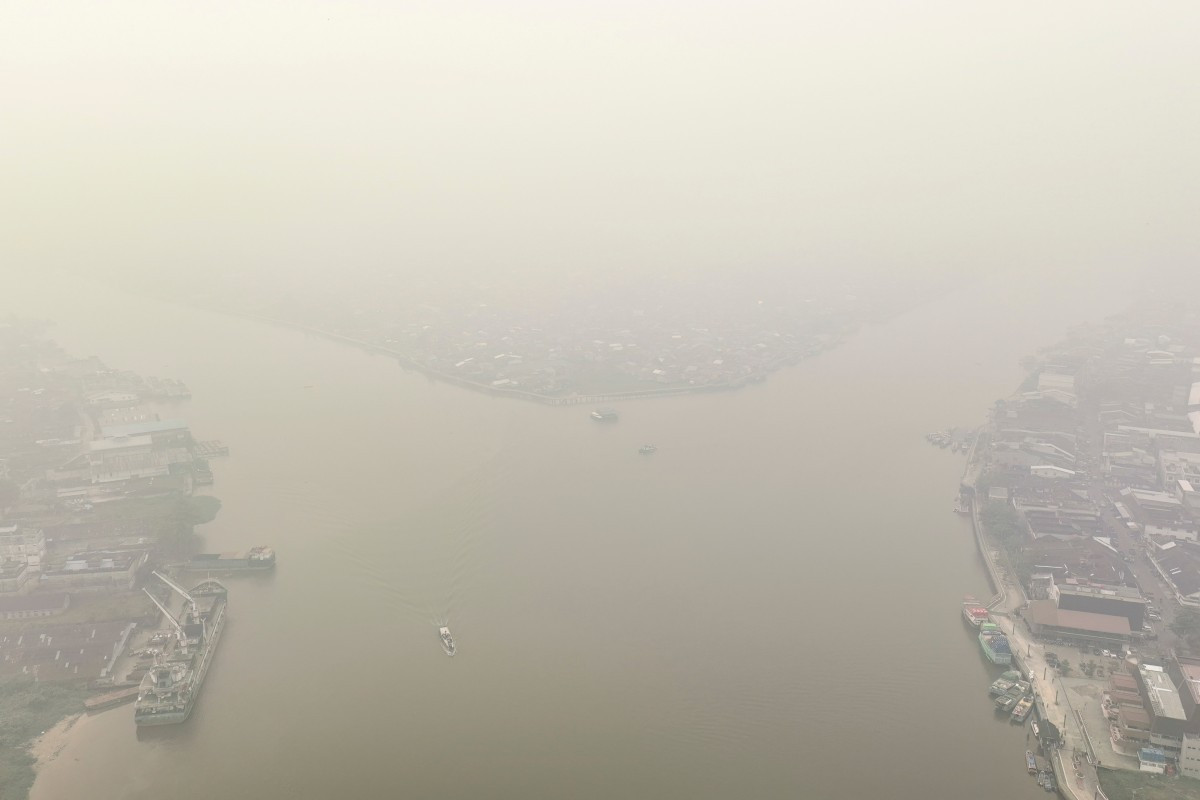 The Kapuas River delta, formed by the Landak (left) and Kapuas Kecil rivers, looms out of thick haze on Aug. 27, 2026, in Pontianak, the provincial capital of West Kalimantan. (AFP/Dito)
L
ast year, the Stockholm Resilience Centre released its Planetary Health Check with a grim finding that barely registered in public debate: seven of Earth's nine planetary boundaries, the guardrails of our global life-support system, have now been breached.
With ocean acidification confirmed as the seventh boundary crossed, only stratospheric ozone and atmospheric aerosol levels remain within safe thresholds. As Johan Rockstrom, who pioneered the framework in 2009, pointed out, more than three-quarters of the systems that keep our planet habitable are now destabilized.
This is far from an abstract scientific metric. It is tangible evidence of the "triple planetary crisis", runaway climate change, biodiversity collapse and rampant pollution, feeding into one another. These crises do not operate in silos. They form a single, unraveling system.
Sadly, Indonesia, home to the world’s third-largest tropical rainforest and massive carbon-storing peat domes, sits squarely at its epicenter. Nothing illustrates how this global breakdown lands locally quite like the recurrent forest and peatland fires in Indonesia.
Data from the Forestry Ministry’s fire monitoring platform SiPongi reveal that over 202,000 hectares burned between January and July 2026 alone. According to the Indonesian Forum for the Environment (Walhi), 70 percent of the hot spots across Kalimantan erupted directly inside corporate concessions, mostly on drained peatlands.
By early September, the European Union’s Copernicus Climate Change Service tracked a 429 percent spike in Indonesian fire emissions above the seasonal average over a seven-day window, briefly placing the country second only to Russia in global wildfire emissions.

State capacity to prevent and extinguish these blazes has visibly frayed despite months of clear foresight. The Meteorology, Climatology and Geophysics Agency (BMKG) had warned of an intensifying El Nino as early as May 2026, yet the institutional machinery stalled under fiscal constraints.