The Jakarta Post
Please Update your browser
Your browser is out of date, and may not be compatible with our website. A list of the most popular web browsers can be found below.
Just click on the icons to get to the download page.


Popular Reads
Top Results
No results found. Please check your search term and try again
Can't find what you're looking for?
View all search results
Popular Reads
Top Results
No results found. Please check your search term and try again
Can't find what you're looking for?
View all search resultsHow Vietnam’s Gen Z is holding power to account
What started with the death of young woman in a traffic accident has escalated into a general protest about a lack of accountability for the powerful.
Change text size
Gift Premium Articles
to Anyone
Share the best of The Jakarta Post with friends, family, or colleagues. As a subscriber, you can gift 3 to 5 articles each month that anyone can read—no subscription needed!
 Set as preferred source
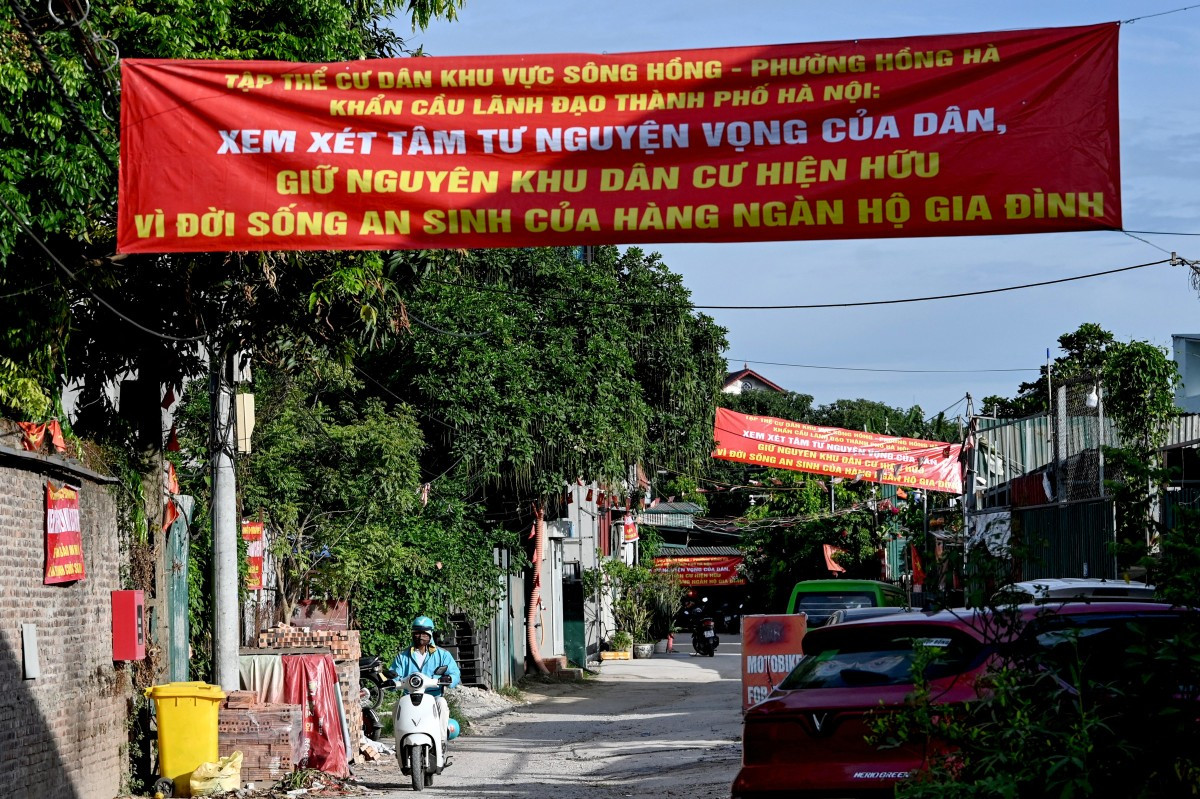 A protest banner, which reads “The residents of the Red River area in Hong Ha Ward earnestly appeal to city leaders to consider the people's inner thoughts and aspirations, maintaining the existing residential area for the sake of the well-being of thousands of households”, hangs over a street at a neighborhood in Hanoi, on June 19, 2026. (AFP/-)
A
fatal car crash and a censored rap album, seemingly unrelated and a year apart, have sparked what could be the largest revolt of Vietnam’s youth in living memory. For days, millions have mobilized around the death of an 18-year-old student, caused by a former National Assembly deputy who walked away without charge. What began as isolated outrage has since put the country’s political system on trial.
On the evening of Aug. 14, uniformed police cleared away bunches of flowers at the base of a tree near the center of Hanoi. Later that night, groups of young people came back and laid more. Where these were removed, they started laying them at other trees and outside police stations. Then they started wearing white ribbons on their backpacks.
This tree, “Memorial tree 55” on Hanoi’s Nguyen Huy Tu St., is at the center of a growing protest for gen Z in Vietnam. It marks the spot where, in May 2025, a black BMW crossed into oncoming traffic and hit a motorcycle carrying a father and his 18-year-old daughter, Do Ngoc Phuong Thuy. Mina, as she was widely known, lost her leg and died days later, shortly before she should have graduated from high school.
Over the next year there appeared to be no progress in the investigation of the incident, except that the driver was identified by the initials NSC But social media users flooded into the information vacuum, starting to link these initials to former National Assembly deputy Nguyen Sy Cuong. There was much online discussion of a government cover-up.
But by August 2026, the car crash and Mina’s death had almost faded from public memory. It may have stayed that way if it had not been for the heavyhanded decision of Vietnam’s minister for culture, Lam Thi Phuong Than, to all but ban a new album by rap artist “MCK”. This censorship against the most popular rap singer among Gen Z drew scrutiny to the culture minister, and from there attention moved to her husband, Nguyen Sy Cuong.
Within days, more than a million posts naming Cuong spread across Threads and TikTok. One local person I spoke to, who for security reasons only wishes to be known by their pseudonym “Tam Khien”, says that young people across the country are outraged.

But, Tam Khien told me, it would be a mistake to view this sequence of events as outrage over one fatal crash, or even a single case of alleged corruption. Rather, it was the spark that lit up grievances with the state that had been present for years.
This is borne out by data from the Vietnam Provincial Governance and Public Administration Performance Index (PAPI), which shows how public attitudes have changed. For more than a decade, when asked which problems they view as the most urgent policy challenges, nationally representative samples have named poverty and hunger. But in 2024, corruption overtook these problems, named by 22.6 percent of respondents, up from under 5 percent the year before.
While this number does not measure levels of corruption in Vietnam, it shows how it has come to dominate public debate. Combined with consistently low levels of confidence in the accountability of the government toward its citizens, rated as low as 0.47 out of 10, the conditions were ripe for a single event to galvanize protest.
Vietnam’s constitution grants a right for public demonstrations, but the law needed to exercise it has never been passed. In its place, a 2005 decree requires gatherings to be registered in advance, and protesters are routinely arrested and prosecuted for “disturbing public order”.
So it is clear to protesters in Hanoi that mass rallies are not a realistic option. Publicly accusing a powerful former official is risky, Tam Khien told me. Instead the emerging movement turned to more creative forms of protest, which confront the state with acts that are hard to prosecute.
They pinned the “Tree of Justice”, as Tree 55 has become known, on Google Maps (although pins have been deleted). They continued to lay in defiance of the authorities removing them, and when the flowers were removed they laid them at other trees. They also mark these other trees with the number 55, an easily recognizable reference, which is ambiguous enough to retain plausible deniability.
People changed their profile pictures to memes taunting officials, made paintings and artistic drawings of the crash victim to commemorate her loss and created a virtual “justice tree” that cannot be cleared away. When posts started being taken down, they switched to displaying their messages in Morse code or binary.
Each of these actions was an adaptation to extensive efforts by the government to crack down on the movement: scrubbing the internet of related content and increasing the police presence at the crash site. Authorities were ordered to paint over the number 55 on trees. This has failed to quell the protests.
On the evening of Aug. 17, state television VTV aired a rare public statement about the crash. Hanoi police confirmed that Cuong had indeed been behind the steering wheel of the BMW. The statement announced that prosecutors had determined no criminal liability, but were vague as to the exact criteria for this decision.
Neither Nguyen Sy Cuong nor his wife have made a public statement about the crash. Meanwhile, the victim’s father appeared on camera saying he fully agreed with the government’s decision and had no complaints. But this was greeted by the protesters as scripted.
Vietnam is not Nepal, where a Gen Z movement occupied the streets and burned the parliament. But the resemblance to the youth movements that upended authoritarian politics from Nepal to Indonesia to Madagascar last year is undeniable.
Each began with a local trigger that would have gone nowhere without years of accumulated frustrations with their elites. Each was leaderless and mobilized quickly online. The groundswell of Vietnam’s Gen Z protest continues to grow and, as the protest is taking forms that are not easily policed, the state appears at a loss as to how to deal with them.
---
The writer is a postdoctoral research fellow at the Department of War Studies, XCEPT (Centre for Statecraft and National Security), King's College London. This article is republished under a Creative Commons license.