The Jakarta Post
Please Update your browser
Your browser is out of date, and may not be compatible with our website. A list of the most popular web browsers can be found below.
Just click on the icons to get to the download page.


Popular Reads
Top Results
No results found. Please check your search term and try again
Can't find what you're looking for?
View all search results
Popular Reads
Top Results
No results found. Please check your search term and try again
Can't find what you're looking for?
View all search resultsAnalysis: Purbaya’s liquidity push: Lending catalyst or the wrong cure?
Change text size
Gift Premium Articles
to Anyone
Share the best of The Jakarta Post with friends, family, or colleagues. As a subscriber, you can gift 3 to 5 articles each month that anyone can read—no subscription needed!
 Set as preferred source
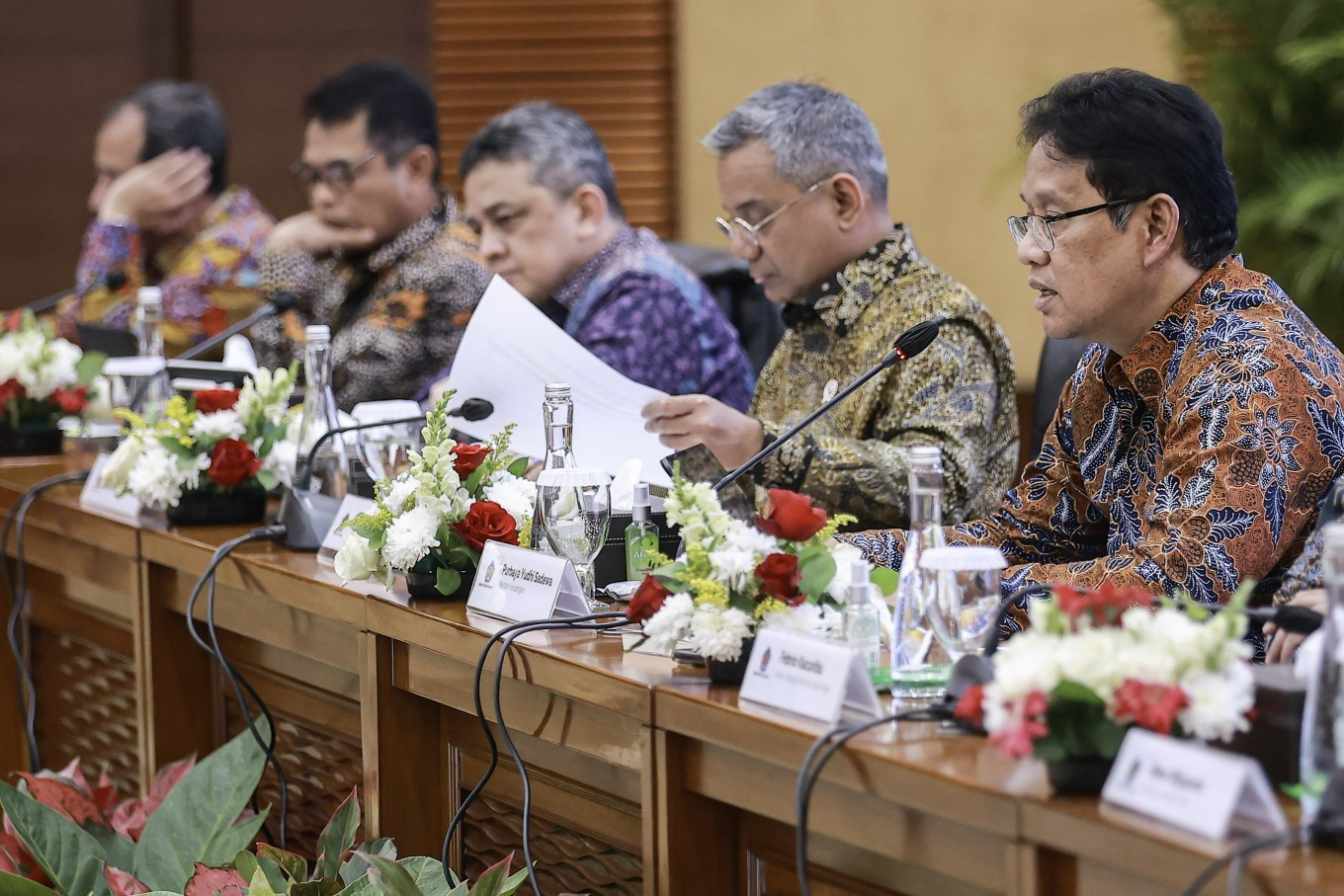 Finance Minister Purbaya Yudhi Sadewa (right) delivers a presentation on Oct. 14, 2025, during a monthly press briefing on the state budget at the Finance Ministry in Central Jakarta. (Antara/Dhemas Reviyanto)
F
inance Minister Purbaya Yudhi Sadewa has once again injected liquidity into Indonesia’s banking system, placing an additional Rp 70 trillion (US$4.3 billion) in state budget surplus funds with state-owned banks. The measure is intended to spur lending to the real sector and, ultimately, accelerate economic growth. Yet its effectiveness remains uncertain, raising a fundamental question: Can another liquidity injection genuinely revive credit growth, or is Purbaya mistaking the symptom for the cause in a classic chicken-and-egg problem?
Purbaya confirmed the latest injection during a media briefing at the Finance Ministry on Aug. 5, saying Rp 40 trillion had been disbursed that day, with the remaining Rp 30 trillion to follow on Aug. 10. Drawn from the state’s accumulated budget surplus (SAL), the funds will be placed with five members of the Association of State-Owned Banks (Himbara): Bank Mandiri, Bank Rakyat Indonesia (BRI), Bank Negara Indonesia (BNI), Bank Tabungan Negara (BTN) and Bank Syariah Indonesia (BSI). BTN and BSI will each receive Rp 10 trillion, while Mandiri, BRI and BNI will divide the remaining Rp 50 trillion in roughly equal shares, following the distribution pattern used in previous rounds.
Purbaya said the latest injection would bring total government funds placed in the banking system to nearly Rp 400 trillion. However, differing figures surrounding the cumulative placements make it more difficult to establish the program’s true scale and evaluate its results. Alongside the new injection, Purbaya extended the placement of Rp 200 trillion in SAL funds from the end of 2026 to July 2027. The extension is intended to give Himbara banks greater certainty that the funds will not be withdrawn abruptly, allowing them greater flexibility to commit the money to new loans.
Greater funding certainty may help, but the banking system does not appear to be short of liquidity. Data from the Financial Services Authority (OJK) for June show that banks’ liquid-assets-to-non-core-deposits ratio stood at 101.92 percent, more than double the regulatory minimum of 50 percent. Their liquid-assets-to-third-party-funds ratio was also comfortable at 23.08 percent, well above the required minimum of 10 percent.
Meanwhile, Bank Indonesia recorded Rp 2,490 trillion (US$138.3 billion) in undisbursed loan facilities, equivalent to 21.52 percent of available credit limits. This large pool of unused credit suggests that the constraint may lie less in banks’ ability to lend than in weak demand or borrowers’ reluctance to draw down available financing.
Bank executives, however, argue that healthy system-wide liquidity does not eliminate funding pressures at individual banks. BRI president director Hery Gunardi, who also chairs the National Banking Association (Perbanas), said SAL placements could support financial stability while strengthening banks’ capacity to extend credit.

Such support could become increasingly important in the second half of the year, with BNI president director Putrama Wahju Setyawan warning that persistently high interest rates would continue to raise funding costs across the industry. As a result, he said, BNI would become more selective in extending credit and adjust rates on some loans.