The Jakarta Post
Please Update your browser
Your browser is out of date, and may not be compatible with our website. A list of the most popular web browsers can be found below.
Just click on the icons to get to the download page.


Popular Reads
Top Results
No results found. Please check your search term and try again
Can't find what you're looking for?
View all search results
Popular Reads
Top Results
No results found. Please check your search term and try again
Can't find what you're looking for?
View all search resultsConnecting India and ASEAN's digital economy agreement
As ASEAN rewrites the rules of Southeast Asia’s digital economy with the DEFA, India must launch a dedicated two-track strategy to integrate cross-border tech and trade without compromising its regulatory sovereignty.
Change text size
Gift Premium Articles
to Anyone
Share the best of The Jakarta Post with friends, family, or colleagues. As a subscriber, you can gift 3 to 5 articles each month that anyone can read—no subscription needed!
 Set as preferred source
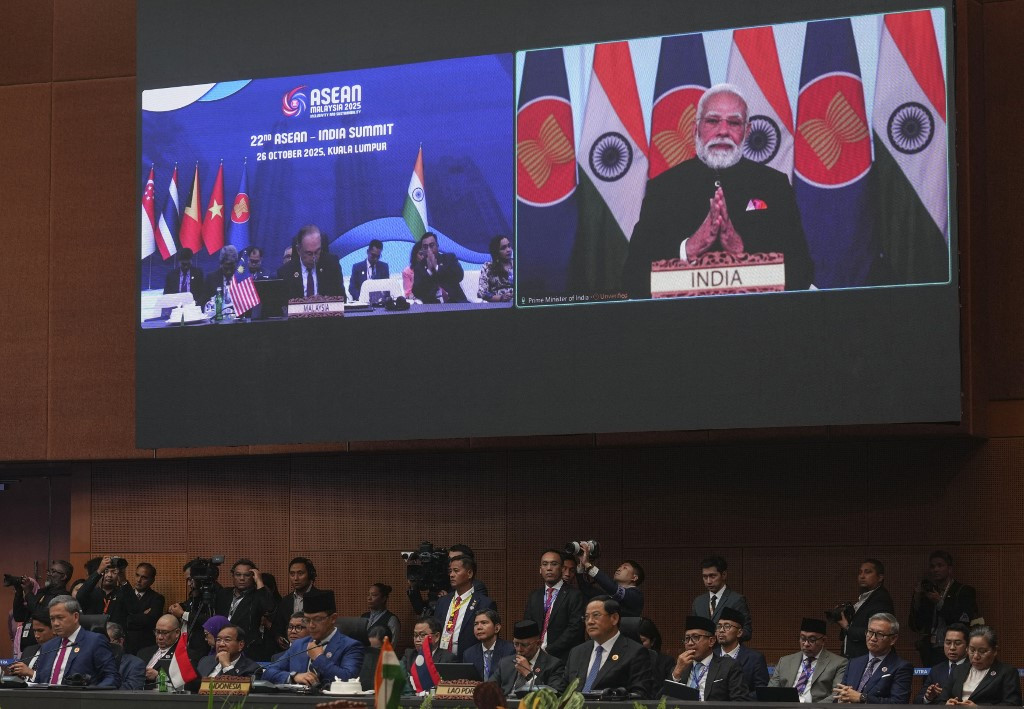 India's Prime Minister Narendra Modi appears on a screen to deliver a speech remotely as other leaders attend the 22nd ASEAN - India Summit during the 47th ASEAN Summit in Kuala Lumpur on Oct. 26, 2025. (AFP/Pool/Rafiq Maqbool)
A
SEAN concluded negotiations on the Digital Economy Framework Agreement (DEFA) in Manila in May of this year. The agreement is ASEAN's first region-wide digital economy instrument. Its negotiating agenda spans nine areas, including digital trade; cross-border e-commerce; payments and e-invoicing; digital identity; cross-border data flows and data protection; online safety; cybersecurity; and emerging technologies.
The DEFA therefore marks a shift from a collection of sectoral initiatives toward a more integrated regional framework.
That shift rests on precedent. The ASEAN Agreement on Electronic Commerce, signed in 2019 and in force since 2021, already committed members to facilitate electronic transactions while recognizing their different laws and levels of regulatory development. ASEAN has since advanced interoperable payments, electronic documents, digital identities and voluntary guidance on artificial intelligence. The DEFA extends this architecture rather than creating it from scratch.
That said, the DEFA does impose some obligations. ASEAN's goal is to reduce regulatory friction, and the negotiated text is not yet public; the depth, exceptions and enforceability of individual commitments can only be seen after signature.
The more defensible claim is that ASEAN has achieved managed interoperability: common commercial outcomes and compatible systems without requiring states to have similar domestic laws. Flexibility, phased implementation and capacity building make integration possible across economies with markedly different institutional capabilities.
This distinction matters for India because the ASEAN-India Trade in Goods Agreement (AITIGA) is still a trade-in-goods agreement. Its review has focused on market access, rules of origin, customs and trade facilitation, standards, sanitary and phytosanitary measures, trade remedies, and legal and institutional provisions. ASEAN and India aim to conclude the review in 2026, but the negotiations remain shaped by New Delhi's concern over its goods deficit and ASEAN's demand for a simpler and more trade-facilitative agreement.

Incorporating the DEFA into the AITIGA would be counterproductive, broadening a goods-focused negotiation at a late stage while drawing in unresolved questions concerning data governance, privacy, competition and online regulation. Yet reducing the digital economy to an aspiration would be equally misguided.