The Jakarta Post
Please Update your browser
Your browser is out of date, and may not be compatible with our website. A list of the most popular web browsers can be found below.
Just click on the icons to get to the download page.


Popular Reads
Top Results
No results found. Please check your search term and try again
Can't find what you're looking for?
View all search results
Popular Reads
Top Results
No results found. Please check your search term and try again
Can't find what you're looking for?
View all search resultsBeyond state budget: How much can the new financial architecture carry?
The government’s bold plan to fund massive growth beyond the state budget hinges on whether its new sovereign wealth apparatus truly mobilizes fresh capital - or merely hides the risks.
Change text size
Gift Premium Articles
to Anyone
Share the best of The Jakarta Post with friends, family, or colleagues. As a subscriber, you can gift 3 to 5 articles each month that anyone can read—no subscription needed!
 Set as preferred source
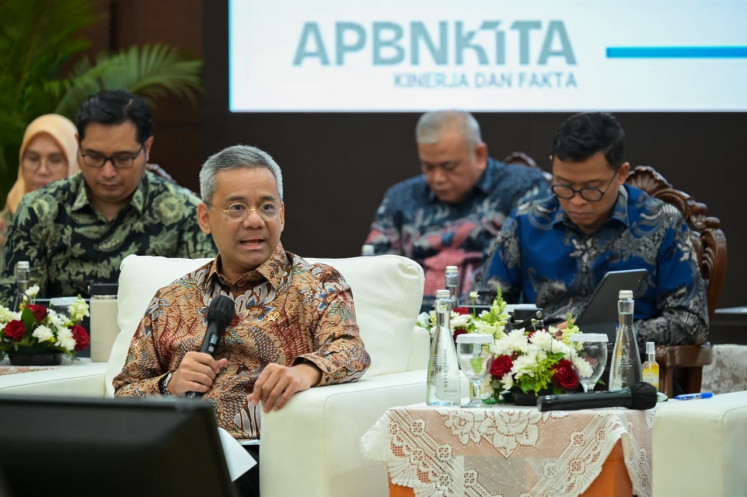
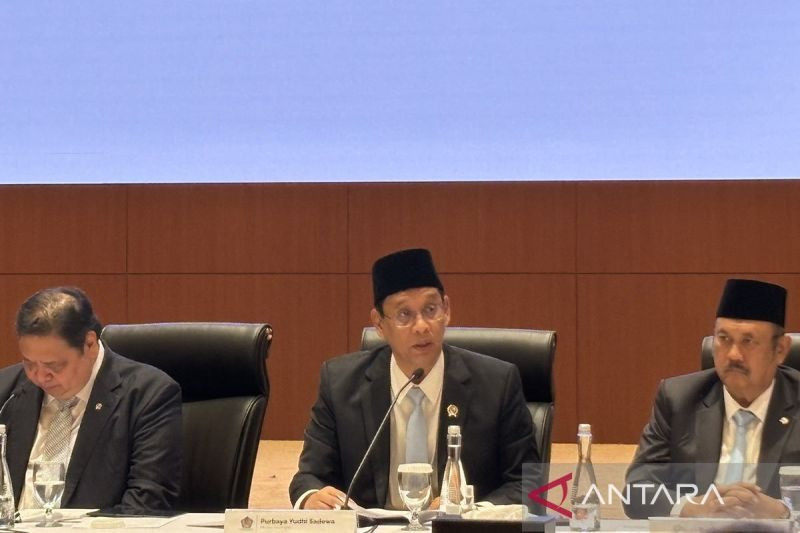 Finance Minister Purbaya Yudhi Sadewa (center) speaks on Friday at the 2027 Draft State Budget and Financial Notes press conference in Jakarta. (Antara/Imamatul Silfia)
W
hen President Prabowo Subianto presented the 2027 state budget draft last week, a central tension immediately came into focus. The government is aiming for 6 percent economic growth and pressing ahead with an expansive development agenda - all while planning to rein in the fiscal deficit to 2.4 percent of gross domestic product. State spending is pegged at Rp 4.10 quadrillion (US$ 230 billion) against projected revenues of Rp 3.43 quadrillion.
Reconciling these numbers is no easy task. Indonesia still faces massive investment demands across infrastructure, industrial downstreaming, energy transition, food security and human capital, even as conventional fiscal space stays uncomfortably tight.
To bridge the gap, policymakers have looked beyond the state budget. Over the past two years, the government has constructed a broader financing apparatus centered on Danantara - its sovereign investment arm - alongside state-owned enterprises (SOEs) and public financial vehicles.
Tapping balance sheets outside the treasury makes sense when the state budget cannot shoulder the load alone. Yet it invites a critical question: Is this emerging architecture actually mobilizing fresh external capital, or is it simply expanding the state’s footprint and reshuffling risk across public ledgers?
If Danantara and its peers can crowd in private and foreign investment, they will meaningfully scale national capacity. But if the apparatus relies primarily on balance-sheet leverage and state-directed credit, it risks masking sovereign exposure while quietly squeezing out the private sector.
Danantara represents the sharpest test of this dynamic. While it oversees upward of $900 billion in SOE assets, the vast majority are operational holdings rather than liquid capital waiting to be deployed. What truly counts is how much actual cash state firms can upstream without starving their own core operations, working capital, and debt servicing.

The constraints are already visible in its funding mix. In August 2025, Danantara was expected to manage Rp135 trillion in deployable funds Rp 70 trillion of which was slated to come from SOE dividends, with the remainder filled by domestic bonds and bank facilities. In practice, only slightly more than half the targeted pool was backed by internal cash generation.




Your Opinion Matters
Share your experiences, suggestions, and any issues you've encountered on The Jakarta Post. We're here to listen.
Enter at least 30 characters
0
/ 30
Thank you
Thank you for sharing your thoughts. We appreciate your feedback.