The Jakarta Post
Please Update your browser
Your browser is out of date, and may not be compatible with our website. A list of the most popular web browsers can be found below.
Just click on the icons to get to the download page.


Popular Reads
Top Results
No results found. Please check your search term and try again
Can't find what you're looking for?
View all search results
Popular Reads
Top Results
No results found. Please check your search term and try again
Can't find what you're looking for?
View all search resultsBaliology and the spirit of scholarship
More than a tropical resort, Bali is a living philosophy, and it's time to reclaim its culture from the lens of Western tourism.
Change text size
Gift Premium Articles
to Anyone
Share the best of The Jakarta Post with friends, family, or colleagues. As a subscriber, you can gift 3 to 5 articles each month that anyone can read—no subscription needed!
 Set as preferred source
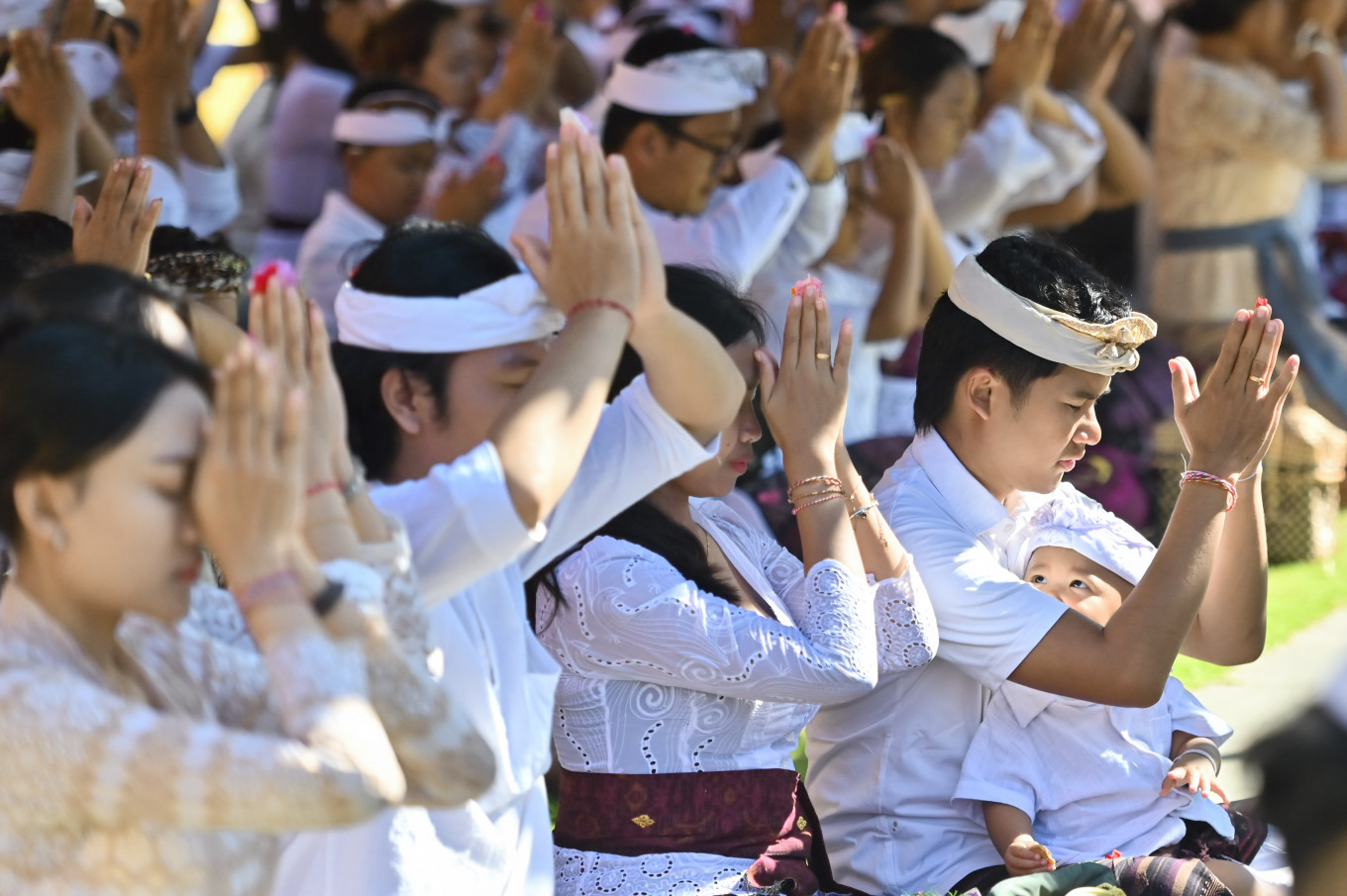 Balinese Hindus pray during Galungan celebrations at Jagatnatha Temple in Denpasar, Bali, on June 17, 2026. Hindus across Bali gather at temples to mark Galungan, a religious holiday celebrating the victory of good (Dharma) over evil (Adharma). (Antara/Fikri Yusuf)
I
n 1984, then-education and culture minister Nugroho Notosusanto inaugurated what became known as "Baliology" on behalf of anthropologist Harsya W. Bachtiar. The milestone represented the culmination of the late I Gusti Ngurah Bagus’s life’s work.
Yet Baliology was never merely about establishing an academic institute; it was an effort to lay the foundations for a new epistemology. In effect, it offered a road map for Balinese society to transition from being passive objects of external study to becoming autonomous subjects with authority over their own cultural knowledge.
Bagus is widely remembered for his intellect and integrity, but equally for his intellectual audacity. At the time, Indonesian social science was heavily constrained by rigid, positivist Western paradigms that neatly separated religion from culture and ritual from art. When Bagus introduced Baliology, many mainstream academics reacted with skepticism, dismissing his framework because it diverged from accepted definitions of modern social science.
To Bagus, Balinese culture could never be understood through a fragmented Western lens. Because Balinese traditions are fundamentally holistic, he proposed a synthesis: combining scientific rigor with deep philosophical reflection, historical analysis and an appreciation for indigenous religious values. He did not reject scientific logic; rather, he grounded it firmly within the local context.
During the late 1980s and early 1990s, Bagus’ intellectual endeavors gained international traction. Invited as a visiting research fellow at the Centre for Southeast Asian Studies at Australia’s University of Wollongong (UOW), he served as both a scholar and a cultural ambassador, introducing Baliology into global academic discourse.
His presence on the Wollongong campus demonstrated that a Balinese intellectual could stand alongside world-renowned sociologists and anthropologists, reinforcing the principle that local traditions need not be subordinate to Western frameworks. His enduring legacy was constructing a vital bridge between modern science and traditional Balinese ideals, effectively connecting East and West.

Crucially, Baliology extends beyond research methodology into ethics and cultural politics. Bagus argued that studying Bali requires the courage to defend cultural roots against the eroding pressures of globalization. Pushing back against the view that custom and religion are obstacles to progress, he maintained that these traditions are the very source of social resilience and wisdom.