The Jakarta Post
Please Update your browser
Your browser is out of date, and may not be compatible with our website. A list of the most popular web browsers can be found below.
Just click on the icons to get to the download page.


Popular Reads
Top Results
No results found. Please check your search term and try again
Can't find what you're looking for?
View all search results
Popular Reads
Top Results
No results found. Please check your search term and try again
Can't find what you're looking for?
View all search resultsAnalysis: JHT is social protection, not tax revenue
Change text size
Gift Premium Articles
to Anyone
Share the best of The Jakarta Post with friends, family, or colleagues. As a subscriber, you can gift 3 to 5 articles each month that anyone can read—no subscription needed!
 Set as preferred source
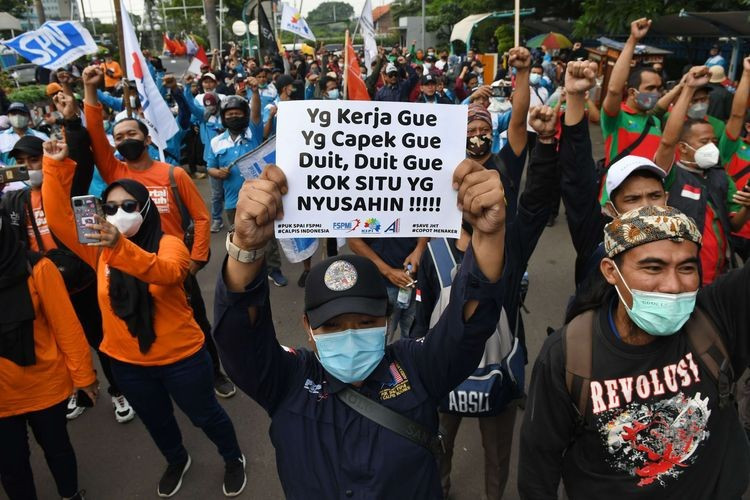 Dozens of workers rally on Feb. 18, 2022, outside the Manpower Ministry on Jl. Gatot Subroto in South Jakarta to demand it cancel a ministerial regulation stipulating a minimum age of 56 for people to start withdrawing from their pension funds. (Antara/Aditya Pradana Putra)
R
etirement savings are meant to provide financial security in old age. Yet Indonesia's renewed debate over the Old-Age Savings (JHT) program has focused largely on tax rates and thresholds, overlooking a more fundamental question: Should the state tax retirement savings at all? In a country where fewer than half of workers participate in the formal social security system, the issue goes beyond taxation to retirement security itself.
Under the current framework, JHT taxation is governed by Government Regulation No. 68/2009 and Finance Ministry Regulation (PMK) No. 16/2010. Workers who withdraw their JHT within two calendar years of retirement pay no tax on the first Rp 50 million (US$2,850) of benefits, while any amount above that is subject to a final income tax of 5 percent. Those who withdraw their savings after the two-year period no longer qualify for this preferential treatment and instead face Indonesia's progressive personal income tax rates.
The government argues that this framework preserves the principle of deferred taxation while encouraging workers to use JHT as genuine retirement savings rather than withdrawing it gradually over time. Although officials maintain that this is not a new tax but a long-standing system of deferred taxation, its continued relevance has come under increasing scrutiny as economic conditions and retirement needs have evolved.
The policy is now under review. Labor groups, led by Presidential Adviser for Labor Affairs Said Iqbal, have proposed abolishing the tax altogether or raising the tax-free threshold from Rp 50 million (US$3,070) to Rp 400 million ($24,600), arguing that the current benchmark, introduced in 2009, no longer reflects today's cost of living. Manpower Minister Yassierli has also expressed support for revisiting the policy.
Finance Minister Purbaya Yudhi Sadewa, however, has adopted a more cautious stance, saying any decision should await further data from BPJS Ketenagakerjaan. The Directorate General of Taxes has floated a more modest proposal by increasing the tax-free threshold to Rp 100 million. Opposing a blanket exemption, the Center for Indonesia Taxation Analysis (CITA) argues that raising the threshold to Rp 400 million would primarily benefit higher-income workers with larger retirement balances, making the policy less progressive.
Formal workers are hardly a privileged group that has escaped contributing to the state. Throughout their working lives, they pay income tax, contribute to BPJS Ketenagakerjaan and BPJS Kesehatan and help finance the very social protection system that supports them in old age. Taxing retirement savings may be legally justified under Indonesia's deferred taxation framework, but it sits uneasily with the broader purpose of social protection.

If retirement marks the point at which workers are expected to rely on their accumulated savings rather than wages, it is also the point at which public policy should prioritize income security over additional revenue collection.