The Jakarta Post
Please Update your browser
Your browser is out of date, and may not be compatible with our website. A list of the most popular web browsers can be found below.
Just click on the icons to get to the download page.


Popular Reads
Top Results
No results found. Please check your search term and try again
Can't find what you're looking for?
View all search results
Popular Reads
Top Results
No results found. Please check your search term and try again
Can't find what you're looking for?
View all search resultsWhy ASEAN, Pacific Islands states must forge a strategic front
To withstand rising superpower aggression, Southeast Asia and the Pacific island nations must abandon timid neutrality and unite around a shared, principled strategy to safeguard their regions.
Change text size
Gift Premium Articles
to Anyone
Share the best of The Jakarta Post with friends, family, or colleagues. As a subscriber, you can gift 3 to 5 articles each month that anyone can read—no subscription needed!
 Set as preferred source
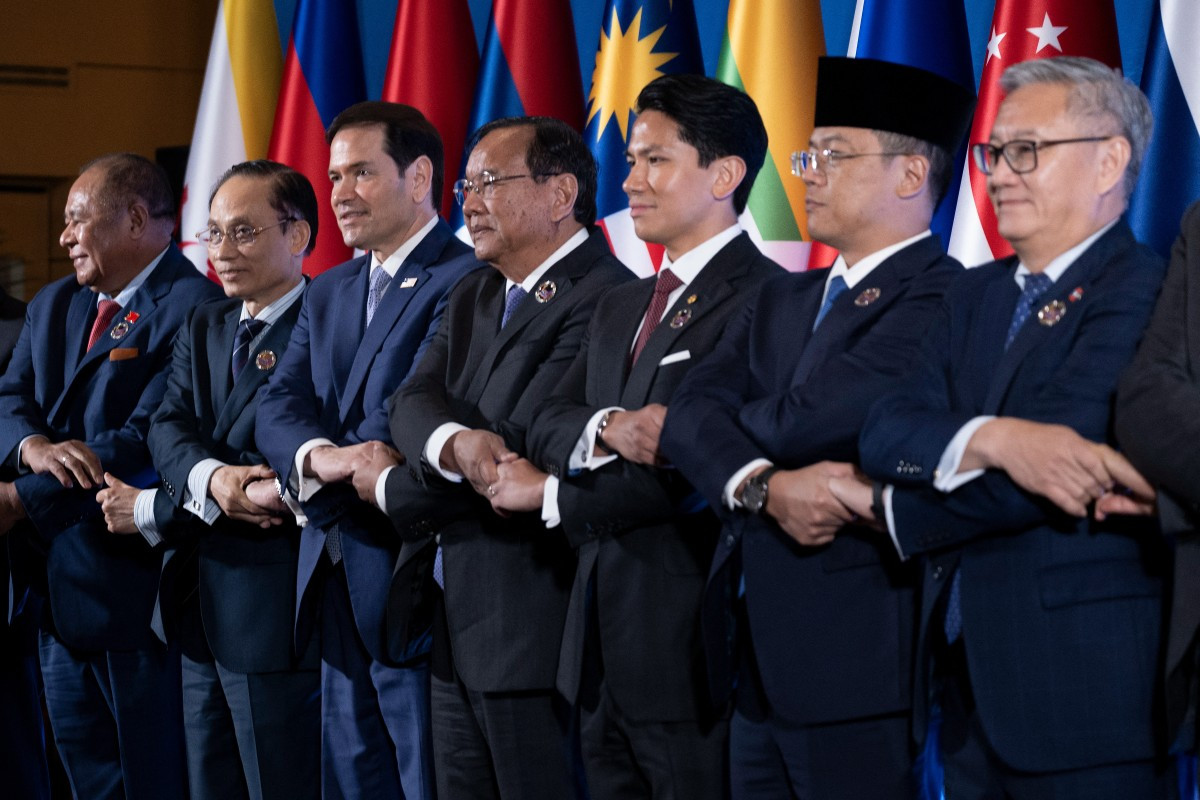 Timor Leste's Foreign Minister Bendito dos Santos Freitas, Vietnam Foreign Minister Le Hoai Trung, US Secretary of State Marco Rubio, Cambodia's Deputy Prime Minister and Foreign Minister Prak Sokhonn, Brunei Foreign Minister Abdul Mateen Bolkiah, Indonesia's Foreign Minister Sugiono, Laos Foreign Minister Thongsavanh Phomvihane, Malaysia's Foreign Minister Mohamad Hasan, Myanmar Permanent Secretary Hau Khan Sum and ASEAN Secretary-General Kao Kim Hourn join hands during the Association of Southeast Asian Nations (ASEAN) Foreign Ministers' Meeting in Pasay, Metro Manila on July 22, 2026. (AFP/Brendan Smialowski)
O
ne of the proudest achievements of Malaysia’s ASEAN chairmanship was the inaugural summit between the Southeast Asian bloc and the Gulf Cooperation Council (GCC), a landmark gathering uniting Southeast Asia with the energy-rich monarchies of West Asia.
Yet, the lack of substantive follow-through between the two regions underscores a fundamental reality: Establishing coordinated foreign policy across regional blocs, even before pursuing a common approach, is an inherently ambitious enterprise.
The European Union, by far the world’s most advanced model of regional integration, illustrates how arduous it is for sovereign nations to forge a unified foreign policy. However, these inherent structural hurdles should not serve as a deterrent. ASEAN must not only sustain its engagement with the Gulf states but also expand its diplomatic horizons.
A natural regional partner for Southeast Asia is the Pacific Islands Forum (PIF), the premier intergovernmental organization uniting the nations and territories of the vast Pacific region. Geographically adjacent to Southeast Asia, Pacific Island nations share deeply overlapping vulnerabilities with ASEAN.
Climate change is paramount among these shared concerns. While Pacific Island nations face existential climate vulnerabilities, Southeast Asia stands equally at the epicenter of global environmental risk. Ocean conservation and biodiversity protection, particularly ahead of the 17th Conference of the Parties to the Convention on Biological Diversity (CBD COP17) in late October, present immediate avenues for joint action. Furthermore, sustainable fisheries and ecotourism offer fertile ground for deeper economic integration.
Beyond environmental and economic synergies, however, lies an urgent geopolitical imperative for dialogue: Maintaining the broader Asia-Pacific as a nuclear-weapon-free zone.

Southeast Asia’s security architecture rests on the 1995 Treaty on the Southeast Asia Nuclear Weapon-Free Zone (SEANWFZ, or the Bangkok Treaty), which expanded upon ASEAN’s foundational 1971 Zone of Peace, Freedom and Neutrality (ZOPFAN) declaration.