The Jakarta Post
Please Update your browser
Your browser is out of date, and may not be compatible with our website. A list of the most popular web browsers can be found below.
Just click on the icons to get to the download page.


Popular Reads
Top Results
No results found. Please check your search term and try again
Can't find what you're looking for?
View all search results
Popular Reads
Top Results
No results found. Please check your search term and try again
Can't find what you're looking for?
View all search resultsStop policing AI in the classroom. Start teaching it
Instead of discouraging students from using generative AI, universities should teach them how to use the technology responsibly, transparently and ethically to prepare them for real-world applications in a fast-evolving workforce.
Change text size
Gift Premium Articles
to Anyone
Share the best of The Jakarta Post with friends, family, or colleagues. As a subscriber, you can gift 3 to 5 articles each month that anyone can read—no subscription needed!
 Set as preferred source
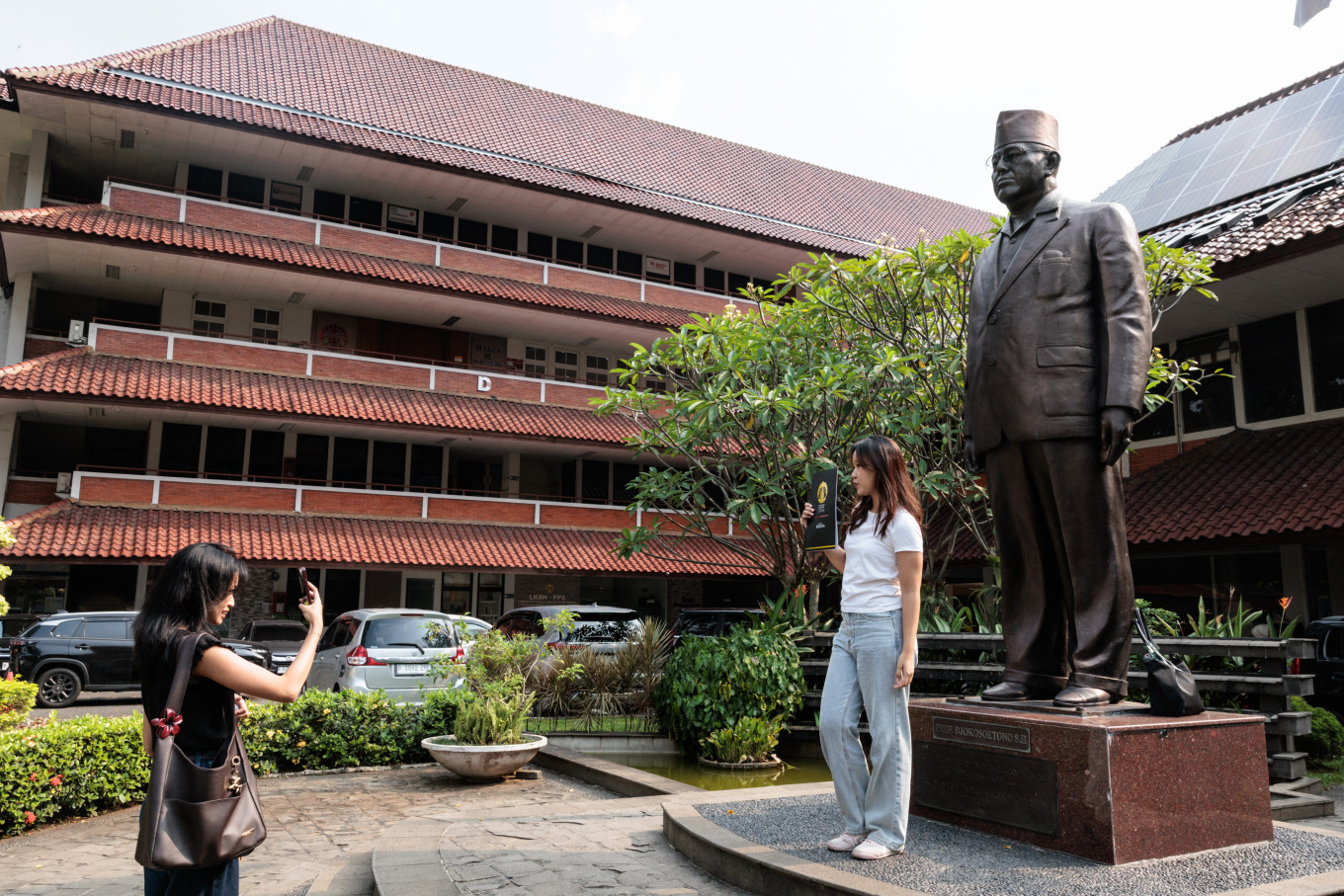 A new law school graduate poses for a photo on April 16, 2026, in front of the statue of noted legal scholar Djokosoetono, the founding dean of the University of Indonesia Faculty of Law in Depok, West Java. (AFP/Yasuyoshi Chiba)
W
hen handheld calculators entered classrooms in the 1970s, critics sounded the alarm on a wave of math illiteracy. With the internet, the panic shifted to the death of reading. Yet neither apocalypse happened. Instead, education adapted, turning these disruptors into essential extensions of human intelligence.
Generative AI marks a similar turning point for higher education. In lecture halls across Malaysia and Indonesia, students routinely use tools like ChatGPT, Gemini and Claude for everything from research and writing to coding and problem-solving.
Many universities are pushing back against this trend, introducing stricter regulations, academic penalties and AI detection software.
This response fundamentally misjudges the challenge. The question isn’t whether students should use AI; they already do. The real question is how universities will train them to use it responsibly.
Instead of fighting generative AI as a threat to integrity, institutions in Malaysia and Indonesia should embrace it as a vital productivity tool by focusing on three priorities: teaching AI literacy, redesigning assessments and embedding ethical frameworks.
Future graduates will enter workplaces where AI assists with predictive analytics, software engineering, financial analysis, legal research and strategic decision-making. More than one-third of entry-level jobs now require AI skills, nearly triple the share from autumn 2025. Some 28 percent of employers say they’re seeking early career talent who can use AI in their work.

Universities should therefore teach AI as a professional competency. Students should learn how to construct effective prompts, evaluate machine-generated outputs, detect hallucinations, verify evidence and recognize the limitations of AI systems. These are no longer optional digital skills but essential competencies for an AI-enabled workforce.
This approach is consistent with UNESCO’s call for a human-centered model of AI governance that prioritizes AI literacy over blanket prohibition.
Rather than discouraging students from using AI, universities should equip them to use it critically and responsibly. Malaysia and Indonesia have an opportunity to lead this transformation.
Indonesia’s recent joint ministerial decree, signed by seven ministers, represents an important step in regulating AI across education. While the policy places greater restrictions on the use of AI to generate instant answers in primary and secondary schools, it also highlights the need for universities to develop clearer operational frameworks for responsible AI adoption.
Malaysia, with its ambitions to become a regional digital and knowledge economy, should similarly position higher education as a driver of AI literacy rather than AI avoidance.
Universities should encourage students to move beyond using AI merely to generate assignments and become creators of AI-driven solutions.
In Malaysia, for example, Islamic economics and finance students could develop specialized AI applications trained on key concepts like Maqasid al-Sharia (the framework for human well-being and justice), waqf (charitable endowments), zakat (obligatory almsgiving) and sharia-compliant investment principles.
AI should become a platform for innovation rather than simply a shortcut for completing coursework.
When assignments merely reward memorization, generative AI feels like a threat. The real challenge isn’t the technology, it’s how we design assessments.
Universities should shift away from traditional take-home essays toward assessments that measure reasoning, judgement and application. Greater emphasis should be placed on oral presentations, live case analyses, project demonstrations, reflective portfolios and collaborative innovation challenges.
Where AI is used, students should be assessed on how they engaged with it. What prompts did they design? How did they identify inaccuracies or misinterpretation? Which sources did they use to verify AI-generated information? How did AI contribute to, rather than replace, their own analysis?
By assessing the learning process instead of merely the final written product, universities can preserve academic integrity while encouraging responsible technological adoption.
Teaching AI without ethics leaves graduates unprepared for the real-world responsibilities of these technologies. This is why universities may need to twin AI literacy with ethical literacy.
For Malaysia, this dialogue can be grounded in the principles of Maqasid al-Sharia, which hold that any policy or practice must be evaluated by its ability to protect five core human goods: faith, life, intellect, lineage and wealth.
AI tools that drive financial inclusion, alleviate poverty or simplify complex policy preserve intellect and wealth. On the other hand, using AI to fake research, deceive lecturers or bypass critical thinking directly violates these principles.
Ethical AI education should not be limited to preventing misconduct. It should cultivate graduates who understand transparency, accountability, intellectual honesty and the social responsibilities that accompany technological innovation.
Ultimately, universities should not aspire to produce graduates who simply know how to use AI. They should produce graduates who know when to trust it, when to question it and when human judgment must prevail.
The future of higher education in Malaysia and Indonesia should not be defined by increasingly sophisticated methods of detecting AI use. It should be defined by increasingly effective ways of teaching students to use AI wisely.
Teaching AI as a productivity skill, redesigning assessments to reward critical thinking and embedding ethical responsibility will better prepare graduates for an economy in which AI is becoming an everyday professional tool.
The universities that lead the next generation of higher education will not be those that police AI the hardest. They will be the ones that empower students to use it more intelligently, creatively and ethically.
---
The writer is an assistant professor at International Islamic University Malaysia. This article is republished under a Creative Commons license.