The Jakarta Post
Please Update your browser
Your browser is out of date, and may not be compatible with our website. A list of the most popular web browsers can be found below.
Just click on the icons to get to the download page.


Popular Reads
Top Results
No results found. Please check your search term and try again
Can't find what you're looking for?
View all search results
Popular Reads
Top Results
No results found. Please check your search term and try again
Can't find what you're looking for?
View all search resultsAnalysis: The anti-LGBTQ push and the securitization of identity
Change text size
Gift Premium Articles
to Anyone
Share the best of The Jakarta Post with friends, family, or colleagues. As a subscriber, you can gift 3 to 5 articles each month that anyone can read—no subscription needed!
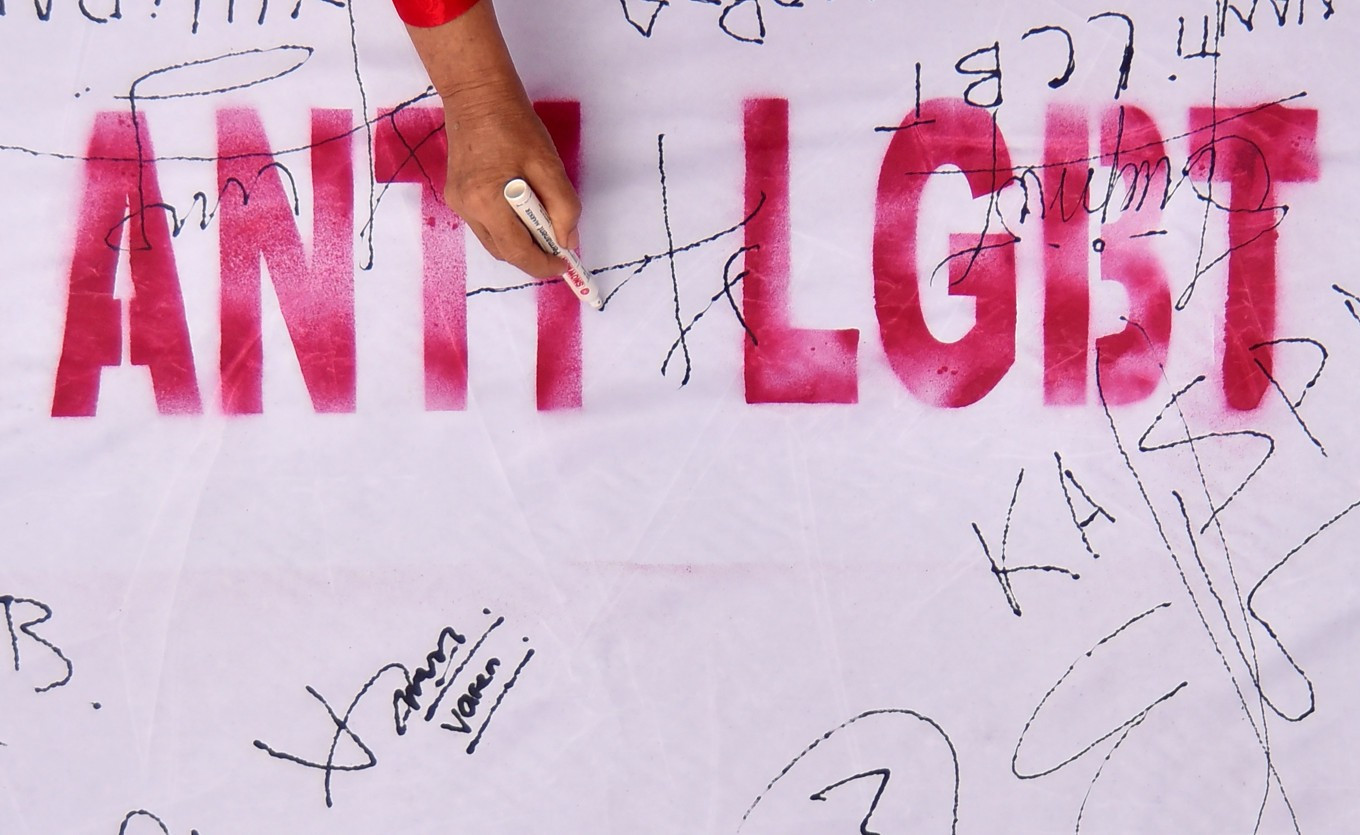 Residents sign a white banner during an anti-LGBT rally on June 21 in Padang, West Sumatra. The event, organized by the West Sumatra administration, the West Sumatra Police and the Minangkabau Traditional Council (LKAAM), invited participants to sign a one-kilometer-long white banner as part of a declaration opposing the LGBT community. Organizers also pledged to take action against LGBT individuals through customary law and called for them to be “eradicated” or expelled from Minangkabau land. (Antara/Fitra Yogi)
L
esbian, gay, bisexual, transgender and queer (LGBTQ) issues have once again surged to the forefront of Indonesia's political and social discourse. Two recent, overlapping developments warrant close examination: the formal classification of the "spread of LGBTQ culture" as a nonmilitary threat under the national defense policy, and a concerted legislative push to introduce criminal sanctions targeting LGBTQ people and advocacy.
While these systemic tensions have existed for years, they gained renewed momentum following the global observance of Pride Month in June. Public discussions have since intensified across national media and digital platforms, prompting a critical reevaluation of the state's role in policing identity, the boundaries of national security and the preservation of constitutional liberties.
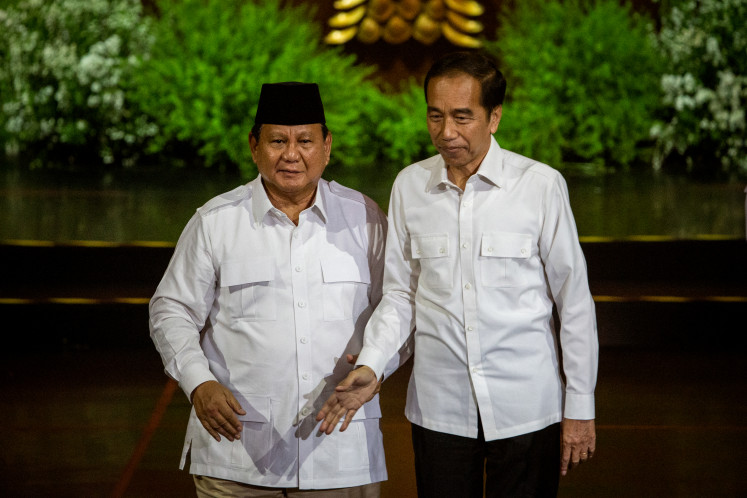
The first major controversy centers on Presidential Regulation (Perpres) No. 111/2025 on the 2025-2029 national defense policy, signed by President Prabowo Subianto on Oct. 24, 2025. Although the regulation has been in place for nearly nine months, its implications started drawing widespread public scrutiny only after specific provisions began circulating online recently.
Crucially, the regulation categorizes the "spread of LGBTQ culture" as a nonmilitary threat, which is defined as unarmed activities that potentially jeopardize state sovereignty, territorial integrity or public safety. Under this framework, ministries, government agencies and regional administrations outside the defense sector are mandated to coordinate joint responses to mitigate the threat.
Constitutional law experts and human rights advocates argue that this classification directly challenges Indonesia’s existing legal architecture. Article 28I, Paragraph 4 of the 1945 Constitution explicitly places the responsibility for protecting, promoting, enforcing and fulfilling human rights squarely on the state, particularly the government. Furthermore, Article 28E, Paragraph 2 guarantees every citizen the right to freedom of belief, conscience and the expression of opinions and beliefs.
Critics contend that framing personal identity as a national security issue risks institutionalizing social stigma and legitimizing extrajudicial discrimination. Furthermore, legal scholars point out that Indonesia's criminal justice system already possesses adequate mechanisms to prosecute offenses regardless of an individual's sexual orientation or gender identity, rendering classifications related to national defense unnecessary and highly inflammatory.

Simultaneously, the Indonesian Ulema Council (MUI) is spearheading a legislative initiative to criminalize LGBTQ-related activities. The conservative clerical body says it wants the House of Representatives to include the bill it is drafting in the National Legislation Program (Prolegnas). The move has found alignment with the Religious Affairs Ministry, several key lawmakers and Islamic political parties.