The Jakarta Post
Please Update your browser
Your browser is out of date, and may not be compatible with our website. A list of the most popular web browsers can be found below.
Just click on the icons to get to the download page.


Popular Reads
Top Results
No results found. Please check your search term and try again
Can't find what you're looking for?
View all search results
Popular Reads
Top Results
No results found. Please check your search term and try again
Can't find what you're looking for?
View all search resultsThe Shinawatra code in Jakarta and the posturing of Thai power
A power play disguised as diplomacy, the Shinawatra family’s high-stakes meeting with President Prabowo in Jakarta reveals a masterclass in reciprocal politics, leveraging international prestige to reshape Bangkok's domestic power balance while securing vital economic lifelines for Indonesia.
Change text size
Gift Premium Articles
to Anyone
Share the best of The Jakarta Post with friends, family, or colleagues. As a subscriber, you can gift 3 to 5 articles each month that anyone can read—no subscription needed!
 Set as preferred source
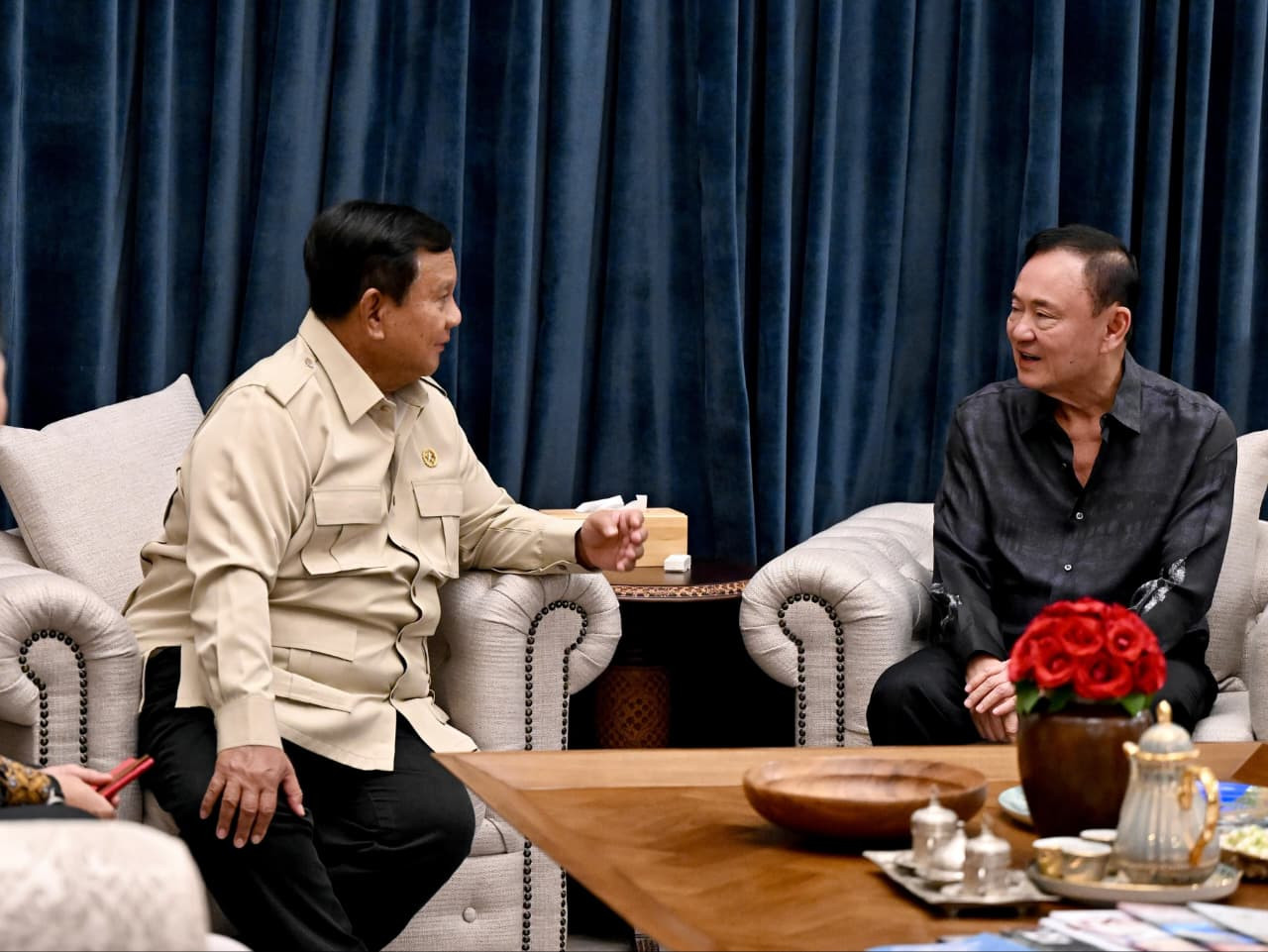 President Prabowo Subianto (left) talks with former Thai prime minister Thaksin Shinawatra at the former's private residence at Jl. Kertanegara in South Jakarta on evening of July 8, 2026. Prabowo and Thaksin discussed various regional and global issues during the meeting, according to Cabinet Secretary Teddy Indra Wijaya. (Courtesy of Presidential Secretariat/Cahyo)
T
he simultaneous appearance of three former Thai prime ministers from a single family, Thaksin Shinawatra, Yingluck Shinawatra, and Paetongtarn Shinawatra, alongside President Prabowo Subianto in Jakarta recently was far from a routine diplomatic courtesy. Instead, it represents a calculated strategic signal beamed across borders back to Bangkok, flashing at a moment when Thailand’s domestic power architecture is navigating profound turbulence and a crisis of institutional trust.
Examining this phenomenon with objective distance requires untangling a web of overlapping interests. The encounter can be decoded across several distinct, critical dimensions.
For Thaksin Shinawatra, the Jakarta summit serves as a vivid demonstration of political resilience. His appointment as an adviser to Danantara, Indonesia’s newly minted state asset fund, coupled with a high-profile reception by the leader of Southeast Asia’s largest economy, serves notice that his personal political capital remains a potent currency in regional affairs.
Through one lens, this move is a masterclass in leveraging international prestige to transcend the legal and political constraints that defined his years in exile. Through another, it inevitably prompts a sharper domestic question: Will Bangkok’s conservative establishment and security apparatus view this display of cross-border influence as an unsettling overreach by a statesman operating outside official channels?
The inclusion of Yingluck and Paetongtarn in the delegation speaks to a deliberate, multi-generational calculus. For Yingluck, the visit functions as a soft trial, a testing of diplomatic waters to rebuild a positive profile in high-level regional circles. For Paetongtarn, who exited the premiership last year amid a bruising constitutional court ruling and maritime border controversies, stepping into a global advisory role alongside her father is a textbook rebranding exercise. It shifts her narrative away from a fraught domestic tenure toward that of an emerging, internationally minded strategist.
Yet, this maneuver carries inherent risks. Given past controversies surrounding overlapping maritime claims in the Gulf of Thailand, the family’s direct engagement in regional economic statecraft will inevitably invite intense scrutiny from the opposition and the Thai public, who remain sensitive to where the line between national interest and family enterprise begins and ends.

The timing of the Jakarta visit could not be more delicate for the current government in Bangkok. The Bhumjaithai Party, a principal pillar of the ruling coalition, is currently mired in institutional scandals and eroding public approval ratings.