The Jakarta Post
Please Update your browser
Your browser is out of date, and may not be compatible with our website. A list of the most popular web browsers can be found below.
Just click on the icons to get to the download page.


Popular Reads
Top Results
No results found. Please check your search term and try again
Can't find what you're looking for?
View all search results
Popular Reads
Top Results
No results found. Please check your search term and try again
Can't find what you're looking for?
View all search resultsThe hidden costs of Indonesia's B50 biodiesel revolution
Indonesia’s ambitious B50 biodiesel mandate promises total energy independence, but a volatile mix of surging food costs, environmental degradation, and fiscal strain could turn this historic experiment into a costly economic gamble.
Change text size
Gift Premium Articles
to Anyone
Share the best of The Jakarta Post with friends, family, or colleagues. As a subscriber, you can gift 3 to 5 articles each month that anyone can read—no subscription needed!
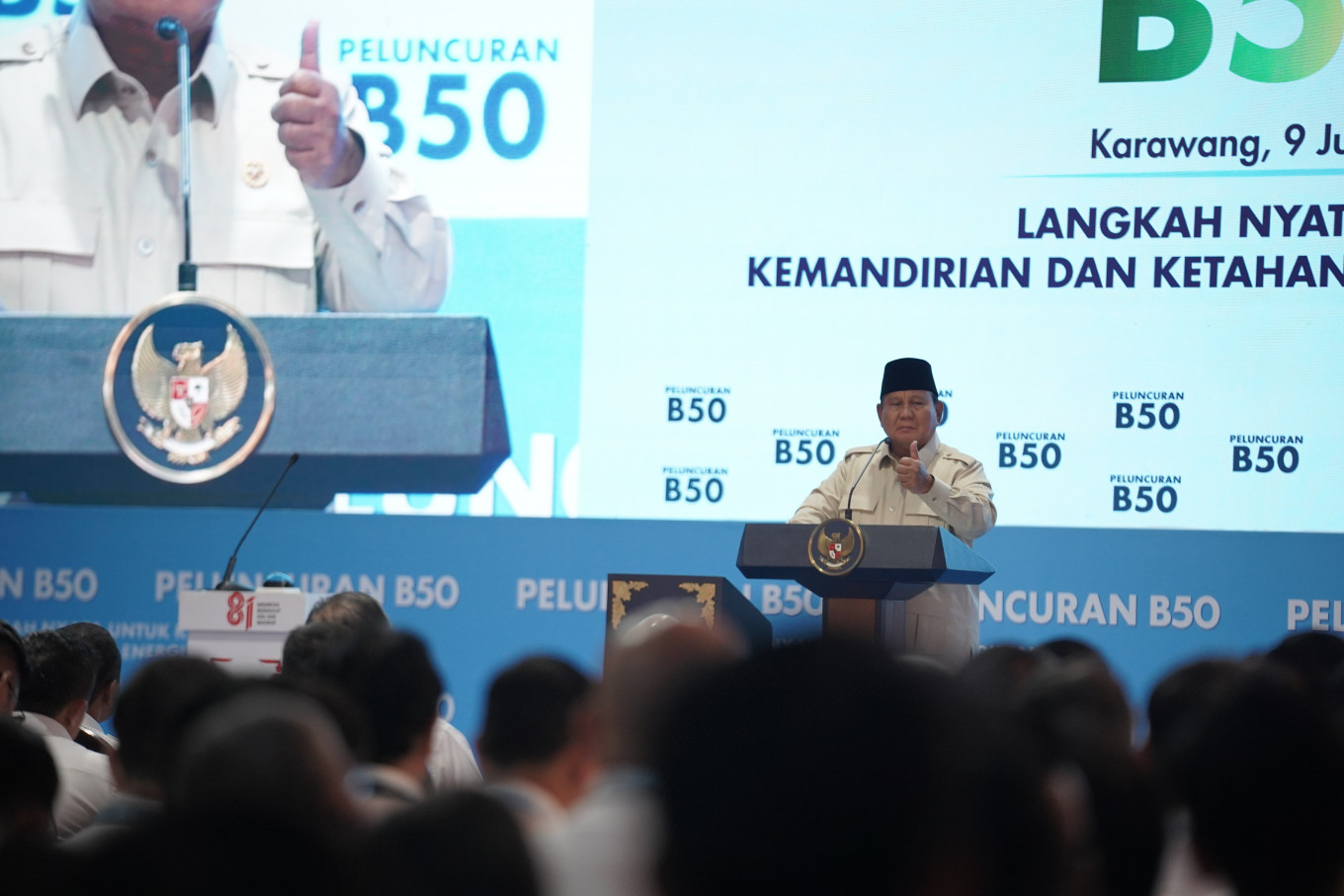 President Prabowo Subianto gestures as he delivers remarks at the launch of Indonesia's B50 biodiesel program in Karawang, West Java, July 9, 2026. Indonesia on Thursday raised its mandatory biodiesel blend to 50 percent from 40 percent, requiring diesel fuel to contain half palm oil-based biodiesel. (Courtesy of/BPMI Setpres)
I
ndonesia’s mandatory B50 biodiesel program, launched by President Prabowo Subianto on July 9, marks one of the country’s boldest energy policy experiments. As the first nation to require a fuel blend containing 50 percent palm oil-based biodiesel, Indonesia aims to eliminate its dependence on imported diesel while shielding its economy from mounting geopolitical risks, including disruptions to global oil supplies through the Strait of Hormuz.
The government expects the policy to replace roughly 3 million to 4 million kiloliters of annual diesel imports, saving as much as Rp 170 trillion (US$9.4 billion) in foreign exchange this year. Officials also project higher value-added growth in the palm oil industry, the creation of more than 2 million jobs and substantial reductions in carbon emissions, reinforcing the narrative that B50 is both an economic and environmental breakthrough.
Yet these ambitions mask a more complex reality. Rather than representing a straightforward energy transition, the policy reflects Indonesia’s struggle to cope with structural weaknesses that have accumulated over decades. Declining domestic oil production, rising fiscal pressures, tightening palm oil supplies and growing environmental disputes all converge within the B50 program.
Indonesia’s upstream oil sector continues to lose ground. Crude production has fallen to around 576,000 barrels per day (bpd), well below official targets, while domestic consumption has climbed to as much as 1.7 million bpd. This widening gap has turned the country into a major net importer, exposing the economy to volatile international oil markets and persistent currency pressures.
The challenge is compounded by limited strategic fuel reserves and mounting subsidy costs. With global crude prices remaining elevated while subsidized fuel prices stay unchanged, the government's energy subsidy bill is under increasing strain. Against this backdrop, reducing diesel imports through biodiesel has become as much a fiscal necessity as a strategic energy choice.
However, the economic logic behind B50 becomes less convincing once attention shifts from fuel imports to palm oil supplies. Although Indonesia remains the world's largest palm oil producer, output has largely plateaued while domestic demand continues to accelerate. At the same time, inventories have declined as more crude palm oil (CPO) is diverted to biodiesel production.

The consequence is a zero-sum competition between fuel, food and exports. Biodiesel has already overtaken the food industry as the largest domestic consumer of palm oil, raising concerns that lower diesel imports could be offset by weaker export earnings and tighter supplies for food manufacturers. Measures requiring producers to prioritize domestic markets may ease pressure on cooking oil prices, but they also reduce export flexibility and distort market incentives.