The Jakarta Post
Please Update your browser
Your browser is out of date, and may not be compatible with our website. A list of the most popular web browsers can be found below.
Just click on the icons to get to the download page.


Popular Reads
Top Results
No results found. Please check your search term and try again
Can't find what you're looking for?
View all search results
Popular Reads
Top Results
No results found. Please check your search term and try again
Can't find what you're looking for?
View all search resultsHow do Pakistan and India go from conflict to dialogue?
Since Pakistan and India remain embroiled in kinetic confrontations below a nuclear overhang, there is an urgent need to come up with ways to defuse tension during crises.
Change text size
Gift Premium Articles
to Anyone
Share the best of The Jakarta Post with friends, family, or colleagues. As a subscriber, you can gift 3 to 5 articles each month that anyone can read—no subscription needed!
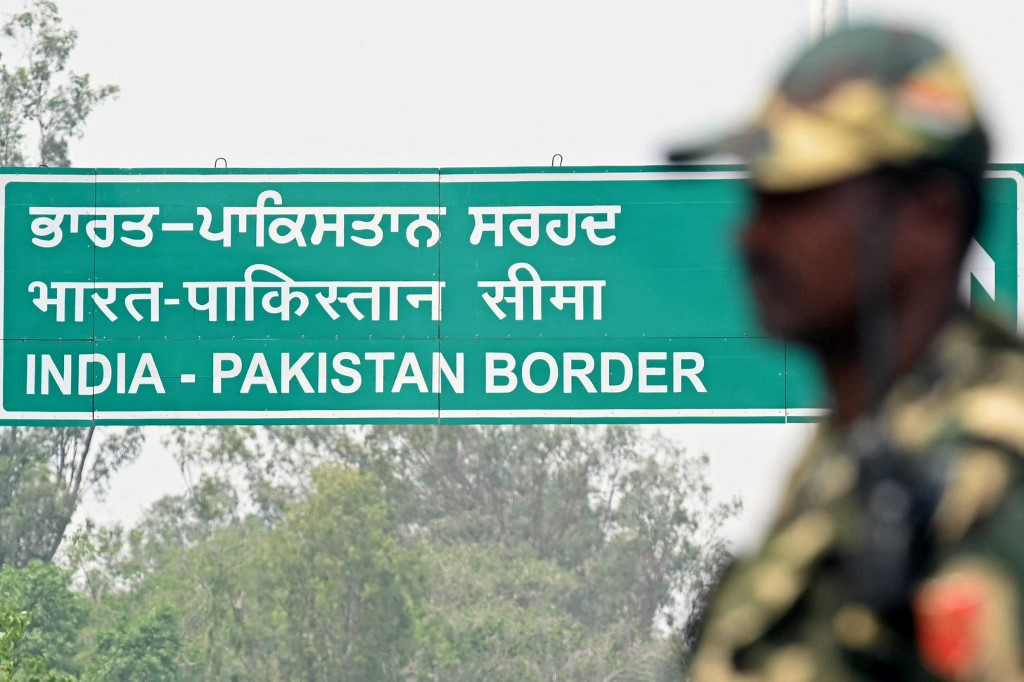 An Indian Border Security Force (BSF) soldier stands guard on May 9, 2025, near the India-Pakistan Wagah border post, about 35 kilometers from Amritsar in India. (AFP/Narinder Nanu)
F
or the past 10 years, India’s Bharatiya Janata Party (BJP) government has adopted a policy of complete disconnect with Pakistan. Even people-to-people and sporting links have been stopped. During this period, India has carried out three kinetic aggressions against Pakistan: September 2016, February 2019 and May 2025. As South Asia witnesses deepening estrangement, the world has moved on. Far-reaching strategic shifts have affected the geopolitics of West Asia, Europe and East Asia. The United States and Iran have fought a 40-day war and are now negotiating a peace settlement, helped by Pakistan and Qatar. The US and China have agreed to steer their competition towards “strategic stability”.
Four major factors have bedevilled bilateral ties since 1947: mutual mistrust, the unresolved dispute over Jammu and Kashmir, India’s use of terrorism to malign Pakistan and New Delhi’s pursuit of regional dominance in South Asia. Most recently, India’s decision to suspend the Indus Waters Treaty (IWT) further marred relations between the two countries.
How does one go from conflict to dialogue? Since Pakistan and India remain embroiled in kinetic confrontations below a nuclear overhang, there is an urgent need to come up with ways to defuse tensions during crises. The two countries are technically still at war because Operation Sindoor launched by India in May 2025 has not formally ended.
India also refuses to accept the role of third parties for conflict resolution. If another major crisis erupts, there could be serious implications for the people of both countries. Given that Pakistan and India possess lethal autonomous weapons like missiles and armed drones, and reaction time is critically short, any potential conflict could spiral out of control.
The only channel of communications is a weekly call between the Director General of Military Operations (DGMOs) of the two countries. So, it’s important that both states institute additional channels of communication to address crisis situations. For instance, they could put national security advisors in regular contact. Another useful measure could be for high commissioners to return to their positions.
There’s an urgent need to find ways to defuse tensions during crises.

Beyond crisis management, the two countries should think about installing dedicated backchannel links. One such backchannel evolved a four-point formula to resolve the Kashmir dispute in 2007. At this point in time, a dedicated backchannel on water sharing could be important. Since April 23, 2025, India has held the IWT in abeyance. Legally, it cannot unilaterally suspend the treaty. The Court of Arbitration has already ruled that India’s decision was illegal. Although India attributes the treaty’s suspension to alleged cross-border terrorism, the real reason seems to be its attempt to complete several projects on the three western rivers allocated to Pakistan and to force the latter to renegotiate the treaty.
Since the lives and livelihoods of millions of Pakistanis depend on the Indus, Jhelum and Chenab, Pakistan has declared that any disruption or diversion of the waters would be dee-med an act of war. That means, the longer India continues with its plans to disrupt waters meant for Pakistan, the higher the chances of another major confrontation. As for India’s desire to renegotiate the treaty to factor in demographic and environmental considerations, it should first restore the IWT and then negotiate with Pakistan any suggested amendments that could be incorporated as an addendum to the treaty.
Other possible measures to build mutual confidence could include the resumption of some people-to-people contacts, such as through pilgrimages, medical treatment and divided families’ reunions. South Asia’s climate vulnerability is also an opportunity to work together for the common good.
If the US sanctions on Iran are lifted, India could review its earlier decision to pull out of the Iran-Pakistan-India (IPI) gas pipeline. Likewise, Turkmenistan-Afghanistan-Pakistan-India (TAPI) has potential benefit for both countries. Suggestions have also been made for India to consider reviving Saarc — a forum which has traditionally provided avenues to defuse tensions and promote cooperation. India views Saarc as a platform where relatively smaller states team up to counter-balance India. If India does not shed this narrow viewpoint, Pakistan and Bangladesh might join hands with China to promote regional cooperation.
Since Narendra Modi government has taken a policy decision not to engage with Pakistan, the gulf is growing rapidly. In this situation, while keeping its doors open for dialogue, Pakistan has no choice but to remain prepared for any misadventure by New Delhi to possibly avenge India’s defeat in May 2025. Meanwhile, Pakistan needs to focus on its own economic security through better governance, continuity of economic policies and connectivity projects with friendly countries.
---
The writer is chairman of Sanober Institute.