The Jakarta Post
Please Update your browser
Your browser is out of date, and may not be compatible with our website. A list of the most popular web browsers can be found below.
Just click on the icons to get to the download page.


Popular Reads
Top Results
No results found. Please check your search term and try again
Can't find what you're looking for?
View all search results
Popular Reads
Top Results
No results found. Please check your search term and try again
Can't find what you're looking for?
View all search resultsThe new fragmentation: From Cabinet politics to institutional rivalries
As institutional rivalries and overlapping intelligence mandates intensify, President Prabowo faces a critical test: preventing the fragmentation of the Indonesian state itself.
Change text size
Gift Premium Articles
to Anyone
Share the best of The Jakarta Post with friends, family, or colleagues. As a subscriber, you can gift 3 to 5 articles each month that anyone can read—no subscription needed!
 Set as preferred source
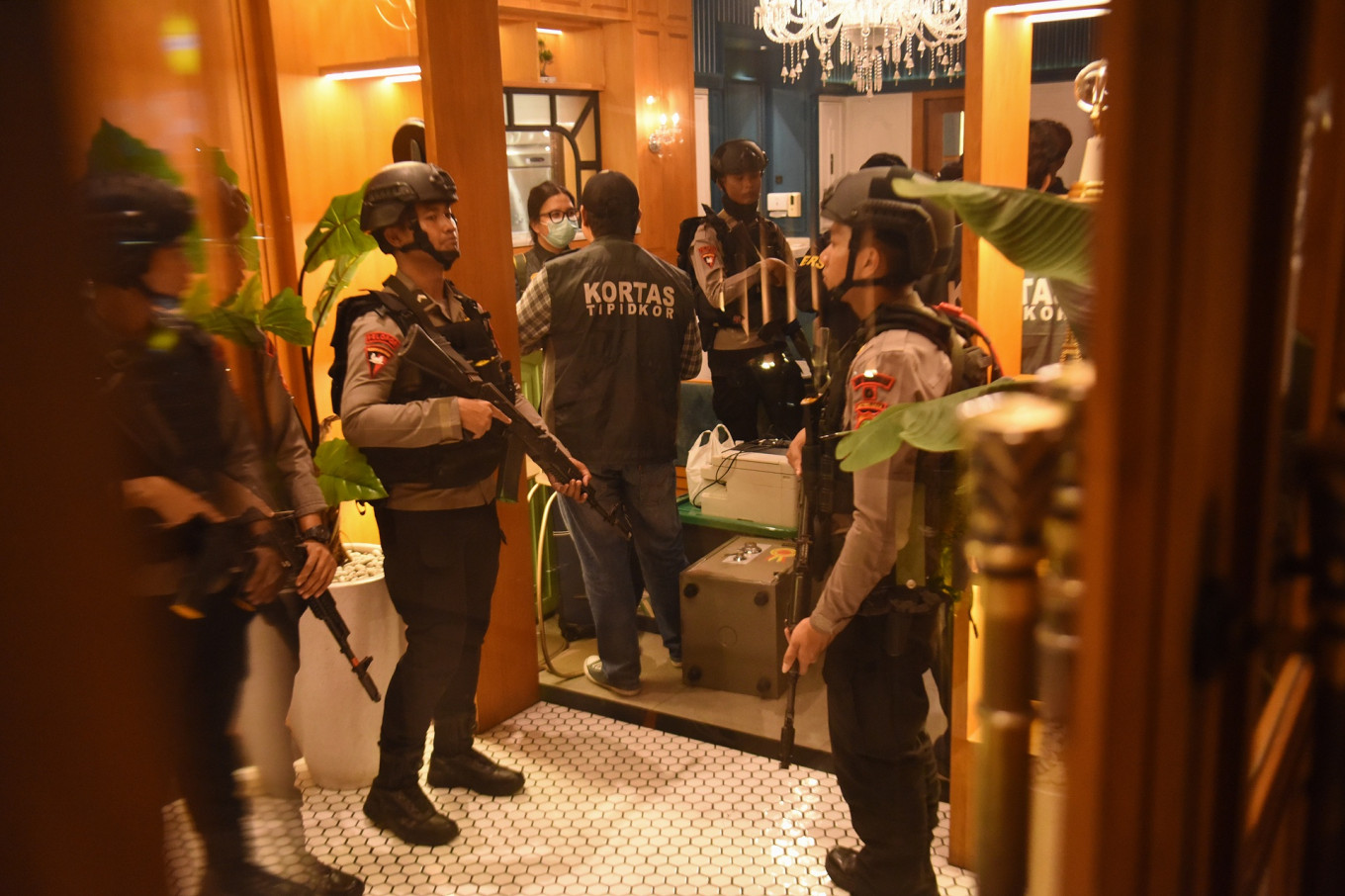 Police officers stand guard near seized evidence during a search conducted in a café in Cipete, South Jakarta on July 8, 2026. Investigators of the National Police's Corruption Eradication Corps and Jakarta Police seized evidence as part of an investigation of an alleged corruption pertaining to coal supply. (Antara/Indrianto Eko Suwarso)
W
hen I wrote about "fragmented governance" in this newspaper in December 2025, my analysis focused on the political configuration of the Prabowo Subianto administration. Built upon a massive coalition, this strategy of embracing nearly all political forces successfully stabilized the post-election landscape. However, beneath that stability lay an inevitable consequence: a growing number of power centers requiring simultaneous management.
By mid-2026, this fragmentation entered a new phase. While the friction previously centered on cabinet configurations and political coalitions, public attention has shifted toward dynamics within the state apparatus itself. Specifically, the tension now involves institutions vested with law enforcement authority, intelligence functions and the use of the state's coercive instruments.
A series of recent events illustrates this trend. The raid on Cafe de'Clan Signature by the National Police’s Corruption Eradication Task Force revived memories of the 2024 surveillance incident involving the Junior Attorney General for Special Crimes, Febrie Adriansyah. Concurrently, reports emerged that Indonesian Military (TNI) soldiers were guarding Febri’s residence amid rumors of an impending raid. On Saturday, the Attorney General's Office (AGO) announced Febrie's resignation and named Rudi Margono as his temporary replacement. .
Indonesia Police Watch reported allegations that a TNI general visited the Jakarta Police regarding witnesses and evidence in major corruption cases, specifically involving coal supplies to state utility PLN, money laundering at state insurance company PT Asabri and corruption at state steelmaker PT Krakatau Steel.
Meanwhile, an investigation into the free nutritious meals program resulted in a police brigadier general, currently serving at the National Nutrition Agency (BGN), being named a suspect.
Each case involves a distinct legal context and must respect the presumption of innocence. However, occurring in close succession, these events lead the public to interpret law enforcement not merely as a judicial process, but through the lens of institutional politics.

In political science, this phenomenon aligns with the "bureaucratic politics" model. In Essence of Decision, Graham Allison explains that state organizations do not simply implement government policy; they inherently seek to preserve and expand their own influence, resources and institutional standing.