The Jakarta Post
Please Update your browser
Your browser is out of date, and may not be compatible with our website. A list of the most popular web browsers can be found below.
Just click on the icons to get to the download page.


Popular Reads
Top Results
No results found. Please check your search term and try again
Can't find what you're looking for?
View all search results
Popular Reads
Top Results
No results found. Please check your search term and try again
Can't find what you're looking for?
View all search resultsThe dangerous labeling of LGBTQ as a threat to national defense
By branding LGBTQ culture as a national security threat, Indonesia's new defense regulation triggers a dangerous constitutional contradiction that undermines the very human rights the state is sworn to protect.
Change text size
Gift Premium Articles
to Anyone
Share the best of The Jakarta Post with friends, family, or colleagues. As a subscriber, you can gift 3 to 5 articles each month that anyone can read—no subscription needed!
 Set as preferred source
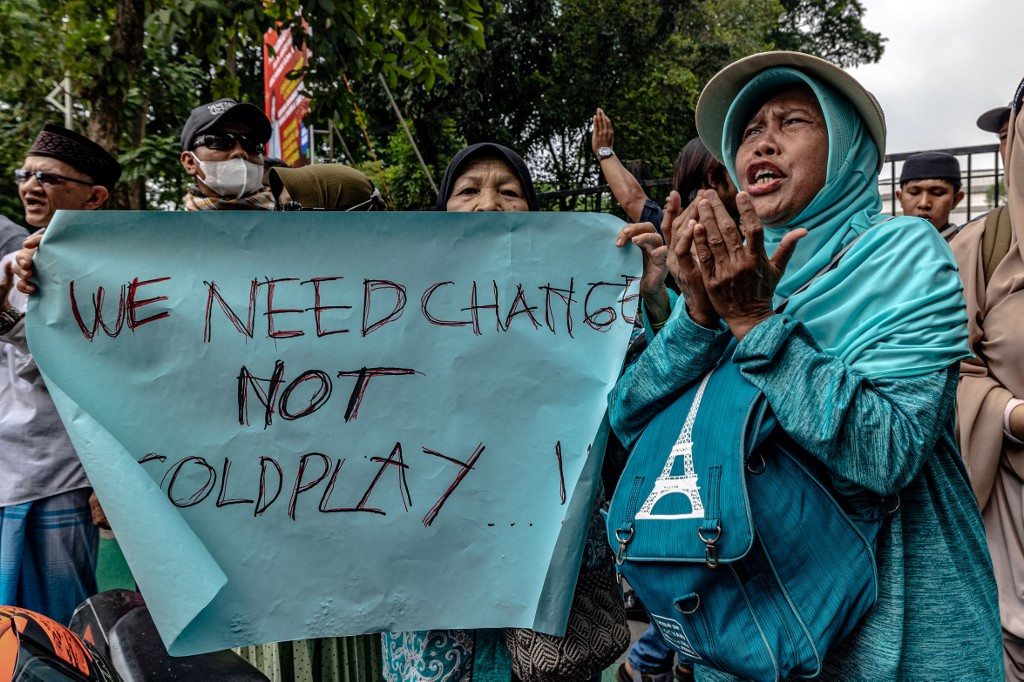 Protesters demand the cancellation of a concert by British rock band Coldplay, which the protesters say supports LGBTQ rights in violation of Muslim doctrine, near the Gelora Bung Karno stadium where the band was scheduled to perform on the same day, in Jakarta on Nov. 15, 2023.
(AFP/Mas Agung Wilis)
Protesters demand the cancellation of a concert by British rock band Coldplay, which the protesters say supports LGBTQ rights in violation of Muslim doctrine, near the Gelora Bung Karno stadium where the band was scheduled to perform on the same day, in Jakarta on Nov. 15, 2023.
(AFP/Mas Agung Wilis)
P
residential Regulation No. 111/2025 on the national defense policy for 2025–2029 makes a highly problematic move: it labels the spread of lesbian, gay, bisexual, transgender and queer (LGBTQ) culture as a "non-military threat" to the nation. Not only does this clash directly with international human rights standards, but it effectively promotes homophobia and greenlights state-sanctioned hostility against LGBTQ individuals and the activists who stand by them.
This labeling contradicts Indonesia's own legal definitions. Under Article 1(6) of Law No. 39/1999 on human rights, a rights violation is defined as any act, whether intentional or negligent, and whether committed by regular citizens or state officials, that unlawfully limits, obstructs or strips someone of their basic human rights.
Ironically, the very same Presidential Regulation (on pages 35–36) acknowledges that human rights violations are themselves a massive threat to national defense. The regulation explicitly warns that violating citizens' rights erodes public trust, damages Indonesia’s international standing, sparks social unrest, triggers mass protests and ultimately stalls the economy by scaring off foreign investment.
This glaring contradiction reveals a fundamental misunderstanding of the constitutional rights enshrined in the 1945 Constitution. Article 28I paragraph 4 clearly dictates that protecting, promoting, enforcing and fulfilling human rights is the absolute responsibility of the State, and specifically the government.
From a modern human rights standpoint, LGBTQ issues are addressed through the framework of sexual orientation, gender identity and expression. A person's sexual orientation and gender identity are core elements of their personal identity, falling squarely under fundamental rights. In fact, Article 28E(2) of the 1945 Constitution guarantees every Indonesian the right to freedom of belief and conscience, which includes the freedom to express thoughts and attitudes aligned with their inner convictions.
On the world stage, the definitive blueprint for these protections is the Yogyakarta Principles. Adopted in 2007 right here in Indonesia, this landmark document was drafted by 29 world-renowned legal experts from 25 countries, including heavyweights like former United Nations High Commissioner for Human Rights Mary Robinson and former UN Special Rapporteur Manfred Nowak.

The Principles simply apply universally recognized human rights to the realities of sexual orientation and gender identity. They build on the foundational truth that all human beings are born free and equal in dignity and rights, meaning everyone deserves these protections regardless of race, color, sex, religion or sexual orientation.