The Jakarta Post
Please Update your browser
Your browser is out of date, and may not be compatible with our website. A list of the most popular web browsers can be found below.
Just click on the icons to get to the download page.


Popular Reads
Top Results
No results found. Please check your search term and try again
Can't find what you're looking for?
View all search results
Popular Reads
Top Results
No results found. Please check your search term and try again
Can't find what you're looking for?
View all search resultsTurning IEU-CEPA into lasting economic gain
Ratification, implementation and utilization are often less celebrated than negotiations, but they are the stages that translate ambition into meaningful outcomes.
Change text size
Gift Premium Articles
to Anyone
Share the best of The Jakarta Post with friends, family, or colleagues. As a subscriber, you can gift 3 to 5 articles each month that anyone can read—no subscription needed!
 Set as preferred source
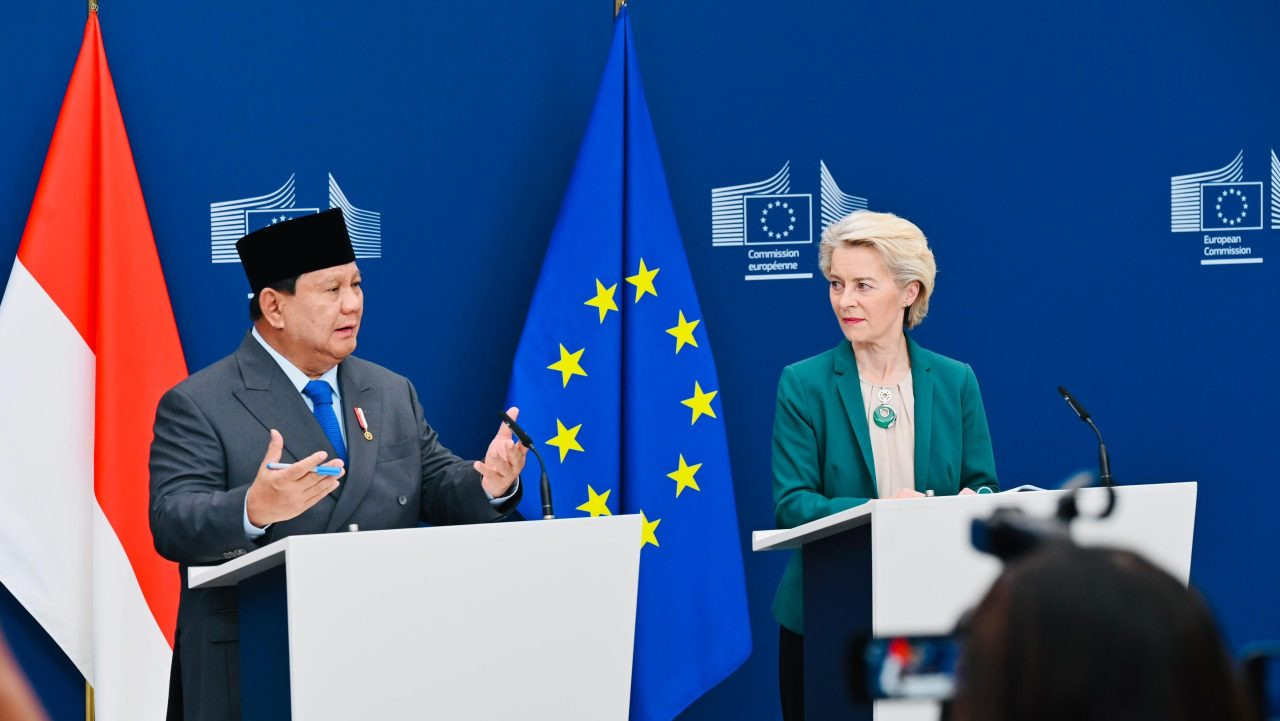 President Prabowo Subianto (left) and European Commission President Ursula von der Leyen announce the 'political agreement' of the Indonesia-EU Comprehensive Partnership Agreement (IEU-CEPA) on July 14, 2025, in Brussels. (Presidential Secretariat Press Bureau/Laily Rachev)
S
ome milestones are so significant that they create the illusion of arrival. In reality, they merely reveal the road ahead. Last year, Indonesia and the European Union achieved what many once thought would remain elusive. After nearly a decade of negotiations, both sides concluded the Indonesia-European Union Comprehensive Economic Partnership Agreement (IEU- CEPA), opening the door to what could become one of the most consequential economic partnerships for Indonesia in the coming decades.
Yet the value of any agreement is ultimately determined by what follows. Ratification, implementation and utilization are often less celebrated than negotiations, but they are the stages that translate ambition into meaningful outcomes.
That message resonated throughout Apindo’s recent business mission to Europe, where we engaged policymakers, business leaders and strategic stakeholders across Amsterdam, The Hague, Brussels and Paris. While discussions covered trade, investment, sustainability and industrial cooperation, a common theme emerged across our engagements: momentum matters, and so does what come next.
Strengthening Indonesia's position as a regional manufacturing and supply-chain base for European businesses serving the wider Asia-Pacific market is perhaps the most consequential opportunity created by IEU-CEPA. As global production networks continue to diversify, the agreement provides a stronger foundation for investment, industrial partnerships and deeper integration into regional and global value chains, reinforcing Indonesia's competitiveness as a long-term production base rather than simply a trading partner.
Europe already represents an important source of long-term capital. Collectively, EU member states ranked as Indonesia's seventh-largest source of foreign direct investment in 2025, with realized investment reaching US$2.37 billion. Much of this investment has flowed into chemicals and pharmaceuticals, real estate and industrial estates, hospitality, trade and business services. Yet the distribution of investment also reveals significant opportunities ahead. Several strategic sectors, including manufacturing, mining, forestry, construction, textiles, footwear, wood processing and fisheries, each account for less than 1 percent of total EU investment realization.
These sectors also hold the key to Indonesia's future growth. Downstream industrialization, the energy transition, digital industries, electric vehicles and battery ecosystems, the creative economy and healthcare supply chains represent the next frontier for European investment while supporting Indonesia's long-term economic transformation.

Services will become an equally important part of this transformation. Modern supply chains depend on efficient logistics, digital infrastructure, finance, professional services, engineering, certification, research and development and after-sales support. As manufacturing becomes increasingly integrated across borders, stronger cooperation in services will enable businesses to operate more efficiently, accelerate technology transfer and create higher value throughout the production ecosystem.