The Jakarta Post
Please Update your browser
Your browser is out of date, and may not be compatible with our website. A list of the most popular web browsers can be found below.
Just click on the icons to get to the download page.


Popular Reads
Top Results
No results found. Please check your search term and try again
Can't find what you're looking for?
View all search results
Popular Reads
Top Results
No results found. Please check your search term and try again
Can't find what you're looking for?
View all search resultsWhen university access depends on the family wallet
When university admission is earned by merit but decided by the wallet, Indonesia doesn't just lose students—it forfeits its future.
Change text size
Gift Premium Articles
to Anyone
Share the best of The Jakarta Post with friends, family, or colleagues. As a subscriber, you can gift 3 to 5 articles each month that anyone can read—no subscription needed!
 Set as preferred source
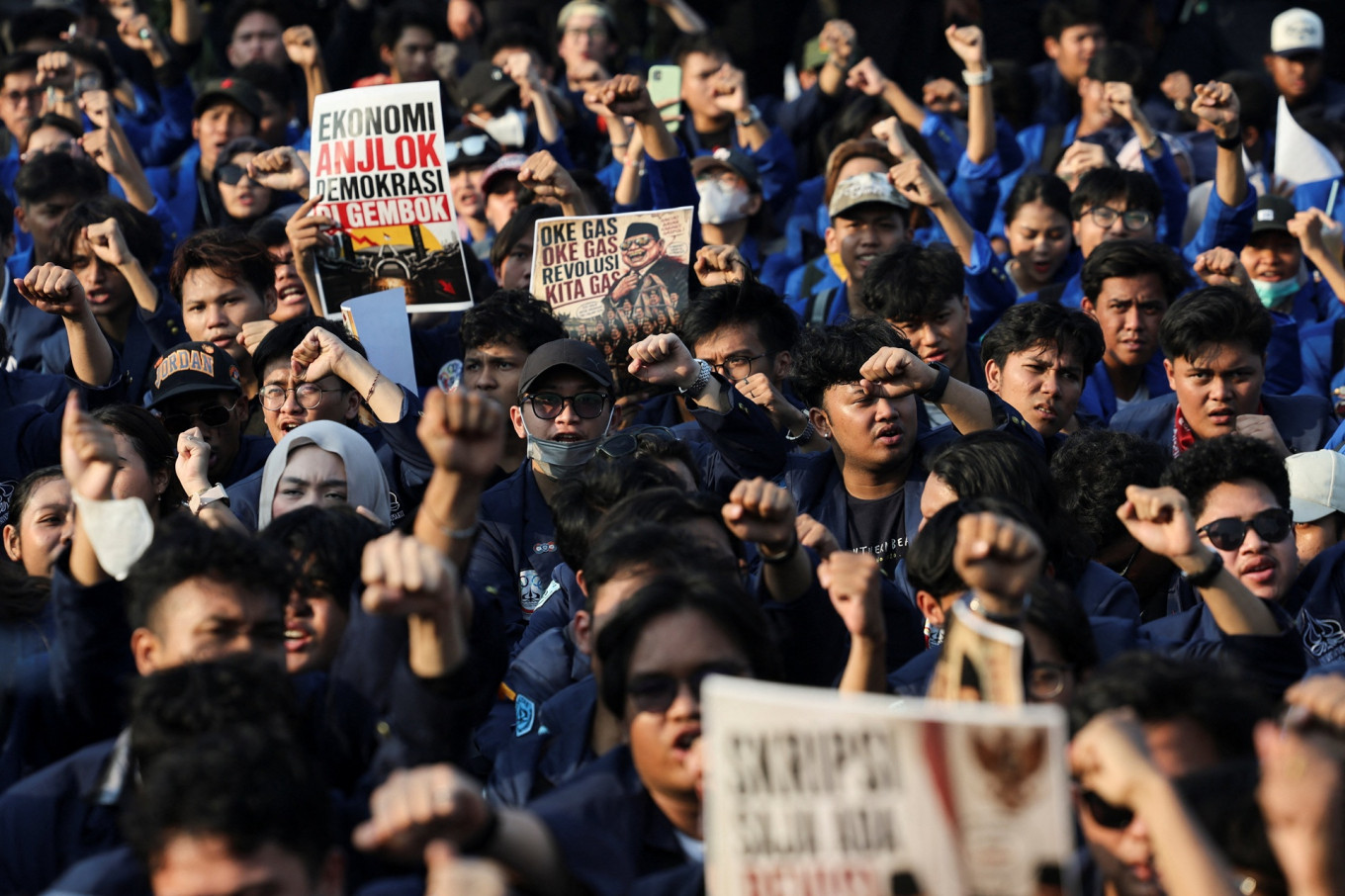 University students hold placards during a protest outside the Senayan legislative complex in Jakarta on June 19, 2026.against government policies, including state budget spending, fuel price hike, free nutritious meal program and expanded military roles in civilian affairs. (Reuters/Ajeng Dinar Ulfiana)
E
very year, we celebrate the students who pass the fiercely competitive selection process for public universities. Yet, a critical piece of the narrative is routinely overlooked: those who earn a seat but never arrive.
Reportedly, roughly 60,000 applicants accepted into state universities ultimately fail to reregister. These individuals are not rejected by the admissions system; they are stopped after the fact by tuition bills, living costs, mismatched programs, or delayed scholarship verifications. Consequently, the country is losing vital talent not at the examination gate, but at the payment counter.
Higher education should serve as the bridge between ability and opportunity. When admitted students must withdraw because their families cannot afford the fees, that bridge effectively becomes a toll road. For a country that has positioned Golden Indonesia 2045 at the center of its national vision, this is no minor administrative hiccup. It is a stark warning about the socio-economic barriers embedded within the nation's development model.
The systemic pressure is already intense. While applications via academic achievement routes have risen sharply, public university capacity remains strictly limited. Given that only about one in five applicants secures admission, every surrendered seat represents a young person who cleared the academic hurdle but tripped over the financial one.
This barrier is particularly pronounced in high-demand programs such as medicine, where single-semester tuition can reach tens of millions of rupiah, and independent admission pathway contributions (uang pangkal) can climb exponentially higher. Merit may open the door, but capital increasingly determines who is permitted to walk through it.
This crisis highlights the friction between public policy and household economics. While the KIP Kuliah scholarship program was designed as a social safety net, many families fall just outside its rigid thresholds. The poorest students may qualify, but vulnerable, lower-middle-income households are frequently classified as "not poor enough" for aid, despite being entirely unable to afford full tuition. For these families, falling into the fifth income decile is not a mere statistical classification; it is a financial cliff edge.

Macroeconomic volatility has rendered this blind spot increasingly dangerous. Layoffs, business closures, and sudden income shocks can push households into vulnerability far faster than official data systems can track. When welfare registries are updated too slowly, universities and scholarship administrators make life-altering decisions based on a family’s past financial status rather than its current capacity to pay.