The Jakarta Post
Please Update your browser
Your browser is out of date, and may not be compatible with our website. A list of the most popular web browsers can be found below.
Just click on the icons to get to the download page.


Popular Reads
Top Results
No results found. Please check your search term and try again
Can't find what you're looking for?
View all search results
Popular Reads
Top Results
No results found. Please check your search term and try again
Can't find what you're looking for?
View all search resultsWhat Indonesian classroom never received
Indonesia’s chronic educational underperformance will never be solved by a top-down curriculum updates. Until policymakers focus on rebuilding foundational cognitive habits, like attention spans and reading stamina, long before students reach university, each new ministerial launch will simply deliver a fresh document to the same broken classroom.
Change text size
Gift Premium Articles
to Anyone
Share the best of The Jakarta Post with friends, family, or colleagues. As a subscriber, you can gift 3 to 5 articles each month that anyone can read—no subscription needed!
 Set as preferred source
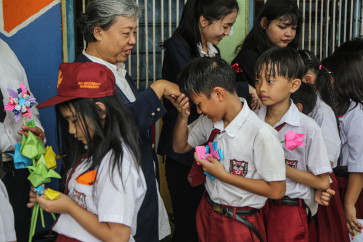
 Students kiss their teacher’s hands during a Teacher's Day celebration at an elementary school in Semarang, Central Java, on Nov. 25, 2025. The event, held under the theme “Great Teachers, Strong Indonesia” and attended by hundreds of students, aimed to help them better understand the teaching profession so they could be inspired to follow in their teachers’ footsteps. (Antara/Makna Zaezar)
A
t a local roadside stall, a secondary school student lifts a smartphone to calculate the total for five young coconuts at Rp 11,000 (62 US cents) each and two medicinal coconuts at Rp 15,000 each. While a solitary vignette does not prove national decline, it illustrates a profound shift: basic mental operations are increasingly outsourced to digital devices long before formal schooling has a chance to take root.
This matters because classrooms do not receive a blank slate. By the time a child enters primary school, their capacity for attention, patience, recall, and self-command already possesses a history. The family is where these foundational habits first take shape.
Consequently, the core issue extends far beyond whether a teenager should use a phone; it is a question of cognitive formation. A school can readily teach content, but it faces a much steeper climb when attempting to rebuild reading stamina, number sense, patience, and self-regulation after those faculties have been left to atrophy for years. By the time this cognitive weakness becomes visible in high school or university, the structural damage is already old.
Indonesia has spent two decades measuring this downstream result. In the 2022 Programme for International Student Assessment (PISA), the country scored 366 in mathematics, 383 in science, and 359 in reading. The mathematics score sat only marginally above Indonesia’s 2003 level, while reading comprehension lagged severely behind the OECD average. Yet, while these scores arrived with predictable regularity, the underlying diagnosis never truly sank into daily classroom practice.
Instead, the official response has routinely favored structural resets: introducing another curriculum, adopting new educational jargon, and ordering a top-down overhaul. Throughout the post-authoritarian reform era, schools have cycled through the Competency-Based Curriculum (KBK), the School-Based Curriculum (KTSP), Curriculum 2013 (K-13), and most recently, Kurikulum Merdeka (Independent Curriculum). The specific sequence matters less than the underlying pattern: systemic weaknesses in student formation and teacher implementation are persistently met with bureaucratic redesign at the apex. Indonesia alters its policy documents far faster than it changes its classroom habits.
When a state apparatus cannot achieve the slow, painstaking work of human formation, it reaches for highly visible substitutes. Curriculum text substitutes for pedagogical clarity; programmatic launches substitute for rigorous teacher preparation; and bureaucratic compliance substitutes for real classroom judgment.

This reliance on external frameworks stands in sharp contrast to Indonesia’s own educational inheritance, which is too often treated as a historical symbol rather than an operating methodology. When Ki Hadjar Dewantara founded the Taman Siswa movement in 1922, he left behind a philosophy preserved in the education ministry’s own motto: ing ngarsa sung tuladha, ing madya mangun karsa, tut wuri handayani (to lead by example, to build resolve amidst the students, and to give encouragement from behind). This was never intended as a mere slogan; it was an explicit statement regarding the moral and formative role of the educator.