The Jakarta Post
Please Update your browser
Your browser is out of date, and may not be compatible with our website. A list of the most popular web browsers can be found below.
Just click on the icons to get to the download page.


Popular Reads
Top Results
No results found. Please check your search term and try again
Can't find what you're looking for?
View all search results
Popular Reads
Top Results
No results found. Please check your search term and try again
Can't find what you're looking for?
View all search resultsFTAs evolve into economic security agreements
Recognizing that uncertainty will persist, countries have begun incorporating provisions akin to “supply chain security clauses” into their FTAs to avoid disruptions in the supply of critical goods.
Change text size
Gift Premium Articles
to Anyone
Share the best of The Jakarta Post with friends, family, or colleagues. As a subscriber, you can gift 3 to 5 articles each month that anyone can read—no subscription needed!
 Set as preferred source
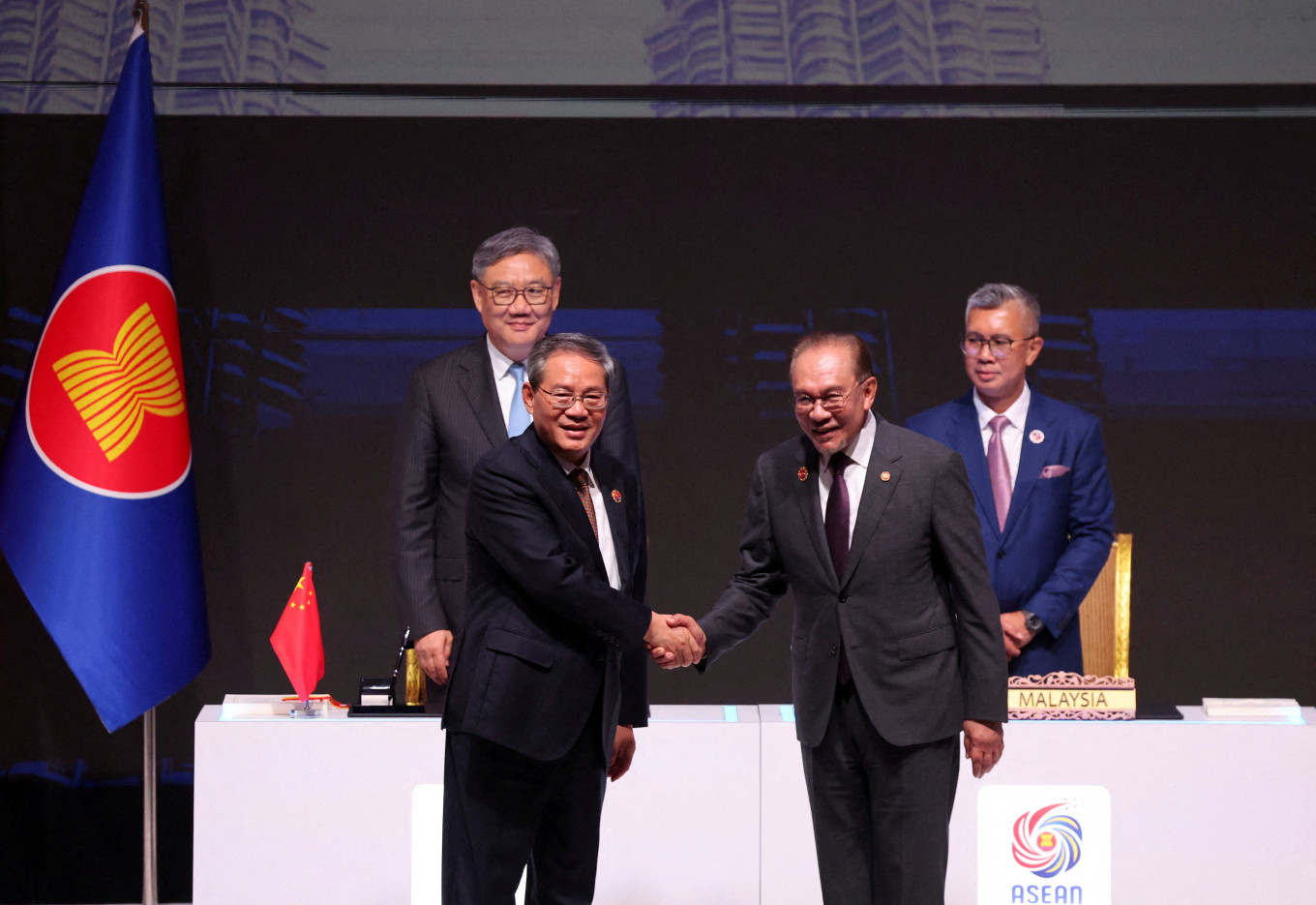 ASEAN chairman and Malaysia's Prime Minister Anwar Ibrahim (left) and Chinese Premier Li Qiang shake hands after witnessing the signing of the ASEAN-China Free Trade Area 3.0 Upgrade signed by Malaysian Trade Minister and ASEAN Economic Ministers Chairman Tengku Zafrul Aziz and Chinese Commerce Minister Wang Wentao ahead of the 28th ASEAN–China Summit, held as part of the 47th ASEAN Summit in Kuala Lumpur, Malaysia, on Oct. 28, 2025. (Reuters/Hasnoor Hussain)
A
mid growing instability in the procurement of critical goods due to “weaponization of the economy”, such as export restrictions on rare earths, efforts are growing to incorporate supply chain provisions into free trade agreements (FTAs).
One example of this trend is the planned revision of the Comprehensive and Progressive Agreement for Trans-Pacific Partnership (CPTPP), which includes Japan, some members of ASEAN and the United Kingdom. FTAs are evolving into economic security agreements.
The global free trade system was established following the end of the Cold War and expanded with the World Trade Organization, which was launched in 1995, at its core.
However, conflicts of interest between developed and emerging nations are becoming increasingly complex. Emerging nations, led by China, have formed new spheres of influence such as BRICS, while the Doha Round, a multilateral trade negotiation under the WTO, has effectively collapsed a quarter-century after negotiations began.
The United States-China trade war, marked by repeated exchanges of economic sanctions, has been escalating since the 2010s. The same is true of China’s economic coercion, symbolized by export restrictions on rare earths, and the weaponization of its economy.
Then, the imposition of tariffs by US President Donald Trump last year delivered the final blow, and the free trade system effectively collapsed after about 30 years. The global economy is now in a state of chaos, driven by a combination of protectionism and the US attack on Iran.

It would be premature to assume that the trade order will return to normal if a new US president takes office. By imposing “Trump tariffs,” the US secured a series of favorable agreements in negotiations with various countries, including expanded procurement of US products and market liberalization. There is virtually no reason for the country to actively reverse these situations, including the tariffs.
Recognizing that uncertainty will persist, countries have begun incorporating provisions akin to “supply chain security clauses” into their FTAs to avoid disruptions in the supply of critical goods. The world is undergoing a process of multi-polarization, with like-minded nations forming robust trade blocs and supply chains.
The nature of FTAs is no longer limited to traditional liberalization measures such as tariff elimination. They have begun to transform into “economic security agreements among like-minded nations.”
A prime example of this is Singapore’s trade agreements with New Zealand and Australia.
Singapore and New Zealand signed in May what their governments describe as the world’s first legally binding agreement on supply chain resilience. The agreement covers items such as food, fuel, medical supplies and chemicals, and it guarantees their supply to the other country even during supply chain disruptions or crises. The two countries plan to amend their bilateral FTA to include a provision prohibiting export restrictions.
In April, Singapore also reached a substantive agreement with Australia on a protocol covering economic resilience and essential supplies. Australia imports a significant portion of refined petroleum products, such as diesel, from Singapore, while Singapore relies on Australia for liquefied natural gas. By making supply to each other mandatory, the two countries aim to strengthen their mutual energy security.
According to media reports, Singaporean Prime Minister Lawrence Wong said at a press conference: “This is not just about managing today’s crisis. It is about building trusted supply lines for a more uncertain future.”
The Indo-Pacific Economic Framework for Prosperity (IPEF), which includes 14 countries such as Japan, US, South Korea and Vietnam, brought its supply chain agreement into effect in February 2024. It establishes an action plan to diversify sources of critical goods in peacetime and, in the event of crises such as disasters or pandemics, provides for emergency meetings to share information and discuss countermeasures.
There are also plans to amend the CPTPP to introduce new provisions for strengthening supply chain resilience. According to a Japanese government official, discussions on revisions have already begun, and the agreement is expected to include measures for member countries to enhance resilience and establish cooperation mechanisms during crises.
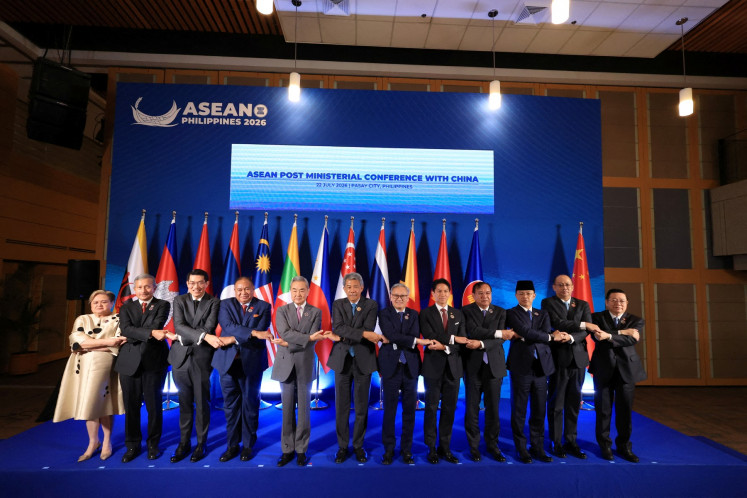
Last October, China and ASEAN revised their FTA to introduce new supply chain provisions. Japan views this as nothing but a formal maneuver designed to allow China to encircle ASEAN.
In 2027, the Regional Comprehensive Economic Partnership (RCEP) agreement, which includes Japan, China, South Korea and ASEAN member states, will be due for revision.
The purpose of the CPTPP review is to deter weaponization of the economy through unfair restrictions on exports of critical goods, and the RCEP review negotiations similarly aim to keep China in check.
Last November, ministers from CPTPP member countries held their first ministerial dialogues with ASEAN and the European Union, and strongly expressed their concerns regarding measures that hinder free trade and investment, as well as economic coercion. Furthermore, the CPTPP and the EU agreed to collaborate on strengthening supply chains and will hold their next meeting within the year to finalize a work plan for areas of cooperation.
If the two massive trading blocs of the CPTPP and the EU, both of which have high standard rules for trade liberalization, deepen their cooperation, it will serve as a major driving force toward restoring the fractured global trade order.
---
The writer is director and a senior writer at The Yomiuri Shimbun.