The Jakarta Post
Please Update your browser
Your browser is out of date, and may not be compatible with our website. A list of the most popular web browsers can be found below.
Just click on the icons to get to the download page.


Popular Reads
Top Results
No results found. Please check your search term and try again
Can't find what you're looking for?
View all search results
Popular Reads
Top Results
No results found. Please check your search term and try again
Can't find what you're looking for?
View all search resultsAnalysis: Lower unemployment rate masks labor market weakness
Change text size
Gift Premium Articles
to Anyone
Share the best of The Jakarta Post with friends, family, or colleagues. As a subscriber, you can gift 3 to 5 articles each month that anyone can read—no subscription needed!
 Set as preferred source
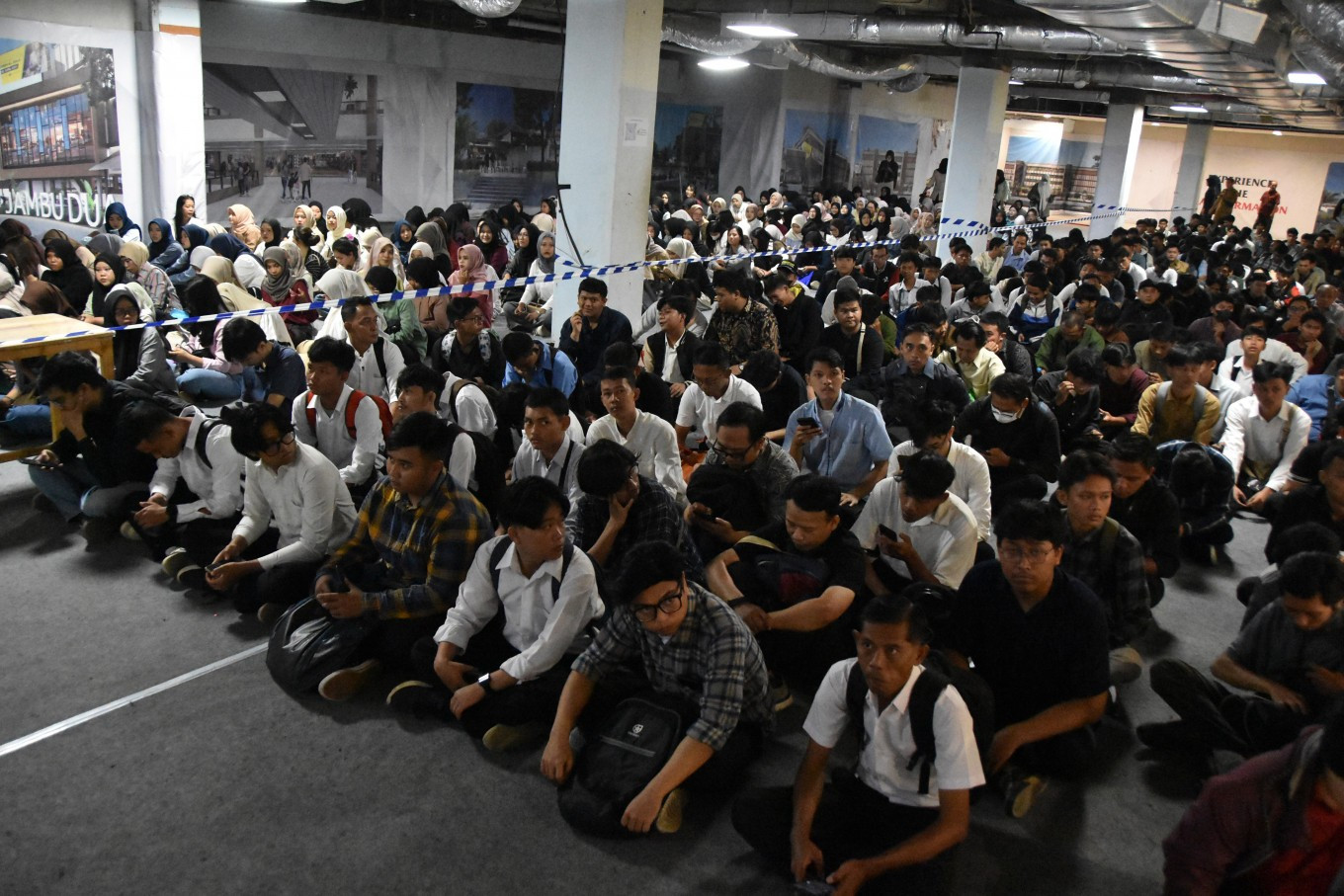 Job seekers wait in line during the opening of the 2026 Bogor Job Fair at Plaza Jambu Dua in Bogor, West Java, Indonesia, on June 8, 2026. (Antara/Arif Firmansyah)
I
ndonesia's labor market is sending mixed signals. Official data show unemployment declining, yet claims for unemployment and old-age benefits are surging, while job seekers now spend nearly 20 months on average searching for work. The contradiction raises a broader question: Is Indonesia’s labor market improving, or are conventional unemployment statistics failing to capture growing pressures beneath the surface?
Statistics Indonesia (BPS) reported an unemployment rate of 4.68 percent in February 2026, equivalent to around 40,000 fewer unemployed individuals than a year earlier. In contrast, the Workers Social Security Agency (BPJS Ketenagakerjaan) recorded a sharp increase in claims for old-age benefits (JHT) and unemployment benefits (JKP) during the first quarter of 2026, rising by 14.1 percent and 91 percent year-on-year, respectively. At the same time, a survey by the Institute for Economic and Social Research (LPEM) at the University of Indonesia (UI) found that job seekers need an average of 19.8 months to secure employment.
The unemployment rate published by BPS therefore provides only a partial picture of labor market conditions. Indonesia follows the International Labour Organization's (ILO) definition of employment, under which a person is considered employed if they work at least one hour during the reference week. While this definition is internationally accepted, it does not necessarily reflect whether employment provides sufficient income to sustain a decent standard of living.
The composition of employment also raises concerns. The share of workers employed in the formal sector declined slightly from 40.6 percent in February 2025 to 40.58 percent in February 2026. This continues a trend that emerged during the COVID-19 pandemic, when formal employment contracted and has yet to fully recover. Since February 2020, the labor force has expanded by 12.3 percent, while informal employment has grown by 18.5 percent.
By comparison, formal-sector employment increased by only 5.1 percent over the same period, indicating that the creation of formal jobs has failed to keep pace with labor force growth, particularly as Indonesia enters a period in which the working-age population accounts for an increasingly large share of the demographic structure.
The growing reliance on informal employment has important implications for worker welfare. Informal workers are generally less likely to receive social protection, employment insurance, minimum wage guarantees and legal protections. As a result, a larger informal workforce increases the risk that workers earn income below a decent living standard despite being classified as employed.

At the same time, finding a job is becoming increasingly difficult. According to LPEM UI, the average job-search duration in Indonesia now approaches 20 months. Educational attainment plays an important role in this process. High school graduates face the longest average job-search period, at around 21 months, compared with 16.7 months for diploma holders and 17.2 months for university graduates. Unsurprisingly, high school graduates account for the largest share of total unemployment, at 28 percent.