The Jakarta Post
Please Update your browser
Your browser is out of date, and may not be compatible with our website. A list of the most popular web browsers can be found below.
Just click on the icons to get to the download page.


Popular Reads
Top Results
No results found. Please check your search term and try again
Can't find what you're looking for?
View all search results
Popular Reads
Top Results
No results found. Please check your search term and try again
Can't find what you're looking for?
View all search resultsThe 'missing middle': Jakarta’s challenge ahead of its quincentenary
As Jakarta approaches its 500th anniversary, glowing infrastructure and plummeting poverty rates mask a fragile socioeconomic reality. The city's future will not be defined by its skyscrapers but by whether it can rescue its massive yet vulnerable aspiring middle class from permanent economic insecurity.
Change text size
Gift Premium Articles
to Anyone
Share the best of The Jakarta Post with friends, family, or colleagues. As a subscriber, you can gift 3 to 5 articles each month that anyone can read—no subscription needed!
 Set as preferred source
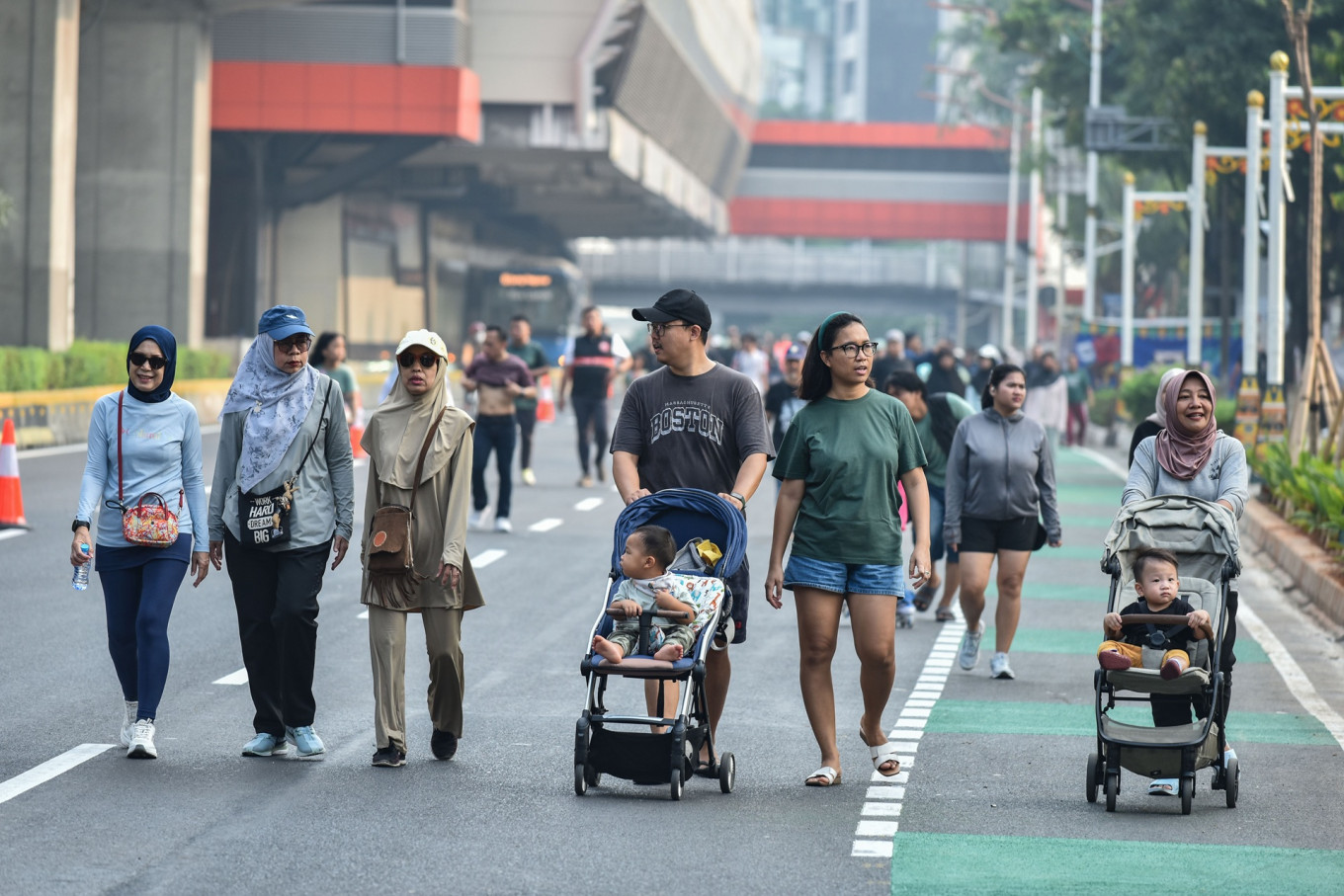 People walk for their health along Jl. Rasuna Said in South Jakarta during Car Free Day on June 21, 2026. (Antara/Fakhri Hermansyah)
T
he slogan for Jakarta’s 499th anniversary, “Moving Toward a New Era of Jakarta”, captures optimism as the city moves a step closer to its 500-year milestone. Yet beneath the narrative of progress, a more pressing question remains: Who is actually moving forward and who is still stuck in transition?
Jakarta is widely seen as an urban success story. Infrastructure has expanded rapidly, from mass transit systems to digital connectivity, reinforcing its position as Indonesia’s economic center. Poverty remains relatively low at 4.03 percent in September 2025, equivalent to around 439,000 people. From a conventional development perspective, this indicates significant progress in reducing deprivation.
However, poverty alone no longer defines Jakarta’s socioeconomic reality. The deeper issue lies in the structure of the middle. More than half the city’s population, around 50.5 percent, belongs to the aspiring middle class: households that are no longer poor but have not yet achieved stable, middle-class security.
Only around 22 percent of the city’s 11 million residents are established middle class, while just 1.6 percent are in the upper class. This composition reveals a structural imbalance: Jakarta is not anchored by a strong middle class; it is dominated by people still trying to become one.
This condition defines what can be called the “missing middle”. Far from merely being a statistical category, the missing middle represents a deep structural vulnerability. It defines households that have escaped poverty but remain exposed to economic shocks. They are employed, participate in consumption and contribute to economic activity, yet their position is fragile. A job loss, health emergency, rising education costs or inflationary pressure can easily push them backward. Their progress is real but not secure.
In development economics, this reflects a broader challenge faced by many middle-income economies. The World Bank has emphasized that the key development constraint is no longer only poverty reduction but also the creation of productive, stable and well-compensated jobs that enable sustained upward mobility. Without such transformation, the middle expands in size but not in stability.

Jakarta’s missing middle becomes more visible when viewed through inequality and consumption patterns. Based on the National Socioeconomic Survey (Susenas) September 2025, using the World Bank’s quintile approach, the distribution of consumption is highly concentrated. The top 20 percent of the population controls more than half of total household consumption in Jakarta, while the remaining 80 percent commands less than half of the city’s economic output. This indicates that while economic growth continues, its benefits are unevenly distributed.