The Jakarta Post
Please Update your browser
Your browser is out of date, and may not be compatible with our website. A list of the most popular web browsers can be found below.
Just click on the icons to get to the download page.


Popular Reads
Top Results
No results found. Please check your search term and try again
Can't find what you're looking for?
View all search results
Popular Reads
Top Results
No results found. Please check your search term and try again
Can't find what you're looking for?
View all search resultsA welcome peace deal
A fragile US-Iran peace deal brings global relief, but it leaves Indonesia with a stark wake-up call after a distant conflict reached into its kitchens and effectively turned off the lights in Jakarta.
Change text size
Gift Premium Articles
to Anyone
Share the best of The Jakarta Post with friends, family, or colleagues. As a subscriber, you can gift 3 to 5 articles each month that anyone can read—no subscription needed!
 Set as preferred source
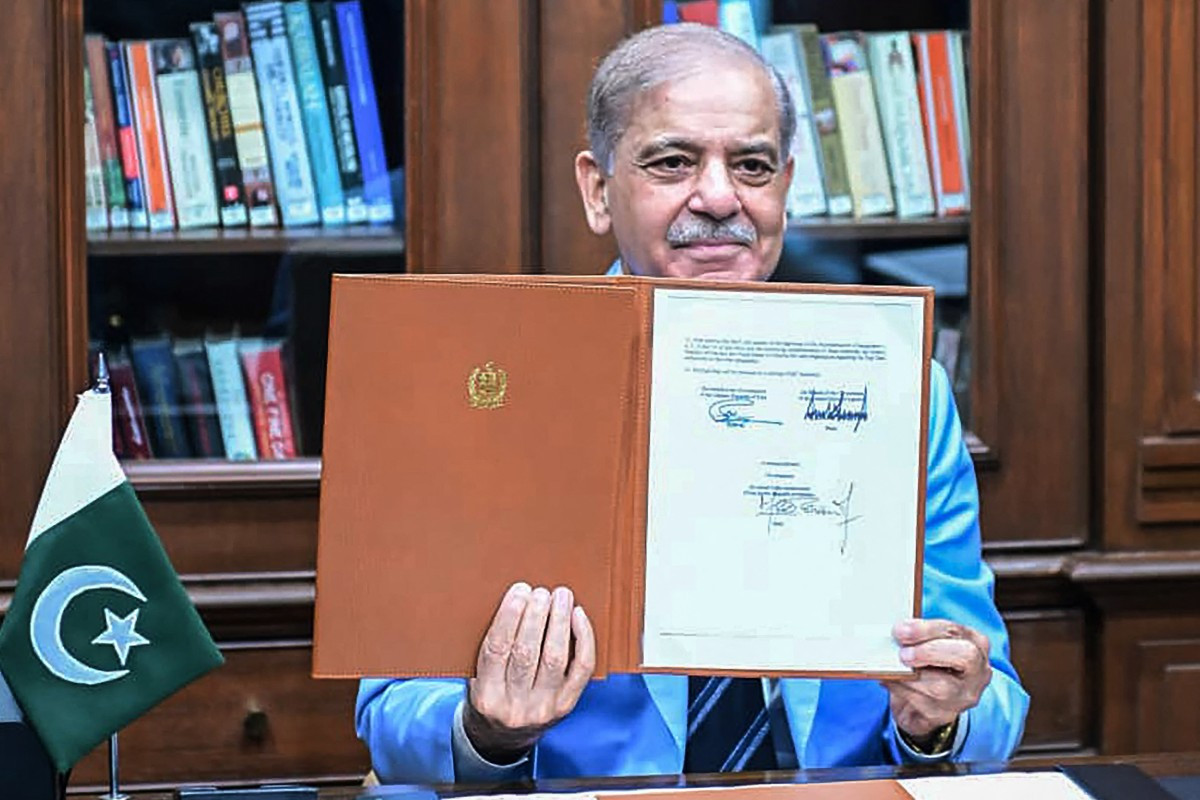 This handout photograph taken and released by Pakistan's Prime Minister's Office on June 18, 2026 shows Pakistan's Prime Minister Shehbaz Sharif holding the memorandum of understanding after signing it as a peace mediator to end the Middle East war, in Islamabad. The United States and Iran have signed a deal to end the Middle East war, with a ceremony set for June 19 in Switzerland that will mark the start of a 60-day negotiation period. The MoU aims to put an end to months of conflict initiated by US-Israeli strikes on Iran in February, which wreaked chaos across the region and rattled the global economy. (AFP/Pakistan's Prime Minister Office)
T
he signing of a memorandum of understanding between the United States and Iran on June 18 is, on balance, good news for the world and for Indonesia in particular.
The agreement, however fragile, halts military operations on all fronts, reopens the Strait of Hormuz and sets a 60-day clock for negotiations on Iran's nuclear program, sanctions relief and a US$300 billion reconstruction commitment.
On the first day of high-level talks in Switzerland on Monday, mediators Pakistan and Qatar said the US and Iran have agreed on “a roadmap for a final deal to be reached within 60 days”, as well as a “de-confliction cell” to ensure “military operations in Lebanon” will end.
After nearly four months of a conflict that the International Energy Agency (IEA) called the "greatest global energy security challenge in history", the prospect of normalcy deserves to be welcomed. And welcome it we do.
But we must also ask what Indonesia has learned.
The war began on Feb. 28 when the US and Israeli strikes killed Iran's supreme leader and triggered the closure of the Strait of Hormuz, the narrow choke point through which roughly 20 percent of the world's seaborne oil and significant volumes of liquefied natural gas must pass.

The consequences were not abstract. Brent Crude surged past $120 per barrel within days.