The Jakarta Post
Please Update your browser
Your browser is out of date, and may not be compatible with our website. A list of the most popular web browsers can be found below.
Just click on the icons to get to the download page.


Popular Reads
Top Results
No results found. Please check your search term and try again
Can't find what you're looking for?
View all search results
Popular Reads
Top Results
No results found. Please check your search term and try again
Can't find what you're looking for?
View all search resultsCommunication: The policy tool we keep forgetting
Change text size
Gift Premium Articles
to Anyone
Share the best of The Jakarta Post with friends, family, or colleagues. As a subscriber, you can gift 3 to 5 articles each month that anyone can read—no subscription needed!
 Set as preferred source
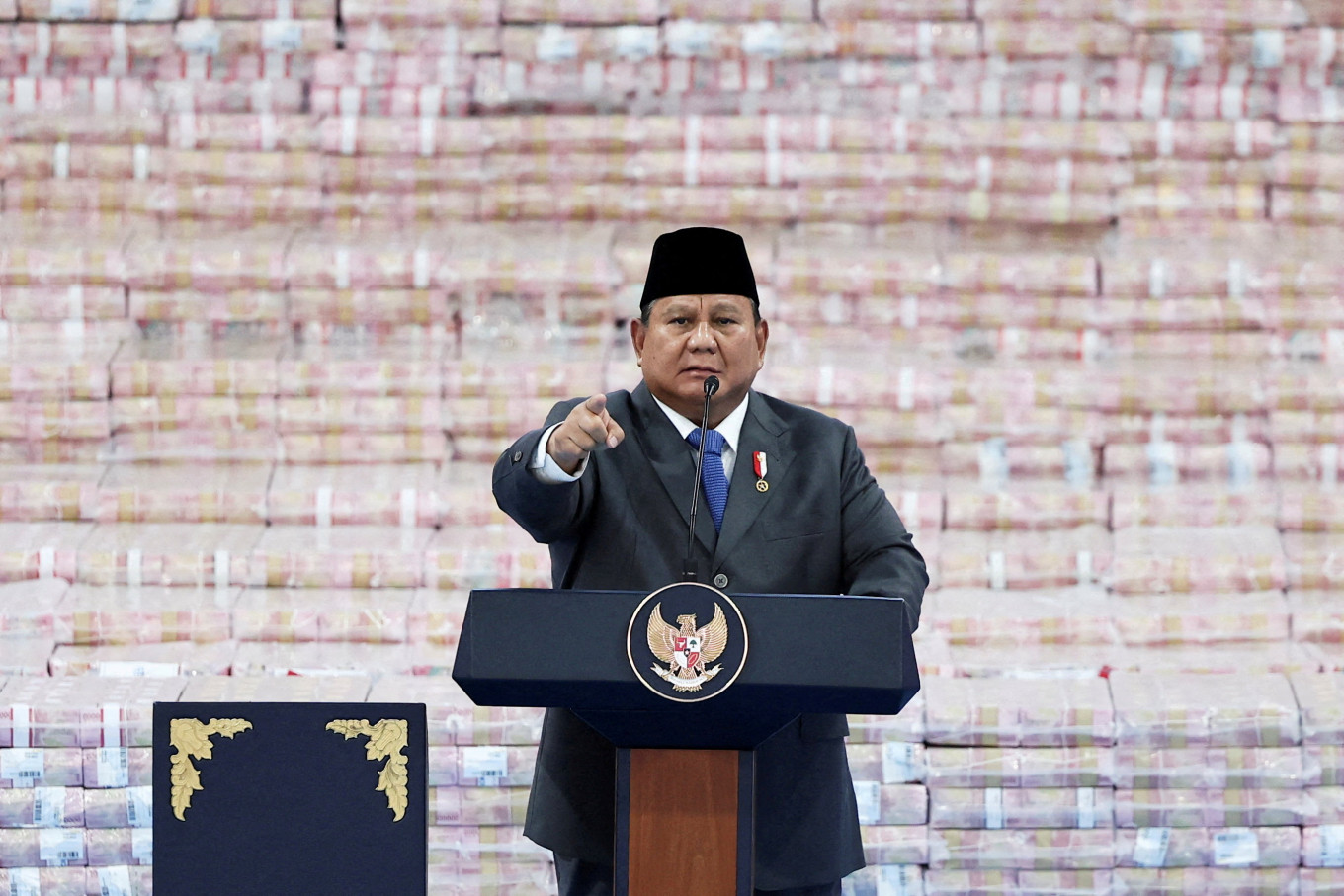 President Prabowo Subianto gestures on April 10 while delivering a speech in front of stacks of banknotes representing fines paid by companies found to have operated illegally in forest areas, during a ceremony marking the work of his forestry task force that has led to a crackdown on illegal plantations and mines, at the Attorney General’s Office (AGO) in Jakarta. (Reuters /Willy Kurniawan)
I
n today’s economy, a good policy can still fail if it isn’t explained well. And often, clear communication is what decides whether a policy succeeds or flops.
This year, Indonesia’s financial markets gave us a sharp reminder. When the rupiah slipped to around Rp 17,670 per United States dollar in May, markets watched two things: the steps taken by monetary authorities and the messages coming from government officials. Some remarks meant to calm the situation only fueled new debate. Public attention shifted from the policy itself to how the message was being read. In the meantime, Bank Indonesia (BI) had to inject about US$10 billion in reserves just to steady the market.
Then came the announcement that exports of palm oil, coal and nickel would be centralized through PT Danantara Sumberdaya Indonesia. The intent was clear: strengthen control over export earnings, increase state revenue, reduce under-invoicing and improve Indonesia’s position in global trade. But before the strategy was understood, markets interpreted it as more state intervention and more uncertainty.
Markets don’t just react to policies. They react to communication. In a modern economy, unclear messaging can spike volatility, weaken the currency, raise funding costs and make investors wait on the sidelines. Perception moves faster than policy.
I learned this firsthand leading a bank through the 1998 crisis. We had to merge eleven banks with different cultures and systems. I assumed the hardest part would be the technical work. It wasn’t. The real challenge was fear. Employees worried about their jobs. Customers worried about their savings. Investors and regulators questioned the new direction.
A consultant told me something I’ve never forgotten: transformation doesn’t succeed because of strategy alone. It succeeds when leaders can communicate change. Every change means moving into the unknown. Uncertainty creates anxiety. Anxiety creates resistance. Good communication is what turns anxiety into trust.

This isn’t just true for companies. It’s true for countries. In the early 1930s, America was in a deep crisis. Banks were collapsing, unemployment was rising and trust in government was breaking down. Franklin D. Roosevelt didn’t just launch the New Deal. He made communication central to it. Through his “Fireside Chats” on the radio, he explained what the government was doing, why it mattered and why people didn’t need to panic. Confidence returned. Money flowed back into banks. Calm replaced panic. Roosevelt proved that a policy’s success depends as much on how it’s explained as on how it’s designed.