The Jakarta Post
Please Update your browser
Your browser is out of date, and may not be compatible with our website. A list of the most popular web browsers can be found below.
Just click on the icons to get to the download page.


Popular Reads
Top Results
No results found. Please check your search term and try again
Can't find what you're looking for?
View all search results
Popular Reads
Top Results
No results found. Please check your search term and try again
Can't find what you're looking for?
View all search resultsHarnessing diaspora potential for sharia economy advancement
Indonesia is sitting on a trillion-dollar opportunity to turn its global diaspora into a powerhouse for the domestic sharia economy. By strategically leveraging knowledge, networks and Islamic financial instruments, the nation can transform this untapped potential into a definitive engine for long-term growth.
Change text size
Gift Premium Articles
to Anyone
Share the best of The Jakarta Post with friends, family, or colleagues. As a subscriber, you can gift 3 to 5 articles each month that anyone can read—no subscription needed!
 Set as preferred source
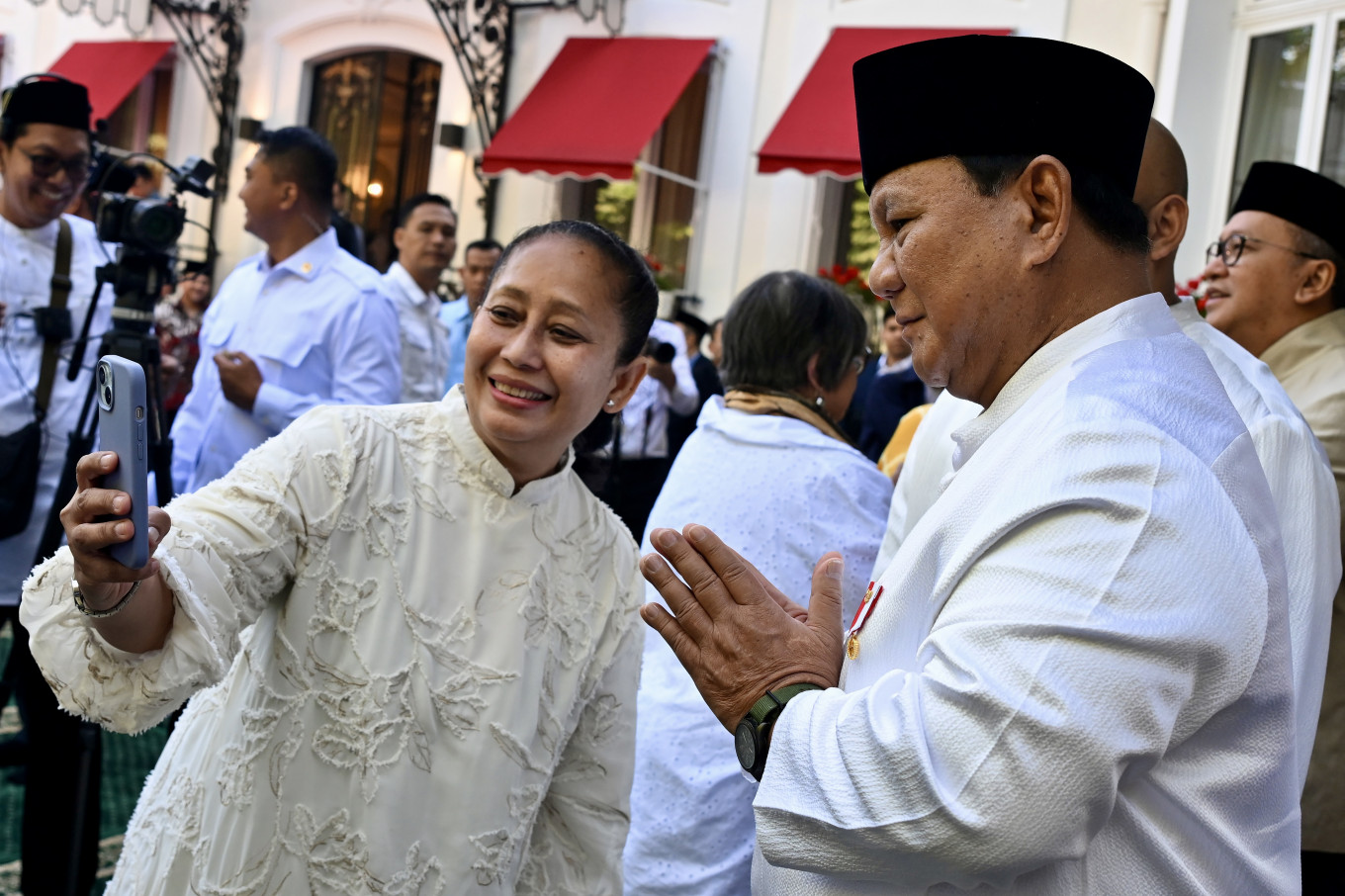 President Prabowo Subianto (right) takes a selfie with a member of the Indonesian diaspora on May 27, 2026, during an Idul Adha (Day of Sacrifice) celebration at Wisma Indonesia, the Indonesian Embassy Residence in Paris. (Antara/Handout/Presidential Secretariat Press Bureau)
W
ith the world's largest Muslim population, a substantial diaspora presence across key global markets and a stake in a global Islamic finance industry whose assets are projected to nearly double to US$9.75 trillion by 2029, according to Coalition Greenwich, Indonesia has both the incentive and the standing to treat diaspora engagement as a sharia economy priority.
Scholarly research presents two perspectives on the emigration of skilled individuals. Some studies view the departure of talent as a disadvantage for the home country, or brain drain, while other works position diaspora communities as crucial transformational agents capable of driving economic advancement in their countries of origin, or brain gain (Schotter and Abdelzaher, 2013; Prita, 2016).
For Indonesia, the weight of evidence suggests that “brain gain” is the more analytically productive framing. Doing so, however, requires a more systematic strategy than what currently exists. Harnessing this potential requires a strategy built around three pillars: knowledge, network and capital.
Knowledge refers to the transfer of expertise and best practices in Islamic finance, enabling local institutions to certify, innovate and develop sharia-compliant products at pace. Network involves leveraging cross-border relationships for business opportunities, collaborations and market access, drawing on the organized institutional infrastructure that Muslim diaspora communities uniquely possess.
Meanwhile, capital encompasses not only remittances but the distinctively Islamic financial instruments that diaspora communities are uniquely positioned to mobilize.
A primary channel through which diaspora communities impact the sharia economy is by facilitating the transfer of knowledge. This operates in both directions and across multiple sectors simultaneously.

Diaspora professionals bring technical and financial expertise from established sharia economy markets abroad, while those embedded in halal industries carry international best practices in certification, supply chain management and product development back home. Those concentrated in hubs such as Kuala Lumpur, Dubai and Riyadh are particularly well-positioned to bridge these flows, given the centrality of those markets to the global sharia economy.