The Jakarta Post
Please Update your browser
Your browser is out of date, and may not be compatible with our website. A list of the most popular web browsers can be found below.
Just click on the icons to get to the download page.


Popular Reads
Top Results
No results found. Please check your search term and try again
Can't find what you're looking for?
View all search results
Popular Reads
Top Results
No results found. Please check your search term and try again
Can't find what you're looking for?
View all search resultsWhy visual evidence matters in Indonesian activism
Today in Indonesia, graphic, violent images and videos often function as political evidence.
Change text size
Gift Premium Articles
to Anyone
Share the best of The Jakarta Post with friends, family, or colleagues. As a subscriber, you can gift 3 to 5 articles each month that anyone can read—no subscription needed!
 Set as preferred source
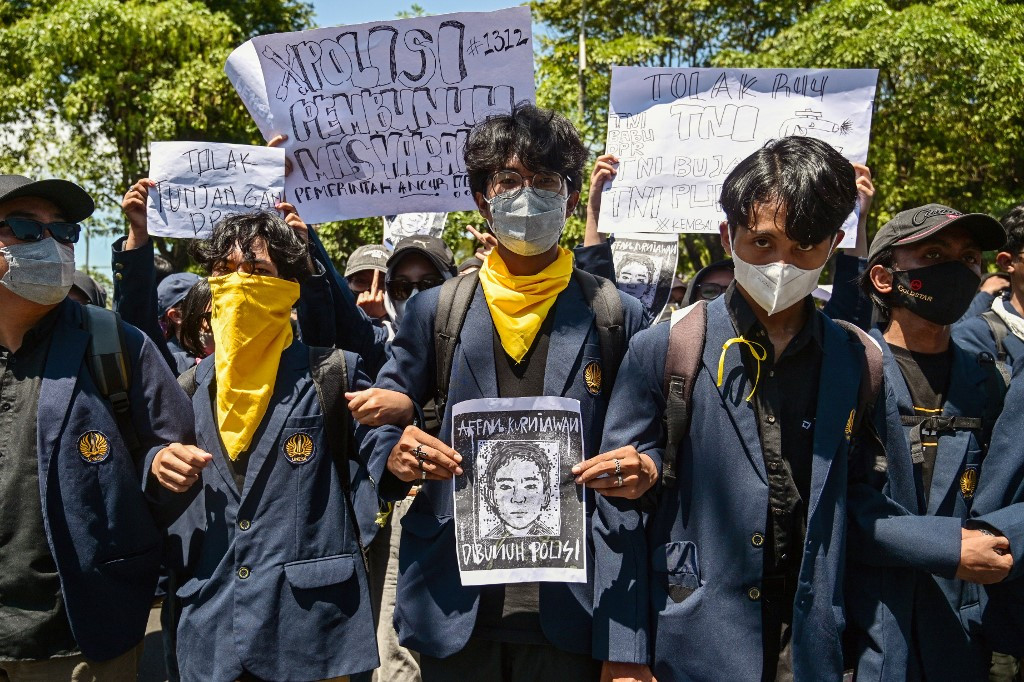 A demonstrator during a protest in front of the East Java Police headquarters in Surabaya, East Java, on Aug. 30, 2025, holds a portrait of Affan Kurniawan, an online motorcycle transportation driver who was run over by a police Mobile Brigade (Brimob) armored vehicle. (AFP/Juni Kriswanto)
A
viral video depicting a gravely injured 14-year-old boy lying on the asphalt sparked national outrage earlier this year. The boy, Arianto Tawakal, had reportedly been struck by a police officer and was later pronounced dead at a nearby hospital.
The case quickly drew comparisons to last year’s death of online motorcycle transportation driver Affan Kurniawan, who died after a police vehicle struck him during a protest. In both cases, public anger intensified not only because of the violence itself, but also because the incidents were captured and circulated online.
These two incidents show how, in Indonesia, graphic videos now function as political evidence. Images depicting serious injuries or death can quickly draw attention and pressure authorities to respond. But this growing dependence on violent imagery also reveals a deeper issue: declining public trust in state institutions to deliver accountability on their own.
This raises an important question: what kind of democracy requires viral and brutal images to demand justice?
The connection between violence and political imagery in Indonesia did not begin with social media.
During Soeharto’s authoritarian New Order regime (1966–1998), the state tightly controlled how violence was represented and understood by the public.

One of the clearest examples was Pengkhianatan G30S/PKI, a state-sponsored propaganda film about the attempted coup of Sept. 30 1965. The film portrayed members of the Indonesian Communist Party (PKI) as sadistic and inhumane through graphic depictions of torture and mutilation, acts that historians have since found little evidence to support.
For decades, the film was screened annually and made mandatory viewing for students. It obscured historical reality: the anti-communist mass killings that followed the coup attempt, which left more than 500,000 people dead. These killings remain underacknowledged in many official narratives today.
The point here is not that today’s viral videos are simply a continuation of New Order propaganda. Rather, the regime established a broader political logic: violence could be made meaningful through images.
Graphic representations of violence became tools for shaping public perception, defining who was dangerous, who counted as a victim and whose suffering deserved attention.
The fall of the New Order regime in 1998 transformed Indonesia’s media landscape. Citizens gained greater freedom to document and circulate their own political narratives, including evidence of state violence.
At the time, the Reform movement promised a more transparent and accountable democracy. Yet, many today still perceive persistent patterns of impunity, including the repression of protesters, intimidation of critics and unresolved past human rights violations.
In this context, videos recorded on mobile phones often serve as counter-narratives to official statements. When institutional trust is weak, visual evidence becomes a way for citizens to verify events for themselves.
This explains why videos, such as the footage involving Arianto and Affan, carry significant political force. The circulation of graphic footage makes it difficult for authorities to easily dismiss or downplay the violence.
However, reliance on graphic imagery also creates ethical problems.
When societies begin to expect visual proof of violence, there can be pressure to produce graphic evidence to gain public attention or legitimacy. This risks reducing suffering to something that must first be seen before it is believed.
This tension was visible in discussions surrounding the mass rapes during the May 1998 riots. Public demands for “proof” of the assaults led to the circulation of unrelated pornographic and gory images falsely presented as evidence. When these images were later proven inauthentic, skeptics used this to cast doubt on the rapes themselves.
As a result, the credibility of survivors became entangled with the authenticity of images they had never even consented to.
A similar ambiguity persists today. Graphic videos can expose abuse and strengthen public accountability. But they can also turn violence into a spectacle, something consumed, shared and repeatedly watched online, rather than actually understood.
In this environment, public moral urgency risks becoming tied less to the injustice itself and more to the visual intensity of the evidence.
The deeper concern is that Indonesians increasingly feel they need viral images of suffering before authorities will respond at all.
We cannot stop people from documenting violence or sharing graphic videos, but we urgently need to build a society where such evidence is no longer a prerequisite for justice.
---
The writer is a PhD candidate at Monash University. This article is republished under a Creative Commons license.