The Jakarta Post
Please Update your browser
Your browser is out of date, and may not be compatible with our website. A list of the most popular web browsers can be found below.
Just click on the icons to get to the download page.


Popular Reads
Top Results
No results found. Please check your search term and try again
Can't find what you're looking for?
View all search results
Popular Reads
Top Results
No results found. Please check your search term and try again
Can't find what you're looking for?
View all search resultsThe theater of democracy: Indonesia's unresolved Reformasi
As Indonesia drifts toward oligarchy and political decay, a new generation of students is ditching street protests for the courtroom, using the Constitution to finish the reform movement started in 1998.
Change text size
Gift Premium Articles
to Anyone
Share the best of The Jakarta Post with friends, family, or colleagues. As a subscriber, you can gift 3 to 5 articles each month that anyone can read—no subscription needed!
 Set as preferred source
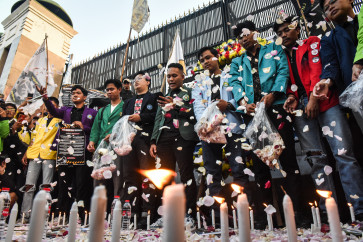
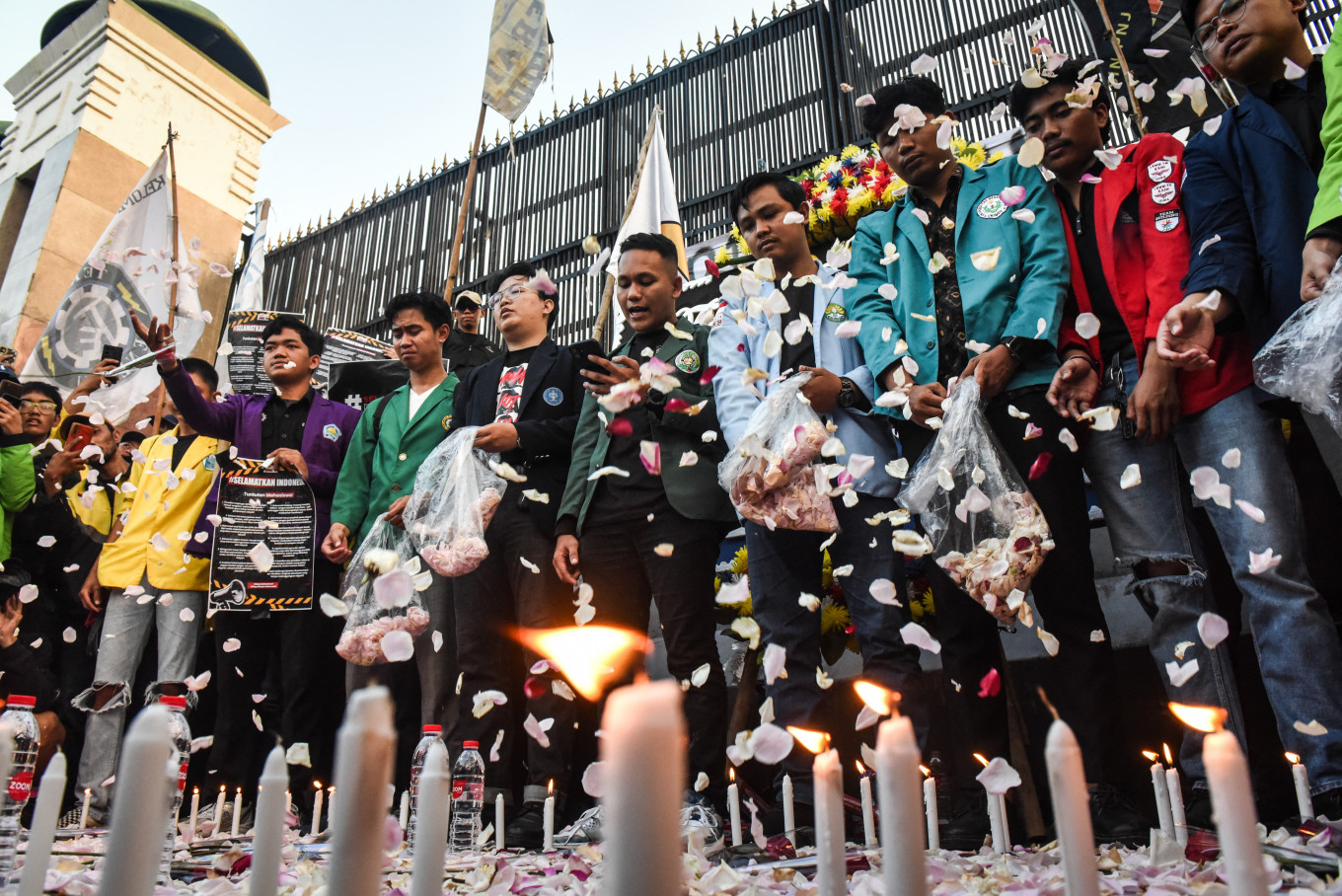 Members of the All-Indonesia Alliance of Student Executive Boards (BEM SI) scatter flower petals during a demonstration outside the Senayan Legislative Complex in Central Jakarta on Sept. 4, 2025, expressing support for the “17+8” reform demands presented by the Tuntutan Rakyat (people’s demands) movement during nationwide protests from August to September. (AFP/Tyo Pribadi)
B
eyond the current debate over making French a compulsory school subject in Indonesia, a classic French maxim rings uniquely true today: L'histoire se répète (history repeats itself). Nearly three decades after the watershed Reformasi movement, collective amnesia has left the core student demands of 1998 trapped in an unresolved cycle.
These demands, which included constitutional amendments to limit presidential terms and establish a more democratic political structure, ending corruption, collusion and nepotism (KKN), abolishing the military's dual sociopolitical function, establishing the rule of law and enacting strong regional autonomy, can be distilled into three enduring aspirations: democracy, rule of law and good governance.
The question today is not whether progress has been made — it has — but whether recent stagnation and regression are imperiling the nation's democratic identity.
Some claim Indonesia is too big to fail. The country's vast geography, economic weight and historic triumphs make this a comforting narrative. Yet nations do not collapse overnight; they erode gradually through the absence of law, rampant corruption and the systematic dismissal of civic demands. Indonesia must safeguard its future through concrete action, not blind faith.
To be fair, milestones have been achieved. Indonesia is now the world's third-largest democracy. The military's guaranteed seats in the legislature are gone, 12 national and regional elections have taken place without a military coup, and the press remains vastly more open than it was under the New Order.
Yet the specter of political decay looms as a silent epidemic over the post-Soeharto era.

Indonesia was once celebrated as a vibrant theater of democracy, but the performance has lost its meaning. While citizens still vote, the rule of law has been commodified, sold to the highest bidder. Political recruitment favors blind loyalty over meritocracy. Furthermore, the governing coalition has systematically hollowed out checks and balances, reducing the legislature’s power to a rubber stamp incapable of producing quality, independent laws.



Your Opinion Matters
Share your experiences, suggestions, and any issues you've encountered on The Jakarta Post. We're here to listen.
Enter at least 30 characters
0
/ 30
Thank you
Thank you for sharing your thoughts. We appreciate your feedback.