The Jakarta Post
Please Update your browser
Your browser is out of date, and may not be compatible with our website. A list of the most popular web browsers can be found below.
Just click on the icons to get to the download page.


Popular Reads
Top Results
No results found. Please check your search term and try again
Can't find what you're looking for?
View all search results
Popular Reads
Top Results
No results found. Please check your search term and try again
Can't find what you're looking for?
View all search resultsNo ASEAN energy security without climate leadership
From the EU's stumbles to ASEAN’s gridlock, the current energy crisis proves that green targets are useless without bold political courage.
Change text size
Gift Premium Articles
to Anyone
Share the best of The Jakarta Post with friends, family, or colleagues. As a subscriber, you can gift 3 to 5 articles each month that anyone can read—no subscription needed!
 Set as preferred source
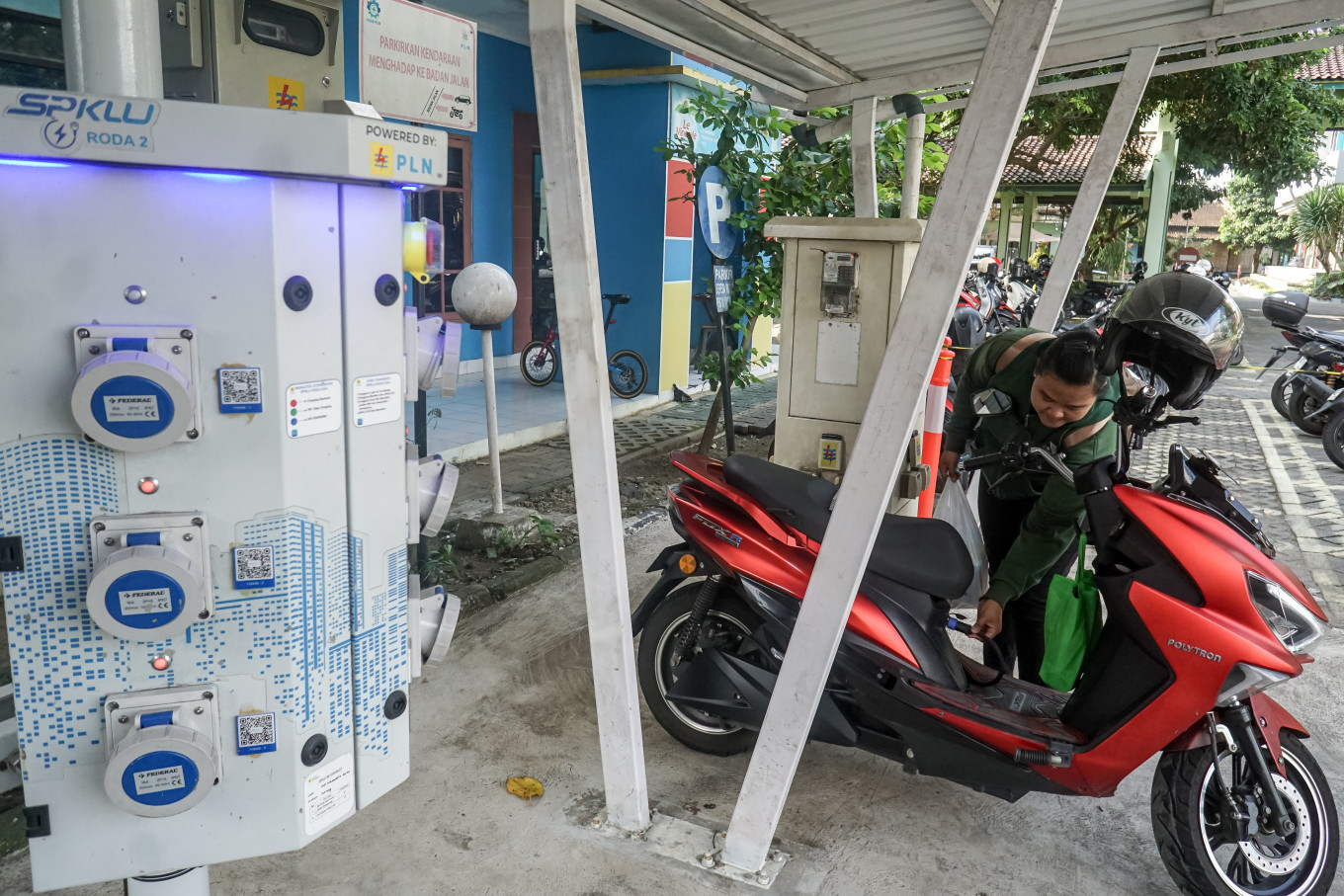 Green energy: An electric vehicle user charges a motorcycle on April 20 at a public electric vehicle charging station operated by PLN UP3 in Surakarta, Central Java. (Antara/Mohammad Ayudha)
T
he current energy crisis, stemming from the ongoing war in the Gulf, should become a catalyst for bold policymaking. This requires a huge amount of visionary leadership everywhere, because the reality is that no region in the world is fully on track to decarbonize and achieve a net-zero society.
Certainly, there are countries doing an excellent job. Among them is China, with its strong commitment to fostering and enhancing renewables. China embraced a nationalistic industrial policy that prioritized the creation of an ecosystem capable of spurring solar and wind power through high levels of state subsidies. While this strategic pivot represents a powerful story on scaling and mainstreaming renewables, there are also pitfalls.
One consequence of this policy was the stifling of the global market, leading to market domination by Chinese companies. In most cases, these firms became highly adept over the last 20 years at leveraging partnerships with Western companies, especially those from Europe.
How can the world react to this situation? The European Union, under the first term of Ursula von der Leyen at the helm of the European Commission, crafted a highly ambitious policy framework: the so-called European Green Deal. It was a very ambitious and holistic attempt to ensure the EU could take a leadership role in the transition to net zero. Unfortunately, under pressure from the European People’s Party—once a moderate center-right family of parties—this legislation has undergone a systemic, intentional erosion.
In theory, the Green Deal is still in place, but it is much weaker than originally envisioned. It remains a big question mark whether Europe will remain a leading voice in promoting policies that can bring us to a truly net-zero society by 2050.
But what about Southeast Asia? Lacking a centralized form of governance, the member nations of ASEAN remain on their own. It is not that there have not been attempts at cooperation. For example, ASEAN agreed in 2023 to implement the ASEAN Strategy for Carbon Neutrality. There is also the ASEAN Plan of Action for Energy Cooperation (APAEC) 2026–2030, and the recent ASEAN Summit in Cebu focused heavily on energy cooperation in an attempt to revitalize the ASEAN Petroleum Security Agreement (APSA).

Focusing on a petroleum-centered agreement should only be a short-term strategy, but it is clear that truly implementing APSA will take years—if it happens at all. So, does it really make sense to invest a huge amount of political capital into it? It could, but only if ASEAN gets serious about being ambitious with renewable energies as well.