The Jakarta Post
Please Update your browser
Your browser is out of date, and may not be compatible with our website. A list of the most popular web browsers can be found below.
Just click on the icons to get to the download page.


Popular Reads
Top Results
No results found. Please check your search term and try again
Can't find what you're looking for?
View all search results
Popular Reads
Top Results
No results found. Please check your search term and try again
Can't find what you're looking for?
View all search resultsIndonesia’s coral reefs are heat‑tolerant, but only up to a point
While Indonesia’s reefs demonstrate a remarkable natural tolerance to heat stress, a long-term national strategy is needed to track the various impacts of warming oceans to safeguard not just coral cover but also to their capacity to heal.
Change text size
Gift Premium Articles
to Anyone
Share the best of The Jakarta Post with friends, family, or colleagues. As a subscriber, you can gift 3 to 5 articles each month that anyone can read—no subscription needed!
 Set as preferred source
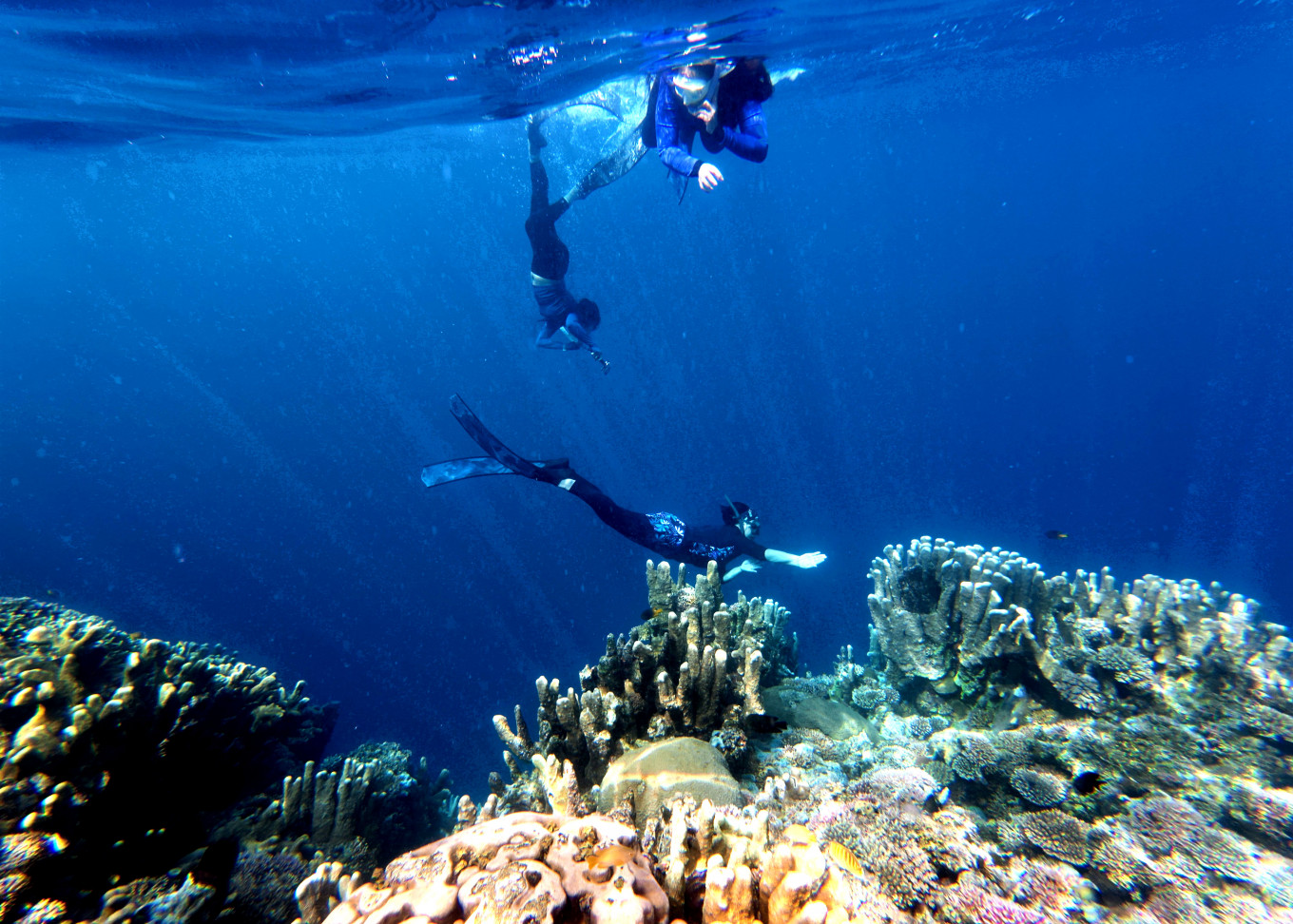 Free divers explore a coral reef on Dec. 28, 2025, at the Oluhuta Paradise marine tourism site in Bone Bolango regency, Gorontalo. (Antara/Adiwinata Solihin)
I
ndonesia is home to the world’s largest and most biodiverse coral reef system, spanning more than 32,000 square kilometers across the archipelago. Just like what is happening globally, these reefs are now bearing the brunt of a warming ocean. Our new study, however, has found that despite rising sea temperatures, coral cover at most of the Indonesian study sites remained remarkably stable over the long term.
Our study compiled long-term coral monitoring data from across the country. Spanning from 2004 to 2023, the dataset covers 394 permanent reef sites across 32 locations. This massive effort was made possible primarily through data shared by the National Research and Innovation Agency (BRIN), Yayasan Konservasi Alam Nusantara, Wildlife Conservation Society (WCS) Indonesia, WWF Indonesia and Operation Wallacea.
Out of the 32 locations, 26 showed no significant overall change in hard coral cover, two actually saw an increase and four experienced a decline. Crucially, this stability persisted even as sea surface temperatures rose significantly across every single study location between 1985 and 2023, with the fastest warming occurring in Eastern Indonesia.
While this is undoubtedly good news, it comes with a major warning: Stability does not mean safety. Once heat stress becomes too frequent or too severe, coral loss can accelerate rapidly.
Much of the stability we observed was based on how reefs responded to earlier major heat events, especially those in 2010 and 2016. Although these past events triggered bleaching and coral loss in several regions, they might not fully capture the unprecedented heat stress that reefs are now beginning to face.
Our findings, however, should not be interpreted as evidence that Indonesian reefs are safe from climate change. While many reefs have weathered past heat stress, increasingly frequent and intense warming could push these vital ecosystems past the point of recovery.

Marine heat waves are becoming more frequent and intense worldwide. The United States’ National Oceanic and Atmospheric Administration (NOAA) confirmed the fourth global coral bleaching event, reporting that bleaching-level heat stress had impacted roughly 84.4 percent of the world’s coral reefs between January 2023 and September 2025.
Indonesia is no exception to this global trend, and bleaching incidents linked to the 2023-2025 marine heat wave have been documented across multiple locations, including reefs north of Jakarta, Karimunjawa in Central Java and the Dampier Strait in Raja Ampat, Southwest Papua.
When we compared changes in coral cover with accumulated thermal stress, we found that coral cover remained stable under low to moderate heat but dropped sharply once that stress crossed a critical threshold of around 12 degree heating weeks (DHW).
DHW is a metric that combines how much hotter the water is than usual and how long that heat persists. Think of it as a cumulative “heat dose” for coral reefs. For instance, 12 DHW could mean 12 weeks of water temperatures sitting at 1 degree Celsius above the usual summer maximum or six weeks at 2 degrees above it.
In our study, coral loss became significantly more likely once temperatures surpassed 12 DHW. In other words, many Indonesian reefs appear capable of absorbing moderate heat stress, but only up to a point.
It is worth noting that “stable” here refers to total live hard coral cover, the only metric consistently tracked across Indonesia’s various monitoring programs. However, coral cover alone does not tell the whole story. A reef can maintain stable overall cover even as it loses many branching corals or large, old coral colonies, becomes dominated by just a few resilient species or suffers a loss in structural complexity.
Indonesia’s reefs do not all respond to heat stress in the same way. While some coral communities recover quickly after bleaching, others struggle, particularly where pollution, sedimentation, destructive fishing and coastal development sap their capacity to bounce back.
Our study highlights that even reefs within marine protected areas (MPAs) cannot escape bleaching when ocean temperatures soar. Protected status cannot stop the ocean from warming, but it can significantly improve recovery prospects by alleviating local pressures.
In Aceh, reefs around Weh Island were ransacked by the 2010 bleaching event. Remarkably, some managed to rebound to pre-bleaching levels of coral cover within roughly six years, a recovery likely aided by long-term protection.
In contrast, around Lombok, particularly in Sekotong district, recurrent and intense heat stress has triggered substantial coral loss, including a major decline following the severe 2016 bleaching event. Compounding the problem, these reefs have also been battered by multiple localized human pressures that have likely impeded their ability to bounce back.
These examples illustrate why climate change and local reef management cannot be treated in isolation. While reducing localized pressures will not prevent bleaching during extreme heat waves, it can give reefs a much-needed fighting chance to survive and recover in their wake.
Our study is the first national-scale analysis to link long-term changes in coral cover in Indonesia with thermal stress across such a large number of monitored reefs. Without long-term monitoring, we cannot tell which reefs are coping with heat stress, recovering after bleaching or slowly declining.
If Indonesia is to protect its reefs effectively, it needs a stronger and more coordinated national strategy for monitoring coral conditions and bleaching impacts. This framework must look beyond mere coral cover to track bleaching severity, mortality rates, recovery trajectories, juvenile recruitment, community composition and structural changes over time.
As the ocean continues to warm, the future of Indonesia’s reefs will depend not only on their natural tolerance but also on our ability to safeguard the very conditions that allow them to heal.
---

The writer is an adjunct research associate in fisheries and marine sciences at IPB University. This article is republished under a Creative Commons license.