The Jakarta Post
Please Update your browser
Your browser is out of date, and may not be compatible with our website. A list of the most popular web browsers can be found below.
Just click on the icons to get to the download page.


Popular Reads
Top Results
No results found. Please check your search term and try again
Can't find what you're looking for?
View all search results
Popular Reads
Top Results
No results found. Please check your search term and try again
Can't find what you're looking for?
View all search resultsWhat’s next after ‘Pesta Babi’ breaks the silence
By holding up an uncomfortable mirror to state-led exploitation and violence in Papua, Pesta Babi has shattered decades of enforced silence, forcing Jakarta to choose between repressive censorship and genuine, rights-respecting reform.
Change text size
Gift Premium Articles
to Anyone
Share the best of The Jakarta Post with friends, family, or colleagues. As a subscriber, you can gift 3 to 5 articles each month that anyone can read—no subscription needed!
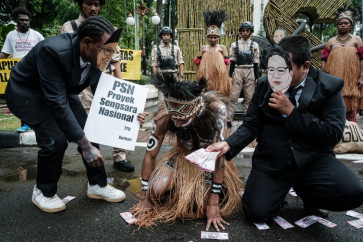
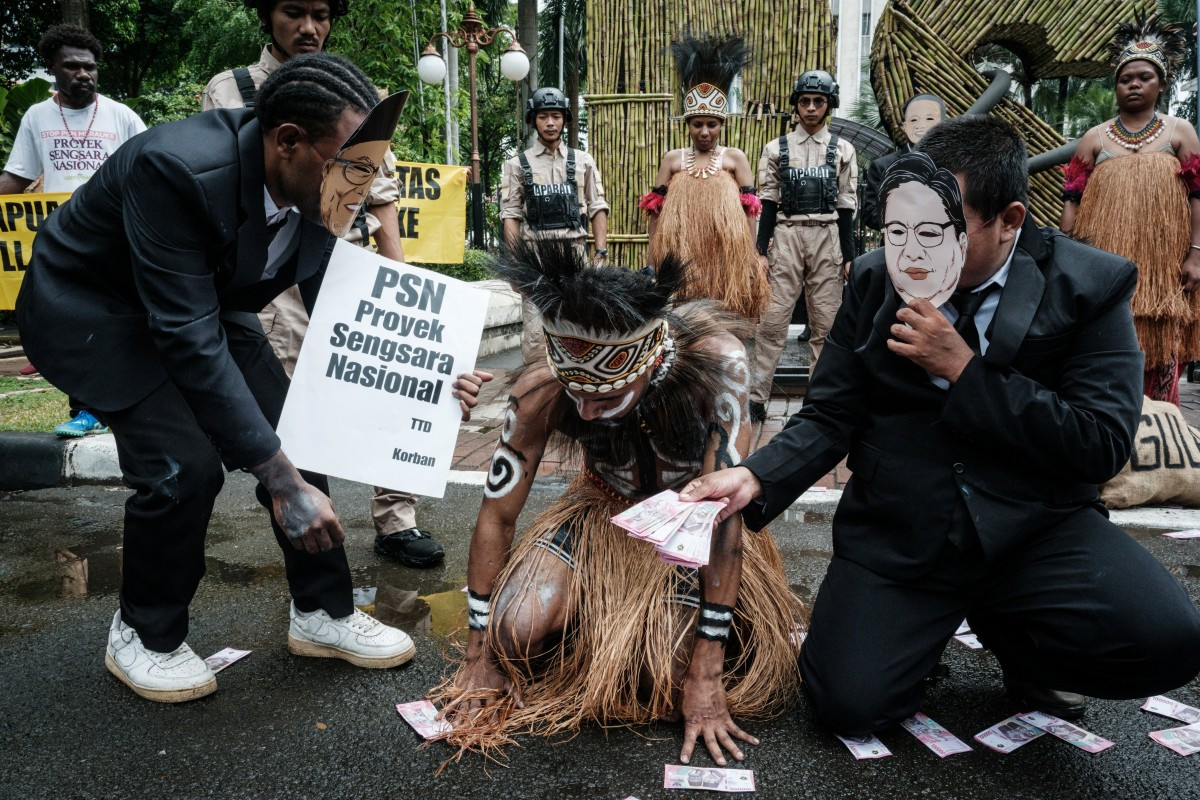 Members of Greenpeace Indonesia and Papuan youths stage a protest featuring theatrical performances against the government's national strategic project for controversial sugarcane plantations Papua, outside the Coordinating Ministry for Economic Affairs office in Jakarta on Dec. 18, 2025. (AFP/Yasuyoshi Chiba )
T
he government’s response to the documentary Pesta Babi: Kolonialisme di Zaman Kita (Pig Feast: Colonialism in Our Time) exemplifies the traditional idiom, "blaming the mirror for an ugly reflection." This metaphor accurately describes an institutional reluctance to engage in self-reflection, wherein authorities choose to suppress critical feedback rather than address underlying governance failures.
The documentary critically examines the displacement of indigenous communities driven by state-led deforestation of over 2.5 million hectares in South Papua. These clearances support large-scale agricultural ventures, including palm oil and sugarcane plantations, alongside national food estate programs framed as "food security" and "energy transition". To secure these National Strategic Projects (PSN), the state has deployed a joint military framework, a manifestation of state power that exacerbates human rights vulnerabilities in an already volatile region.
By documenting environmental degradation and chronic state violence, the film serves as a catalyst for public accountability, threatening the historical impunity enjoyed by regional state actors. Papua has long functioned as an exceptional zone for civil liberties within Indonesia, characterized by disproportionate human rights violations, including arbitrary detentions, unlawful killings, torture, and state-mandated internet blackouts, perpetrated with minimal legal recourse.
The documentary's rapid dissemination, securing over 13 million views via the Jubi media outlet within its first two weeks, demonstrates a significant public appetite for uncensored regional reporting. Achieving unprecedented domestic reach, it garnered over 11,000 screening requests and at least 1,800 public viewings across the Indonesian archipelago. This widespread distribution underscores a structural failure in traditional state censorship mechanisms when confronting digitized, community-led information networks.
In response, the state has attempted to neutralize the critique by disrupting at least 52 public screening venues nationwide. This strategy extends to judicial retaliation against the filmmakers, evidenced by investigations launched against producer Dandhy Dwi Laksono and a local pro bono legal defender. This legal challenge was initiated by Yasinta Moiwend, an indigenous woman from the Malind tribe featured in the documentary, who alleges her likeness was used without prior consent and has demanded the film's withdrawal.
However, the litigation brought by Yasinta, who suddenly secured private legal representation, has generated significant controversy. Her family raised alarms regarding her abrupt relocation from Wogikel Village in the Merauke regency to Jakarta on May 24 without collective consultation.

Given her socio-economic constraints, the logistics of financing a complex, multi-modal transit involving maritime, overland, and air routes to the capital raise questions regarding external facilitation. While external observers respect her formal legal stance, her sudden alignment with state narratives contrasts sharply with her historical trajectory as a vocal opponent of the PSN and a defender of customary land rights.