The Jakarta Post
Please Update your browser
Your browser is out of date, and may not be compatible with our website. A list of the most popular web browsers can be found below.
Just click on the icons to get to the download page.


Popular Reads
Top Results
No results found. Please check your search term and try again
Can't find what you're looking for?
View all search results
Popular Reads
Top Results
No results found. Please check your search term and try again
Can't find what you're looking for?
View all search resultsThe market as an unlikely ally against democratic backsliding
When democratic institutions are dismantled in plenary chambers, the language of capital translates political overreach into economic ruin and in doing so, creates a powerful new battlefield for change.
Change text size
Gift Premium Articles
to Anyone
Share the best of The Jakarta Post with friends, family, or colleagues. As a subscriber, you can gift 3 to 5 articles each month that anyone can read—no subscription needed!
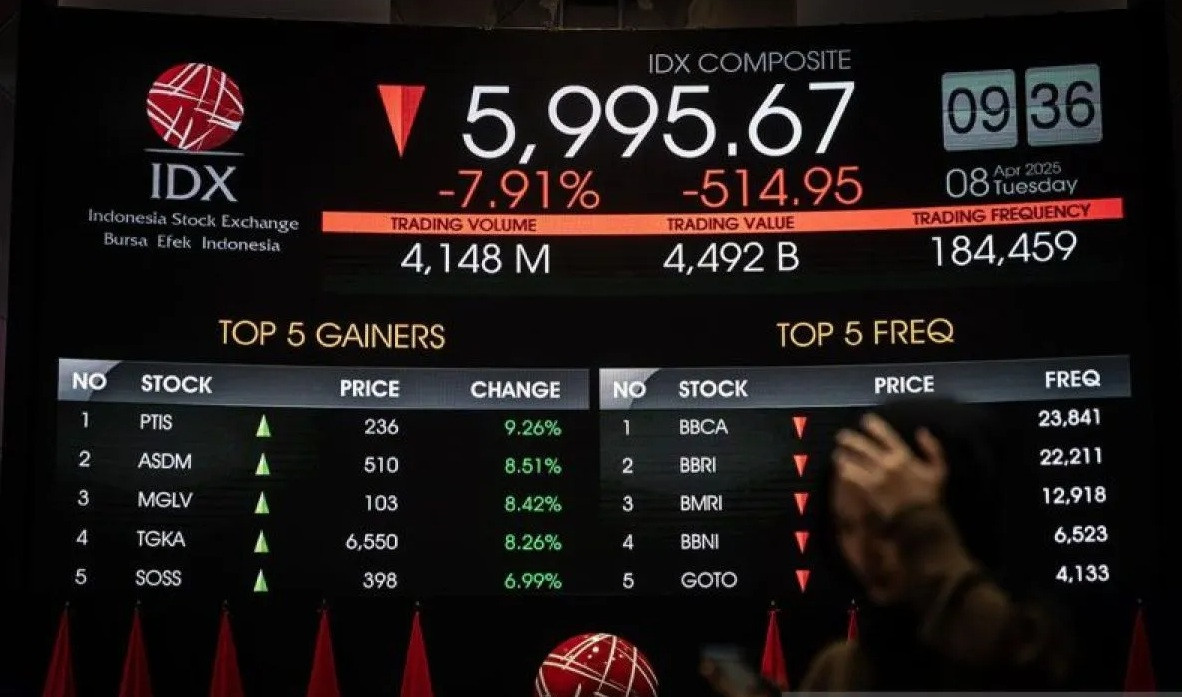 A woman places a hand on her head in front of an electronic information display on April 8, 2025, showing movements of the Indonesia Stock Exchange (IDX) Composite index at the IDX headquarters in Kebayoran Baru, South Jakarta. (Antara/Bayu Pratama)
D
uring my presentation at the Republic Conference, a gathering on May 30 in Yogyakarta that convened 130 civil society organizations to confront the current state of the country, my diagnosis was sober: Since 2019, our democracy has not merely stalled, it has regressed through entirely lawful means.
We have watched the Corruption Eradication Commission (KPK) be pulled back under executive control, the Constitutional Court's credibility hollowed out, the Job Creation Omnibus Law concentrate capital at the expense of labor and the environment and the 2025 Military Law revision reopen civilian posts to active officers.
None of this arrived by tank or mass arrest. Instead, it was systematically dismantled within the very plenary chambers meant to safeguard a democracy. We have a name for this: authoritarian legalism.
Yet I argued something the room did not expect. Until today, the most disciplined opposition to this regression has not been political parties or the remnants of the 1998 reform movement, but the market.
Consider the central contradiction of our current situation. Politically, power has rarely looked more absolute: The state commands the largest coalition government in our history, faces an opposition that barely exists and has subdued independent institutions one by one. Yet beneath this formidable surface, economic confidence is draining away: The rupiah faces a structural decline, bond yields are climbing, reserves are depleting and net foreign selling has shifted from an anomaly to a fixed pattern.
Strength and erosion are side by side. Why? It is because the market does not read institutional capture as stability but as decay.

Index providers and rating agencies such as MSCI, the Financial Times Stock Exchange (FTSE) and Standard & Poor discipline states through credit ratings, index inclusion and environment, social and governance (ESG) assessments. They will not tolerate a command economy or wholesale violation of the rule of law because such things destroy the value of the assets they price.