The Jakarta Post
Please Update your browser
Your browser is out of date, and may not be compatible with our website. A list of the most popular web browsers can be found below.
Just click on the icons to get to the download page.


Popular Reads
Top Results
No results found. Please check your search term and try again
Can't find what you're looking for?
View all search results
Popular Reads
Top Results
No results found. Please check your search term and try again
Can't find what you're looking for?
View all search resultsPeatlands hold climate secrets we still miss
Peatlands have been developing over millennia on every continent and although they are globally important ecosystems, there is still much we don't know about them in order to make informed policy decisions today for benefits in the future.
Change text size
Gift Premium Articles
to Anyone
Share the best of The Jakarta Post with friends, family, or colleagues. As a subscriber, you can gift 3 to 5 articles each month that anyone can read—no subscription needed!
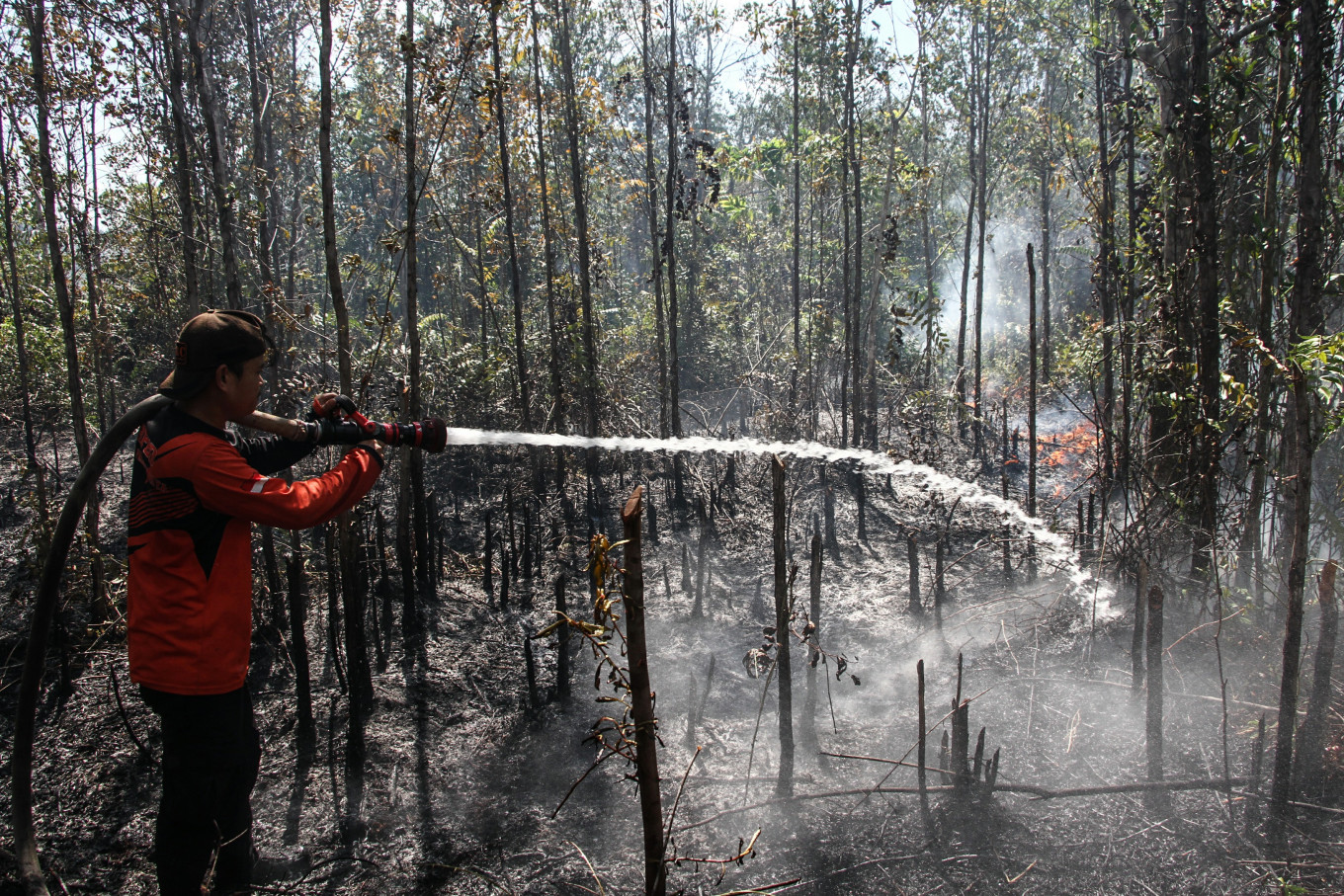 A worker with the Palangka Raya Disaster Mitigation Agency battles a fire on Jan. 16, 2026, in a peatland area in Bukit Tunggal subdistrict, Palangka Raya, Central Kalimantan. (Antara/Auliya Rahman)
P
ush a metal corer into a peatland, and you pull up something remarkable: a dark, dense, spongelike material made of partly decomposed plants. This peat is rich in carbon. In some places, that peat has been building up for thousands of years. Peatlands are the ecosystems where this happens.
Peat is often associated with the bogs of Scotland or Ireland, but peatlands occur on every continent, from the Arctic to the tropics. They can sit beneath open moorland, under swamp forest or in remote floodplains. What links them is water: In wet, oxygen-poor ground, dead plant material does not fully rot away, so carbon accumulates over centuries and millennia.
That makes peatlands globally important. Although they cover only 3-4 percent of Earth’s land surface, they store nearly a third of the world’s soil carbon. When they remain intact, they can keep locking away carbon over very long timescales. But when they are drained or converted for agriculture, forestry or development, that stored carbon is exposed to air and released back into the atmosphere as greenhouse gases (GHG), including carbon dioxide.
Thus, peatlands can become major sources of GHG emissions when degraded. Globally, peatland degradation is estimated to account for 5-10 percent of human-caused carbon dioxide emissions each year.
For ecosystems so important to the global carbon cycle, we still know surprisingly little about some basic things. One of the biggest questions is simply: Where are all the world’s peatlands?
That may sound like a question scientists should already have answered, but many peatlands are hard to detect from the surface, difficult to access or lay beneath dense forest. Large areas of the tropics remain poorly mapped.

What may be the world’s largest tropical peatland complex, located in the Congo Basin, was only formally confirmed to science in 2017. That discovery was astonishing, not just because of its size but also because it showed that globally important carbon stores can still remain effectively hidden in plain sight.
This uncertainty matters. If countries do not know where their peatlands are, they cannot fully account for them in climate plans, biodiversity strategies or national GHG inventories. And if we are still refining estimates of peatland extent, we are also still refining estimates of how much carbon they store.
That gap was one reason behind a new study I coauthored. Rather than trying to answer a single peatland question, we asked a broader one: What does the peatland community think science most urgently needs to resolve?
Working with a global network of more than 100 coauthors, my team ran an open survey in 21 languages and received responses from over 450 people across 54 countries. Participants included researchers, policymakers and practitioners. An independent panel then prioritized the responses, producing 50 questions for peatland science over the next decade.
What emerged was not just a set of narrow technical questions; it showed a discipline that is changing fast.
Some priorities were surprisingly fundamental. Participants highlighted the need to map peatlands better, especially in poorly surveyed tropical regions (the Congo peatland is an excellent illustration of this point), and to improve estimates of global carbon storage and GHG emissions. Others focused on how peatlands would respond to climate change, whether drought, fire and warming could push some peatlands past tipping points where they release more carbon than they store.
Restoration is another major concern. There is already broad agreement that conserving intact peatlands and rewetting drained ones are essential for climate and biodiversity goals: At least 30 million hectares of degraded peatland need to be rewetted by 2030 as a first step toward meeting climate change targets.
But restoration is not one simple recipe. A damaged upland bog in Britain is different to a drained tropical peat swamp forest in Indonesia or a permafrost peatland in the Arctic. What works in one place may not translate neatly to another.
Just as striking was how often participants raised questions about communities, livelihoods, power and fairness. Peatlands are not empty landscapes waiting to be fixed; in many places they are lived in, worked and culturally significant.
Participants asked how local and indigenous knowledge could shape restoration, how wet agriculture, also called paludiculture (farming crops on rewetted peatlands or wetlands), and other peatland livelihoods might work in practice, and whether the benefits of carbon finance and conservation will actually reach local communities.
Peatland science is no longer just about describing these ecosystems. It is increasingly about decisions: which peatlands are protected, which are restored, how land is used, who bears the costs and who benefits.
Our study has limits: Most respondents were researchers, and some peatland-rich regions and perspectives were less well represented than others. So while this is not a final blueprint for what peatland science should look like everywhere, it does offer a community-informed snapshot of where the biggest gaps now lie.
For a long time, peatlands were treated as marginal, soggy places at the edge of more useful land. Peatlands are now becoming central to climate regulation, water security, biodiversity and the livelihoods of many people who live on and around them.
Pulling peat from the ground means touching material that has been building up for millennia. It is a reminder that these landscapes work on timescales much longer than our own.
But the decisions that will shape their future are being made now, and they will help decide not only whether peatlands remain a climate buffer or become another source of instability but also who gets to benefit from their protection and restoration in the future.
---
The writer is an associate professor of geography at Royal Holloway, University of London. This article is republished under a Creative Commons license.