The Jakarta Post
Please Update your browser
Your browser is out of date, and may not be compatible with our website. A list of the most popular web browsers can be found below.
Just click on the icons to get to the download page.


Popular Reads
Top Results
No results found. Please check your search term and try again
Can't find what you're looking for?
View all search results
Popular Reads
Top Results
No results found. Please check your search term and try again
Can't find what you're looking for?
View all search resultsCapitalizing on the Malacca Strait
Indonesia must trade its outdated regional rivalries for a sophisticated maritime strategy that honors international law while finally turning the Malacca Strait into a true engine for national growth.
Change text size
Gift Premium Articles
to Anyone
Share the best of The Jakarta Post with friends, family, or colleagues. As a subscriber, you can gift 3 to 5 articles each month that anyone can read—no subscription needed!
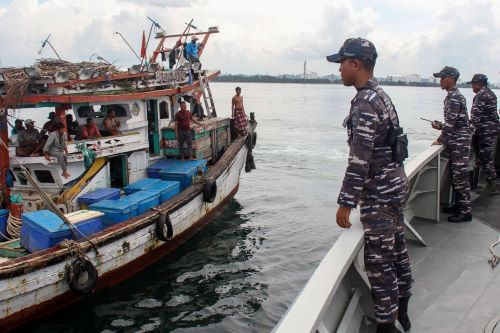 Indonesian Navy seamen prepare to search a fishing boat on Oct. 19, 2024, in the waters bordering the Malacca Strait off Lhokseumawe, Aceh, during a patrol to combat the trafficking of goods and people. (Antara/Rahmad)
I
ndonesia must accelerate its efforts to catch up with Singapore and Malaysia in taking full advantage of its position as a littoral state of the Malacca Strait. As one of the world’s busiest sea lanes, the strait is a vital economic artery. However, any proposal to charge vessels for passage will inevitably backfire; such a move directly contradicts the United Nations Convention on the Law of the Sea (UNCLOS). To pursue tolls is to play with fire.
For decades, Indonesia has focused on short-term gains rather than long-term maritime strategy. Historically, national discourse has often shifted toward criticizing our neighbors' economic success instead of addressing our own domestic policy shortcomings. Singapore, in particular, has frequently served as a convenient target for frustration, occasionally dismissed as a "little red dot" despite its outsized economic influence compared to the Indonesian archipelago.
Recently, Finance Minister Purbaya Yudhi Sadewa appeared to draw inspiration from an Iranian proposal to charge ships for transit through the Strait of Hormuz. While Iran signed UNCLOS, it never ratified the treaty. However, this does not grant any nation a license to ignore international maritime law. It is a significant relief that Purbaya quickly retracted the suggestion before major regional stakeholders, such as China, Japan and South Korea, could react. Foreign Minister Sugiono and the Navy have since reaffirmed that the strait remains a free transit corridor for all vessels.
Sugiono recently reiterated that Indonesia supports freedom of navigation and expects maritime traffic to remain smooth, open and mutually beneficial. "We hope for free passage, and I believe this is a shared commitment among many countries to create a shipping lane that is neutral and mutually supportive," he noted. While this official stance is clear, there is no guarantee that other officials will not revisit Purbaya’s misguided proposal in the future.
Despite controlling the longest stretch of this 900-kilometer waterway along Sumatra, Indonesia reaps disproportionately small benefits. Historically, when piracy spiked in the strait, suspicion often fell on Indonesia, creating a persistent security challenge for the Indonesian Navy. Today, piracy has been significantly reduced, thanks in part to routine military operations and intensive collaboration with the international community, including partners like Japan.
Nevertheless, Indonesia’s maritime service industry continues to lag. Singapore remains the world’s second-busiest container port, while Malaysian hubs like Port Klang have modernized and expanded, generating billions in revenue. This economic reality explains why these nations reacted with diplomatic concern to the suggestion of a transit toll.

Our historical approach to Batam, originally intended to rival Singapore, has been flawed from the outset. A more realistic strategy would have been to position Batam as a complementary partner. International investors maintain a high level of trust in Singapore’s governance and infrastructure; Batam’s proximity and lower labor costs are currently insufficient to shift that confidence.