The Jakarta Post
Please Update your browser
Your browser is out of date, and may not be compatible with our website. A list of the most popular web browsers can be found below.
Just click on the icons to get to the download page.


Popular Reads
Top Results
No results found. Please check your search term and try again
Can't find what you're looking for?
View all search results
Popular Reads
Top Results
No results found. Please check your search term and try again
Can't find what you're looking for?
View all search resultsAnalysis: With falling rupiah, economic resilience faces its toughest test
Change text size
Gift Premium Articles
to Anyone
Share the best of The Jakarta Post with friends, family, or colleagues. As a subscriber, you can gift 3 to 5 articles each month that anyone can read—no subscription needed!
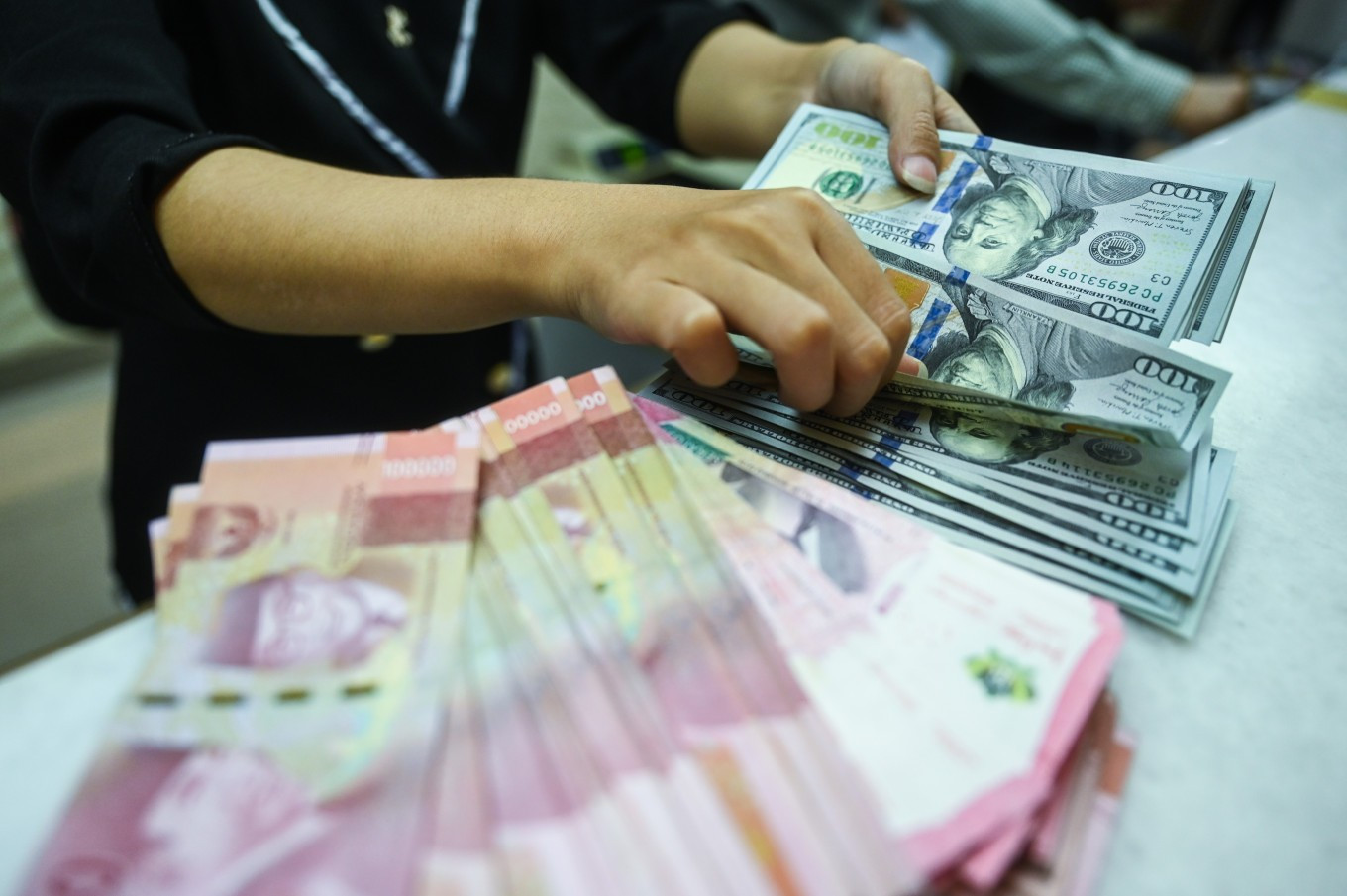 A clerk counts United States dollar banknotes on May 22, 2024, at a money changer in Jakarta. (Antara/Rivan Awal Lingga)
I
ndonesia’s economy is approaching a dangerous crossroads. While Finance Minister Purbaya Yudhi Sadewa projects robust 5.5 percent growth, he has also warned that the country is in “survival mode” amid escalating global tensions. Beneath the headline optimism, rising energy prices, weakening purchasing power and mounting fiscal and monetary pressures are exposing deeper structural cracks, raising a critical question: Can Indonesia withstand the shock, or is its resilience beginning to wear thin?
Global credit rating agencies Moody’s and Fitch Ratings have revised Indonesia’s outlook to negative, along with the outlooks for four major banks, Bank Mandiri, Bank Central Asia, Bank Negara Indonesia and Bank Rakyat Indonesia, despite their solid liquidity and profitability. In their assessments, both agencies highlighted rising policy uncertainty and Indonesia’s growing economic vulnerability amid the escalating conflict in the Gulf.
At the same time, MSCI has maintained its freeze on the rebalancing of Indonesian stocks in its global indices, a restriction first imposed in February due to concerns over market accessibility. Its decision to postpone the planned May review until June has further dampened sentiment in the local market.
Markets have responded harshly. The rupiah weakened from 16,641 per United States dollar on Sept. 1, 2025, to 17,324 by April 30, while the benchmark Indonesia Stock Exchange (IDX) Composite index fell from above 9,000 points in January to below 7,000 in April.
The rupiah’s deep depreciation has persisted despite a balance of payments surplus of US$6.1 billion in the fourth quarter of 2025 and $2.23 billion in the first two months of 2026, as well as relatively stable inflation of 3.48 percent in March 2026. This suggests that deeper structural pressures are at play.
One contributing factor is the rapid expansion of base money, which has grown by more than 11 percent year-on-year since December 2025 after a prolonged period of subdued growth. At the same time, Bank Indonesia’s (BI) holdings of government securities have continued to rise under the burden-sharing program, reaching 24.94 percent in March 2026, significantly higher than the sub-20 percent level seen during the COVID-19 period. While such measures were justified during crises, their continuation under more normal conditions has raised concerns over central bank independence and market confidence.

The consequences of these combined policies are becoming increasingly visible. Pressure intensified in April, when net capital outflows reached Rp 40.8 trillion ($2.36 billion), further weakening the rupiah. Risk premiums have also risen, pushing yields on 10-year government bonds close to 7 percent. This is increasing the government’s debt-servicing burden, with interest payments already accounting for 18 percent of state revenue, well above the commonly cited 15 percent warning threshold.