The Jakarta Post
Please Update your browser
Your browser is out of date, and may not be compatible with our website. A list of the most popular web browsers can be found below.
Just click on the icons to get to the download page.


Popular Reads
Top Results
No results found. Please check your search term and try again
Can't find what you're looking for?
View all search results
Popular Reads
Top Results
No results found. Please check your search term and try again
Can't find what you're looking for?
View all search resultsInvestors can still outwit AI, but only if they’re unpredictable
When dealing with problems that have a large degree of qualitative uncertainty or where the answer requires a judgment call, genAI is just as biased as most humans.
Change text size
Gift Premium Articles
to Anyone
Share the best of The Jakarta Post with friends, family, or colleagues. As a subscriber, you can gift 3 to 5 articles each month that anyone can read—no subscription needed!
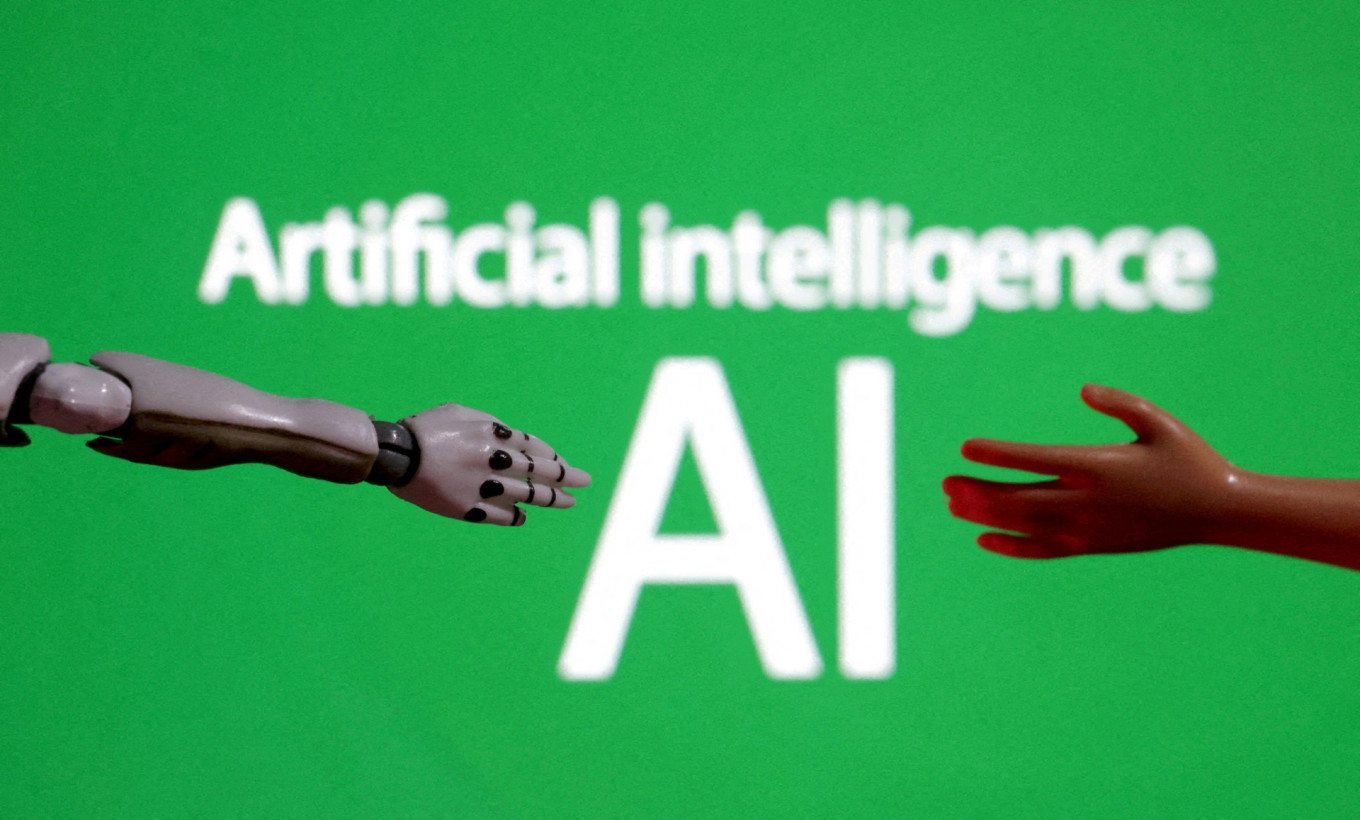 Miniature robot and toy hands point toward the words “Artificial intelligence AI" in this illustration created on Dec. 14, 2023. (Reuters/Dado Ruvic)
I
nvestors know artificial intelligence is coming for their jobs. Machines can already run complex analyses of investments and portfolios, threatening fund managers' livelihoods.
But new studies show where AI falls short, and it is in those blind spots where human managers still have the ability to generate "alpha" or excess returns.
For weeks now, stocks have been sorted into AI winners and AI losers. Share prices of companies with business models that may be disrupted by AI have sold off, while the makers of AI hardware and software have kept rising. It is no secret that many academics and companies are testing the ability of AI to pick stocks and manage portfolios. So should fund managers fear for their jobs?
In recent weeks, I have come across several academic studies that examine both the capabilities and limitations of AI. The most comprehensive and interesting is a new NBER working paper by Boston University Assistant Professor Pietro Bini and his colleagues.
They ask four leading generative AI (genAI) models, GPT, Claude, Gemini and Llama, to answer a set of questions used to measure behavioral biases in finance and economics. They then evaluate whether these models give a rational answer or an answer that is biased in the same manner as most humans.
What emerges from the data is an interesting split. When dealing with common cognitive biases, like the gambler’s fallacy or base-rate neglect, where genAI can fall back on well-established mathematical formulas, the answers are largely free from bias. One can therefore expect that in forecasting situations in which humans may be subject to such biases, genAI will likely outperform investors made of flesh and bone.

But when dealing with problems that have a large degree of qualitative uncertainty or where the answer requires a judgment call, genAI is just as biased as most humans. When the model can not rely on a mathematical answer, it has to deduce a solution from its training data. And the training data is mostly man-made and thus codifies the same biases as humans. It is a case of garbage-in, garbage-out.
Importantly, these results indicate where human investors might be able to outperform machines moving forward.
In another study, Lauren Cohen from Harvard Business School in Massachusetts, the United States, and his collaborators trained AI to learn the decision processes of thousands of US equity fund managers. The goal was to predict which stocks a fund manager would buy, sell or hold next quarter or the following year.
If AI can do this consistently, fund managers really should be worried about their jobs.
The bad news is that the AI-equipped researchers managed to correctly predict 71 percent of all future trades. The good news is that fund managers' alpha was rooted mostly in the other 29 percent.
Naturally, fund managers have different processes, so there is variability in how well AI can anticipate their actions.
Funds that are run based on a prescriptive, inflexible process, or by an inflexible fund manager, are, unsurprisingly, more predictable. These funds tend to invest more in stocks that are clear-cut cases for a specific investment style.
For example, value funds with a rigid, prescriptive process tend to invest only in the most obvious value stocks and ignore the ones that are ambiguous cases.
But if everyone knows that company A is a value company, then the shares would already be in the portfolios of most fund managers following that investment style. And that leaves less room for new investors, including AI models, to gain any advantage by buying the stock.
Company B, meanwhile, may be a value stock, but may struggle with a difficult competitive environment, ineffective management or other factors that cannot easily be quantified. A fund manager would need to use judgment to determine whether this was truly a value stock or something that was "cheap" for a reason. This is where fund managers become unpredictable to AI.
If a fund manager "sees something" in company B that isn’t in the data, an AI model will struggle to predict the purchase. Yet, if that judgment turns out to be correct, the shares of company B will likely rally much more as new investors flock to buy the stock.
The result is that fund managers whose actions are harder for AI to predict, who appear more random and are better at handling qualitative factors, tend to outperform both their peers and the broader market.
Of course, these human advantages may prove fleeting. As AI models learn from ever richer data sets and from the very managers they now struggle to predict, today's blind spots could narrow, shifting the frontier of truly human alpha yet again.
The lesson for investors is thus that in the age of AI, a fund’s alpha will increasingly come from being able to predict the unpredictable.
---
The writer is an investment strategist at independent investment bank Panmure Liberum. The views expressed are personal.