The Jakarta Post
Please Update your browser
Your browser is out of date, and may not be compatible with our website. A list of the most popular web browsers can be found below.
Just click on the icons to get to the download page.


Popular Reads
Top Results
No results found. Please check your search term and try again
Can't find what you're looking for?
View all search results
Popular Reads
Top Results
No results found. Please check your search term and try again
Can't find what you're looking for?
View all search resultsDanantara at one: Between the promise and the proof so far
One year in, Danantara has proven it can move mountains of capital, but the real test is whether it can move the needle on structural reform without falling into the old traps of state-directed lending.
Change text size
Gift Premium Articles
to Anyone
Share the best of The Jakarta Post with friends, family, or colleagues. As a subscriber, you can gift 3 to 5 articles each month that anyone can read—no subscription needed!
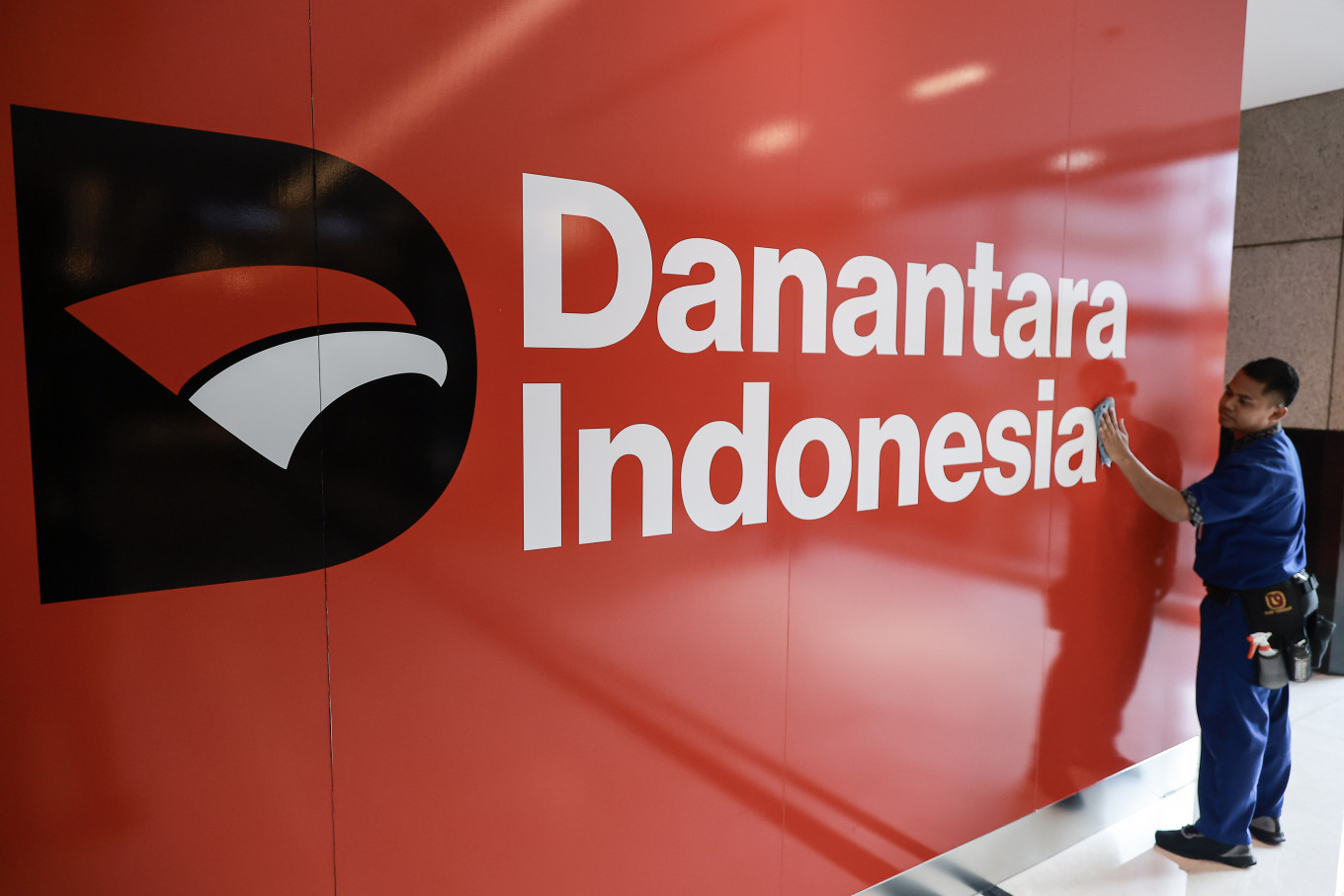 A worker cleans a room on Sept. 8, 2025, at Wisma Danantara Indonesia, South Jakarta. In its first six months of operation, state asset fund Danantara recorded several important achievements, including securing US$10 billion (Rp 163.18 trillion) in funding from a consortium of 12 foreign banks. (Antara/Dhemas Reviyanto)
O
ne year after its establishment on Feb. 24, 2025, state asset fund Danantara is no longer merely a conceptual proposition. It has mobilized substantial capital through international syndicated loans, domestic funding from conglomerates via patriot bonds, state-owned enterprise (SOE) recapitalizations, equity co-investments and several downstream industrial projects.
These developments are far from trivial. The question is no longer whether Danantara exists in practice, it clearly does. The deeper policy issue is now what kind of institution it is becoming: a disciplined sovereign investor or a more diffuse, politically responsive capital allocator.
In the last 12 months, Danantara has proven its capacity to mobilize capital at scale and coordinate major investments, but its credibility will ultimately hinge on disciplined allocation, stronger SOE governance and returns that justify its leverage.
Conceived as both a state investment platform and an SOE super-holding, Danantara marks one of Indonesia’s most ambitious public capital restructurings since the post-crisis reforms of the early 2000s. In financial terms, the institution acted decisively in its first year, securing approximately US$10 billion in syndicated credit facilities from regional and global bank consortia. Because such transactions typically require extensive due diligence and rigorous risk assessment, they signal lenders' confidence in the institution’s bankability, underpinned by sovereign credibility and asset depth.
Domestically, Danantara has raised around Rp 50 trillion to 70 trillion ($3.2 billion–$4.5 billion) through patriot bonds, primarily from major Indonesian conglomerates. With 2 percent coupons, modestly below corporate yields, the subscriptions reflect not just financial appeal, but a strategic buy-in to Indonesia’s evolving state-business architecture.
However, leverage is not a victory lap; it is a debt treadmill. A $10 billion facility at an average interest cost of 5–6 percent implies annual interest servicing of roughly $500 million to $600 million before amortization. If patriot bonds amount to Rp 60 trillion at a 2 percent coupon, they will add roughly Rp 1.2 trillion in annual interest commitments.

This arithmetic underscores the need for viable returns. Capital mobilization must ultimately be justified by commercial performance, and rapid balance-sheet expansion raises the premium on disciplined capital allocation.