(Shutterstock)
It is January 2006. I am 30 years old and watching helplessly as my husband, the word still new on the tongue, is pushed out of the holding room at the Mexico City airport, where I have been shut in without explanation. An elderly Korean lady is the only other occupant. She doesn’t make eye contact. There is nothing that gives away anything in this place. It is wholly featureless, without windows or texture. It is a non-place, just as I suddenly find myself a non-person.
When I speak to ask what’s going on, no one registers my voice. I have no right of refusal here. I must “follow,” “sit,” “wait”. It doesn’t matter how polite or how educated I am or how my moisturized skin indicates the use of expensive unguents. At this moment, as at many other times in the future, I am wholly defined by my passport, and it’s a bad one: Indian.
I’m to attend the wedding of a Mexican friend I know from university in London. The bride and groom are taking us, the invitees, along with them on their honeymoon around the country. We will visit Oaxaca and Puebla. There will be pyramids and tacos and Frida. I’ve been beside myself with excitement, turning words like Popocatepetl and Quetzalcoatl around in my head like 3-D objects.
But the excitement is of a tempered kind. Indian passport holders inevitably experience travel anticipation in a contaminated form. The purity of fantasy is alloyed with the toxin of visas. It is literally a dreadful excitement.
For my husband, to travel is a right, provided he can afford the plane fare; one that derives from his having been born in the city of Alicante in Spain. For Delhi-born me, travel is a privilege, to be earned by convincing visa-officers that I am worthy, obedient, and financially solvent. That I will return. That I won’t attempt to get an illegal job as a dishwasher. I need to show bank account details and property papers, university degrees and police clearance certificates. I always must hold my breath until the page on my passport is stamped; until a bureaucrat somewhere is satisfied by my supplication.
When I received the invite for the wedding in Mexico, I immediately knew I was in trouble. Applying for a Mexican visa with an Indian passport from China, where I lived, was going to be even less fun than filing convoluted tax returns in triplicate. Requesting a visa from inside India was difficult enough, but acquiring one from a third country always caused haute consternation. An Indian outside India was not in her proper place. She needed lots of extra scrutiny.

Thank you!
For signing up to our newsletter.
Please check your email for your newsletter subscription.
I made my way to the Mexican embassy in Beijing almost immediately after receiving the invite – for a trip that was still four months away. The lady at the consulate was alarmed. On my behalf. While fully sympathetic to my desire to attend the wedding, she revealed, sorrowfully, that the Mexican embassy’s Beijing consulate could not process Indian visas. My passport would be taken from me and sent to Mexico City, where a background check, which would take a minimum of three months to complete, would determine whether or not I was travel-worthy.
So I waited for just over three months, after which I got a call from the consulate lady. “Good news,” she said, audibly excited. “Your visa is approved. Please come and collect your passport.”
This is why I am stunned. I had jumped as high as I’d been asked to. I had filled in the forms and been verified across continents. I was solvent. I’d been good. Now I realize that I was mostly just naïve. While waiting in the immigration line at the airport, I dare to not feel anxious. I chatter with my husband about what we’re going to do as soon as we have collected our luggage. I have forgotten how long the distance between passport control and the luggage carousel is for people like me. Being married to a white European feels amnesic.
My husband is ahead of me in the queue. The immigration official glances at his visa-less Spanish passport for a nanosecond and gestures him through. I am next, and I approach with the confident smile of the correctly certified.
The official does not smile back as he takes a long, hard look at me and then begins to slowly flip through my passport. There is such menace in the deliberation with which he turns each page. Back and forth, back and forth. Perhaps he can’t spot the visa, given that my passport is crammed with them.
I reach out to indicate the correct page, only to have him recoil, as if punched. My spluttering explanations are abruptly terminated as he hoists himself out of his chair and asks for me to follow him. “Why?” I say, bewildered. “What’s going on?” asks Julio, my husband. Our words are lost in the hot, close air.
Moments later, my mind is uncomprehending as I wait in this cell. Why am I in what is effectively jail, instead of with my friends? I imagine them getting impatient at our lack of egress and my anxiety mounts.
Why can’t I speak to my husband?
Why will no one say anything?
I am angry. And then I am just tired. It has been a monstrous trip from Beijing to Mexico City. I glance at the Korean lady. She has barely moved.
After about half an hour – or is it 10 hours? – the door to the room swings open. An airport official points at me. “You can go,” she says. There is no further explanation of what has just gone down. I spot my husband hovering behind the lady. We clutch hands, hurry to the exit, and disgorge ourselves into the hubbub of the arrival hall.
There is a certain type of person, and I count myself among this demographic, who equates travel with virtue. We proselytize crossing borders as a way of breaking free of narrow domestic walls. We advise moving outside our comfort zones as fodder for curiosity and empathy. We feel kinship with the cosmopolitanism of the ancient Greek philosopher, Democritus, who said: To a wise man, the whole earth is open, for the native land of the virtuous soul is the entire world.
But amid this conception of travel as self-improvement, the question of who gets to travel, and under what circumstances, is easily ignored.
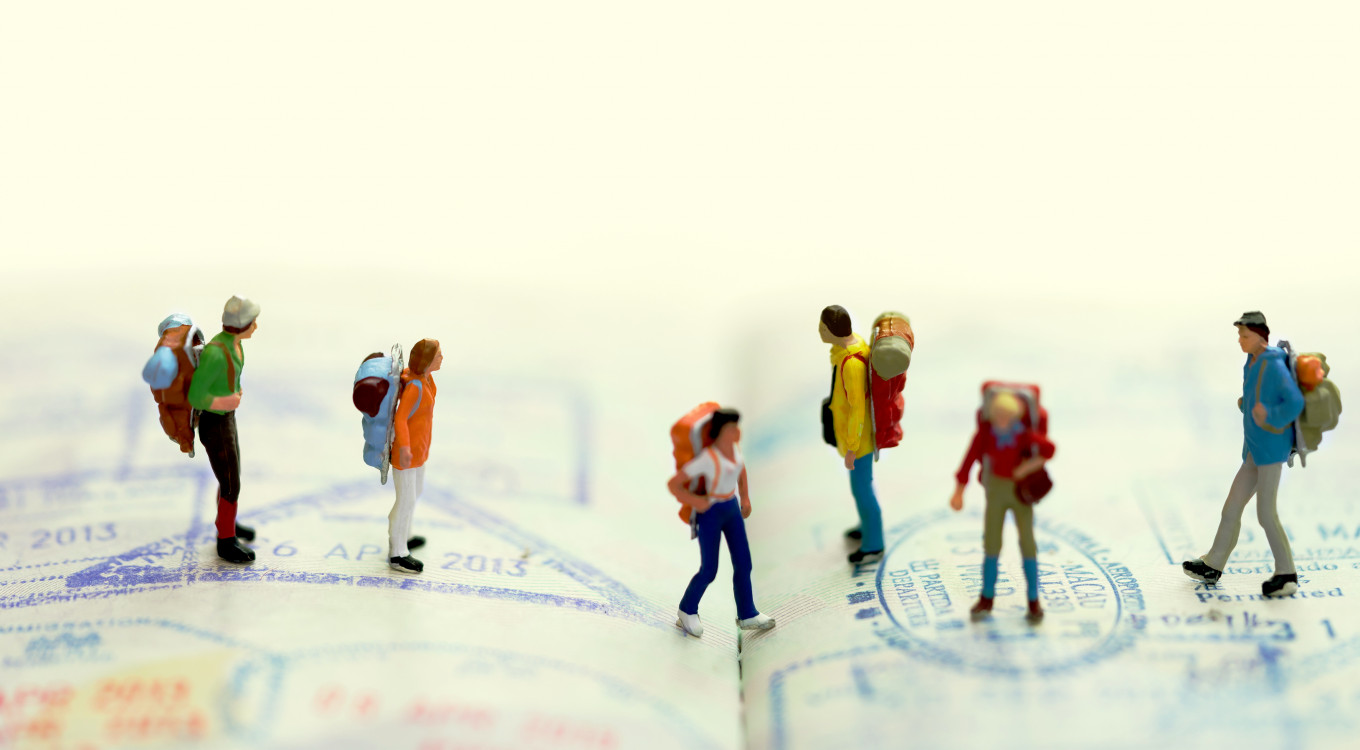
A young German male backpacker and an older, head-scarved, Iranian woman may travel on the same planet, but these might as well be in different solar systems. Race, religion, gender, class and above all, nationality have determined the caste system of global travelers for the entirety of my life, a hierarchy that is only getting more ossified.
Passportism has much of the caste system’s ingrained randomness in its bigotry, with national security as a fig leaf. First World-passport holders are hereditary brahmins, with the rest of the globe fitting into differing levels of hierarchy.
Those who identify as sensitive travelers are often flashy virtue signallers. They volubly abhor racism, sexism, homophobia et al. Their cosmopolitan values are in opposition to these blinkered world views. But the most basic enabler of travel for global brahmins, the passport, is also the greatest impediment to free movement for the world’s backward castes. And yet, passportism, or discrimination against Third World passports, somehow hides in plain view, as a perfectly valid form of bias, free of the moral repugnance that casteism and its ilk provoke.
Most passport brahmins remain blithely unaware of the humiliations inflicted on those less privileged. This ignorance is in the same vein as in which white people often declare there to be no racism because they have never experienced it. But unlike other forms of prejudice, passportism has an objective ranking. According to the Global Passport Index, a French passport allows one to travel to 135 countries without a visa. For an Afghan national that number is 7.
Given how today, a French passport is the equivalent of a key to the world, it is ironic that the document has roots in the locking down of undesirable movement.
In France, as in many parts of Europe, including Britain and Russia, passports were originally intended to limit the movement of peasants from the countryside to the cities. Saddling peasants with the necessity of travel permits protected city dwellers from overcrowding and resource scarcity, allowing them their pleasant, rabble-free gentility.
In contemporary times, there is an equivalent in the Chinese hukou, an internal passport that polices the access of people from rural areas to urban spaces in China. Despite its metaphorical association with access, think of phrases like ‘a passport to a better life’, a passport is almost always as much about restriction, a hydra-headedness that remains embedded in contemporary passportism.
Despite its metaphorical association with access, think of phrases like ‘a passport to a better life’, a passport is almost always as much about restriction, a hydra-headedness that remains embedded in contemporary passportism.
Another kind of travel document, one granting safe passage to the bearer in foreign lands, issued in the name of a royal or religious eminence has an even longer history. The earliest mention of one appears in the Old Testament of the Bible, wherein the prophet, Nehemiah is granted letters from the ancient Persian King Artaxerxe, requesting the governors of the lands beyond the Euphrates to grant him safe passage to Judah (modern day Israel/Palestine).
In Britain, the first reference to a ‘safe conduct’ document dates to a 1414 Act of Parliament, during the reign of Henry V. Almost 200 years later in 1599, Shakespeare made a lyrical reference to this early passport in his play about the same monarch. On St Crispin’s Day, on the eve of the Battle of Agincourt, the bard has Henry V urge his men to fight against the larger French forces.
‘That he which hath no stomach to this fight, / Let him depart; his passport shall be made,’ said the fictional Henry V.
If visas had existed then, caveats would have been needed. ‘Let him depart; his passport shall be made, although that gent shall needeth to waiteth f’r a visa appointment and yond might seeth that gent well into fusty age. Bett’r to just square the French.’
Henry himself, like all successive monarchs, was not subject to the need for a passport to travel, the argument being that passports are issued to British nationals in the name of the ruler. Even today, King Charles remains sans-passport, the ultimate by-birth brahmin.
In fact, for much of the 19th century, travel brahmins, high-born men from white nations, could swan about the world without passports and with servants, if their bearing was sufficiently haughty to ensure that no questions were asked. If you looked like you were born to mobility, you could usually enjoy it.
Passports, as we recognize them today, made an appearance only about a century ago, rising from the ashes of the First World War. The Great War accentuated the nation-ness of nations. Questions of who properly belonged inside what boundaries became exigent, ostensibly on grounds of national security.
In 1920, the League of Nations suggested a worldwide passport standard. Four years later, the United States passed the Immigration Act of 1924 to limit the influx of immigrants to the right kind. And how did one determine who was right and who wrong? By identifying their country of origin via their passports.
There are multiple ways to discriminate based on color: skin yes, but also travel documents.
The cleverness of the passport as a standard for sorting humans, lies in its purported objectivity. Imagine someone who is a staunch believer in Enlightenment values and, as a corollary, is appalled by the caste system. It would be rather awkward for this someone to justify the restriction of the mobility of another, purely based on the color of their skin or religion. The passport, however, is the hypocrite’s ally.
It is June 1994. I am 18 years old, and smoking with imagined aplomb, aboard a rickety Uzbekistan Airline plane. My eyes sting, my throat is parched, but I am aflame with freedom and nervous excitement. A sense that I am about to begin Life hops in my stomach, and smoking without the need to hide from the parental panopticon is symbolic of this liberty; an autonomy in consonance with flight. I am aloft in a myriad ways.
The plane is taking me from New Delhi, where I have recently started university, to Oxford, where my older brother is just wrapping up his studies.
My route, via Tashkent, might be unorthodox, but it is cheap. Uzbekistan Airlines is barely two years old at this point, having been established in early 1992, following the dissolution of the Soviet Union. The planes themselves are a lot older than the airline, but I am young, and the age of planes does not register, only the price of tickets.
I have been funded, somewhat meagerly, by my father to join my brother on a month-long trip interrailing across Europe. I have a rail ticket that allows me unlimited journeys on a network of trains that crisscross the continent, 600 pounds to cover all expenses, an international youth hostel card, and a rucksack.
My brother, five years my senior, has been entrusted to act as my chaperone and guide. He has planned for us to visit France, Germany, Austria and Italy. I’ve had no say in the itinerary or much else, but I have determined to be as unobtrusive as possible. The fear that I will wake up to realize that it’s all been a fevered dream, is real. I am treading softly, unbelieving of my luck.
The name of each country is so exciting that my nerves do the quick step as I imagine walking their streets, being in places sprung from the pages of the books that had, for the most part, been my portals to travel until then.
I spend several hours over a couple of months outside various embassies in Delhi, applying for visas. We are in a pre-Schengen, pre-visa outsourcing world. I meet with consulate officials, many of whom are kind, and excited for me, stirred out of their boredom by my unusual profile.
I am an exotic case: not a would-be immigrant, not a student, not part of a family of holidaymakers, not a man, not embarking on an arranged marriage with a European passport holder.
I am a female adolescent, about to perform the kind of modernity they approve of. I fit the travel as ‘finishing school’ paradigm, which has a hoary history in Europe. I wish to travel to glean experiences that are outside any institutional curriculum, mayhap to kiss a stranger.
The consular officers get the idea of a young person seeking the kind of self-realization that occurs while sipping a glass of wine on an Italian piazza. The visa officials smile and press stamps into my passport with generous attention. They wish me ‘“bon voyage”.
I wouldn’t be surprised if they discuss my application over family dinners. It’s one they’re unlikely to have come across often in India, a place where after-school math tuition is the standard version of ‘finishing school’.
India is also a place where the idea of traveling to foreign countries often makes people anxious about what they will eat. “Foreign” is not a place for enjoyment when you are unsure whether your accent will be understood, and when you fear causing offense with your saree-clad bodies or your too-slow-way of walking.
For many Indian parents, sending their 18-year-old daughter off to loiter across Europe would be an almost criminal act of irresponsibility.
Mine are unicorns. Their permissiveness and my wanton desire for movement betray my deracination, a state that my English-speaking tongue already hides in plain sight. I am sailing forth on gossamer wings of cultural confidence, having read the right books, developed the ‘right’ kind of secular outlook, and clad in jeans and a tee.
There is always a degree of smoke and mirrors when it comes to our identity, but more so with Macaulay’s descendants like myself. I haven’t questioned who I am much, yet. I need to travel to begin that excavation.
And so, before I buy my Uzbekistan airlines ticket to the world outside, I finger through my passport with the five glorious stamps it is now decorated with. I feel like the infant Lord Krishna who contained the whole world within his mouth. My muggle identity is already evident in the mélange of allusions with which I make sense of my internal world.
Interrailing is the late 20th century version of The Grand Tour, the cross-continental journey that was popular, between the 17th and 19th centuries, in aristocratic circles in Europe, as a way of ‘finishing’ a young man’s education.
These travels, which could last years, were intended to hone his social graces and broaden his cultural horizons. The route comprised the greatest hits of continental offerings: Paris, Basel, Geneva, Flanders, Vienna and always, most importantly, the art-drenched cities of Italy.
By the mid-19th century, wealthier members of Europe’s middle classes also began to travel, climbing the social hierarchy by imitating the behavior of the nobility. Later, as the middle class grew apace with the infrastructure for the railways, commercialized mass tourism was born and the travel guidebook emerged as its mid-wife.
The most notable amongst these guides were those by Karl Baedeker, who founded his Koblenz-based publishing house in 1827. These were the McDonalds of early European travel: making what could have been a confounding experience, standardized and accessible. First-time travelers were unburdened of choice or discernment. They could simply follow what the books told them to do.
The conventions of Baedeker guides have had remarkable staying power, their shadow looming over the bibles of 1990s’ travel: Lonely Planet and The Rough Guide.
Exploring the European continent by the time I am about to embark on my journey is a more democratic exercise than it was a century ago. Only black, brown, east-Asian (Japanese excepted) and indigenous peoples are noticeably absent on the circuit.
The bio-persona of The Rough Guide that my brother has purchased to usher us along our way is a young, white, middle-class, backpacker, who wants to travel on the cheap. The question of ‘cheaper than what,’ remains uninterrogated.
By consuming The Rough Guide, I feel included in a demographic within which I am an imposter. The book addresses a me that is not really me. My priorities are misaligned with the intended reader.
Ensuring I don’t overstay my visa (each country has issued me a permit for precisely the number of days and dates I have told them I will visit) is a far bigger preoccupation than choosing the restaurant with the best view. And yet, I trill to the headings: sleeping, eating, entertainment, tours, sights, festivals, top ten. The guide is my Blakean grain of sand, and I see in it: the keys to the world.
Pallavi Aiyar is a territorially polygamous correspondent, columnist, and author. She has reported from — and raised a family in — China, Belgium, Japan, Indonesia and Spain. She writes about the world with indiscriminate delight and a weakness for the surprising connections between people and places.