The Jakarta Post
Please Update your browser
Your browser is out of date, and may not be compatible with our website. A list of the most popular web browsers can be found below.
Just click on the icons to get to the download page.


Popular Reads
Top Results
No results found. Please check your search term and try again
Can't find what you're looking for?
View all search results
Popular Reads
Top Results
No results found. Please check your search term and try again
Can't find what you're looking for?
View all search resultsIndonesian teachers need a say in school AI policies, Cambridge says
Teaching the use of artificial intelligence at schools has become the quiet responsibility of teachers in Indonesia and worldwide to develop the practical knowledge of what responsible AI integration actually looks like.
Change text size
Gift Premium Articles
to Anyone
Share the best of The Jakarta Post with friends, family, or colleagues. As a subscriber, you can gift 3 to 5 articles each month that anyone can read—no subscription needed!
 Set as preferred source
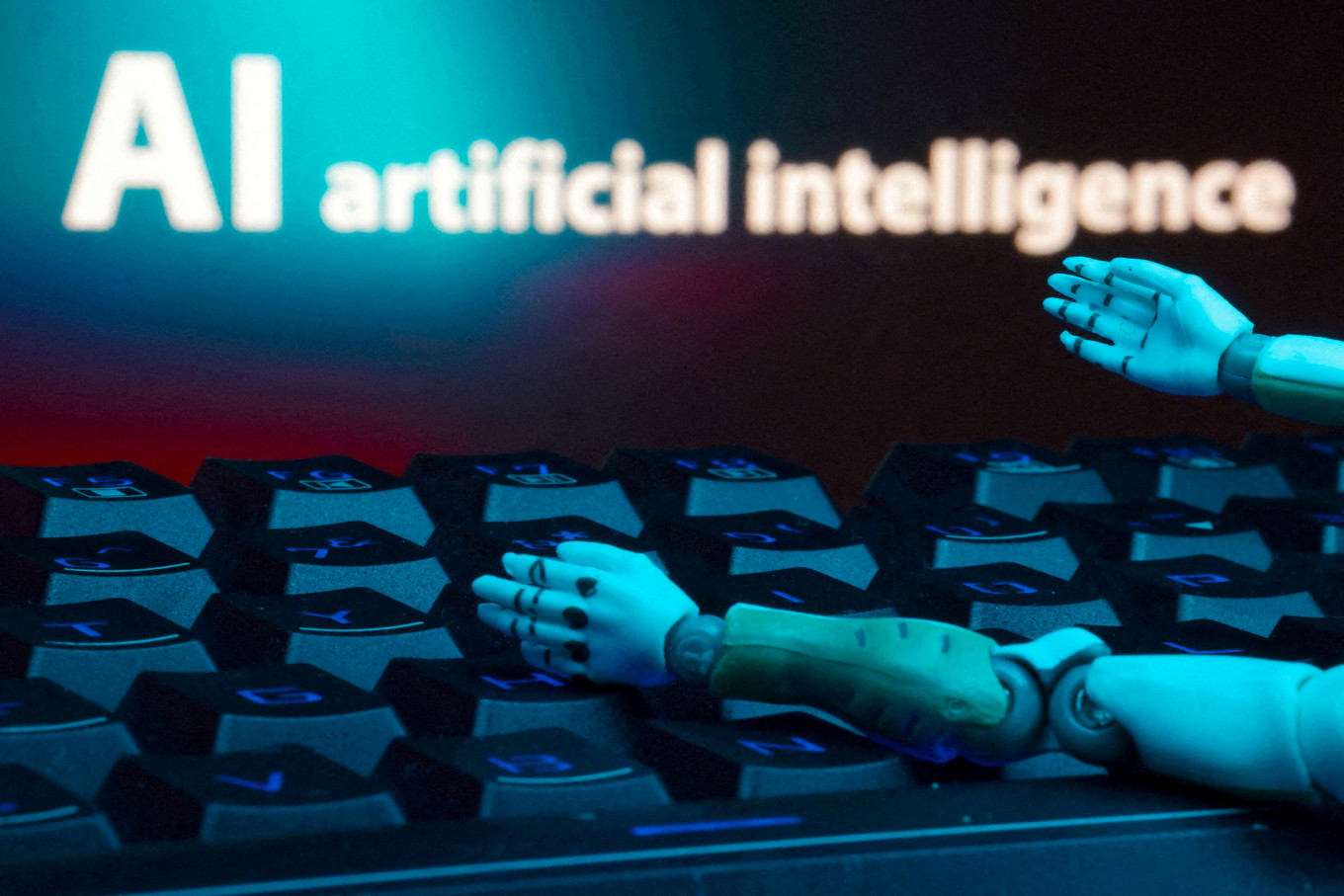 A message reading “AI artificial intelligence,“ a keyboard and robot hands are seen in this illustration created on Jan. 27, 2025. (Reuters/Dado Ruvic)
P
olicymakers in Indonesia should work closely with teachers to shape policy for the artificial intelligence age in schools and build on initial efforts to prioritize investment in comprehensive, sustained teacher professional learning to ensure educators can effectively use AI in their classrooms and critically engage with tools, a new Cambridge University Press Assessment report recommends.
“Crucially, teachers and learners should contribute to the design, procurement, implementation and evaluation of GenAI tools so that policy is grounded in classroom realities,” Cambridge University Press Assessment director of research Evelina Galaczi said in press release issued on Oct. 1.
“Policymaking has often struggled to keep pace with the rapid rate of technological change, but teachers have had to adapt.
Galaczi said that the situation has led to gulfs in knowledge and an inconsistent approach to AI education and adoption.
“As often happens, it has become the quiet responsibility of teachers in Indonesia and worldwide to develop the practical knowledge of what responsible AI integration actually looks like,” she said.
“Teachers who are already successfully experimenting with AI in their classrooms are prioritizing professional judgement, human-centered practices and critical AI literacy.”

She added that we can ensure AI becomes an effective and responsibly applied tool for teaching and learning, not a crutch for learning shortcuts, by following this lead.
The new report, “Shaping AI Policy and Practice in English Language Teaching”, draws on the best practices of English language teachers from around the world who have been early adopters of GenAI, as well as earlier Cambridge research on AI and teacher use, seeking to bring structure to an often-disjointed approach to AI use and adoption.
The findings suggest many teachers globally are navigating AI, but in a vacuum, often without clear direction. Teachers’ number one concern is how to support students to become AI-ready - to critically analyze AI outputs, proactively question their accuracy and skillfully use GenAI as a tool to support, rather than shortcut, learning.
Cambridge sets out eight key principles for harnessing AI effectively in schools to support teachers and inform evolving policy in Indonesia and worldwide.
The first principle is to involve teachers and learners in AI governance. Teachers and learners should contribute to decisions about the implementation and evaluation of GenAI tools so that policy is grounded in classroom realities.
“Invest in sustained teacher professional learning. Teachers need ongoing support to evaluate tools critically, make informed pedagogical decisions, adapt GenAI to learning goals, and teach students responsible use,” the report continues.
“Embed critical AI literacy as a curriculum expectation. Students should learn how to question AI outputs, identify bias and inaccuracies, use GenAI as a learning support rather than a shortcut and understand when not to use it. Critical AI literacy is essential and not an optional add-on.”
The fourth principle is to reform curriculum and assessment frameworks. Curriculum and assessment systems should recognize process evidence, feedback literacy, learner reflection and independent thinking alongside final products, in an integrated learning and assessment approach.
The report also recommends prioritizing human-centered educational outcomes. “Policy frameworks should focus on the human capabilities that need to be strengthened in the AI era, such as critical thinking, communication, autonomy, emotional intelligence and social responsibility,” the report said.
Building trust through ethical use and robust safeguards will be the sixth principle. Responsible integration and trust by all stakeholders, e.g., teachers, learners, parents, depends on clear approaches to data privacy, age-appropriate access, inclusivity, responsible authorship, transparency and accountability.
Cambridge also recommended protecting teacher agency and professional judgement. Policies should position teachers as decision-makers in tool design, selection, classroom integration, evaluation and improvement — not merely as implementers of externally chosen technologies.
Lastly, ensuring equitable access to high-quality tools completes the eight-point principles. Policy should address language diversity, local contexts, accessibility and under-resourced settings so that GenAI does not widen existing inequalities.