The Jakarta Post
Please Update your browser
Your browser is out of date, and may not be compatible with our website. A list of the most popular web browsers can be found below.
Just click on the icons to get to the download page.


Popular Reads
Top Results
No results found. Please check your search term and try again
Can't find what you're looking for?
View all search results
Popular Reads
Top Results
No results found. Please check your search term and try again
Can't find what you're looking for?
View all search resultsInvestigation finds animal welfare concerns at Bali wildlife attractions
The investigations found that nocturnal species, including owls and bats, were displayed during daylight hours and repeatedly handled by visitors, according to the report.
Change text size
Gift Premium Articles
to Anyone
Share the best of The Jakarta Post with friends, family, or colleagues. As a subscriber, you can gift 3 to 5 articles each month that anyone can read—no subscription needed!
 Set as preferred source
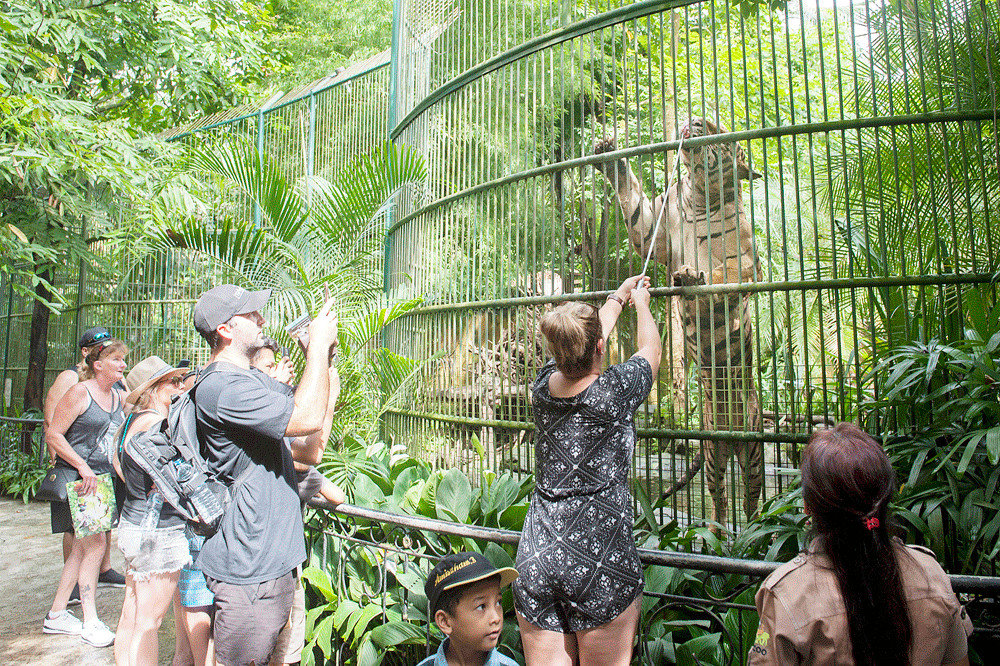 A visitor feeds a Bengal tiger at Bali Zoo in Gianyar, Bali, in this file photograph. (Antara/-)
A
new investigation has raised concerns over the welfare of wildlife used in Bali’s tourist sector, documenting cases in which animals are allegedly exposed to dangerous conditions for commercial gain.
The report, released by the Bali Wildlife Protection Coalition, a network of organizations and individuals working to protect wildlife, is based on field investigations carried out in 2017, 2023 and 2026.
Researchers examined conditions at facilities housing or displaying wildlife, including zoos, tourist attractions and venues that promote themselves as conservation facilities.
The investigations documented a range of species, including elephants, dolphins, turtles, primates, birds, reptiles and bats. The report examines how the animals were housed, handled and used in tourism activities, and investigates whether some practices were consistent with animal welfare and conservation standards.
Tornita Santara, a representative of the Bali Wildlife Protection Coalition, said the investigations had identified recurring and systemic animal welfare concerns at a number of wildlife tourism facilities in Bali.
“Investigators found animals kept in inadequate enclosures and in conditions that restricted their movement and limited their ability to display natural behavior. At some facilities, inadequate barriers between animals and visitors allowed direct contact, raising concerns over animal welfare and public safety,” she said on Monday.

Read also: Authorities foil effort to smuggle hundreds of birds out of Bali
The investigations found behavior that the coalition said could indicate stress and a lack of environmental stimulation, including repetitive or stereotypic movements.
An albino male long-tailed macaque was repeatedly observed displaying such behavior and appeared to have a facial injury, according to the report. Captive dolphins were also observed swimming in circles and repeatedly bobbing their heads.
The investigations further found that nocturnal species, including owls and bats, were displayed during daylight hours and repeatedly handled by visitors, according to the report.
The investigations also documented incidents involving visitors. In one case, a tourist was seen pouring a carbonated drink into a squirrel enclosure. In another, a tourist was seen pulling an iguana by the tail.
“Handling, touching, feeding, bathing, riding and other forms of wildlife-based entertainment are fundamentally at odds with the objectives of genuine wildlife conservation,” Tornita Santara said.She said international animal welfare standards cited in the report emphasized that animals kept under human care should be able to express natural behavior and be protected from stress, fear and injury.
Femke den Hass, cofounder of Jakarta Animal Aid Network (JAAN) Indonesia, said wildlife should not be treated as objects for public interaction or entertainment.
“They deserve to live in conditions that respect their natural behavior, welfare and dignity,” Den Hass said. “It is time to move away from exploitation toward tourism and conservation practices that genuinely put the needs of wildlife first.”
Nina Jackel, founder and president of Lady Freethinker, a nonprofit media and animal advocacy organization that is part of the coalition, said wildlife should not be used as props, performers or rides, particularly when such activities are presented to tourists as conservation.
“Genuine conservation means protecting wildlife and respecting their natural behavior and welfare,” Jackel said. She said tourists could help drive change by choosing experiences based on observation and respect rather than direct interaction.
“Bali can show that a thriving tourism industry and strong animal welfare standards can go hand-in-hand,” Jackel said.
Read also: Bali’s rabies crisis in spotlight following Jembrana dog attack
As Bali continues to attract millions of domestic and international visitors, wildlife tourism has become an established part of the island’s tourism offering, with facilities ranging from commercial zoos and animal parks to sanctuaries and attractions marketed as conservation initiatives.
According to Bali’s Natural Resources Conservation Agency (BKSDA Bali), the island has 13 registered wildlife conservation institutions, alongside several commercial zoos, animal parks and community-led turtle sanctuaries. (nal)