The Jakarta Post
Please Update your browser
Your browser is out of date, and may not be compatible with our website. A list of the most popular web browsers can be found below.
Just click on the icons to get to the download page.


Popular Reads
Top Results
No results found. Please check your search term and try again
Can't find what you're looking for?
View all search results
Popular Reads
Top Results
No results found. Please check your search term and try again
Can't find what you're looking for?
View all search resultsFree meal expiry labels criticized as inadequate
The government’s plan to put expiration date labels on free nutritious meal packages has drawn criticism that it could shift responsibility for food poisoning onto beneficiaries while leaving deeper food safety problems unaddressed.
Change text size
Gift Premium Articles
to Anyone
Share the best of The Jakarta Post with friends, family, or colleagues. As a subscriber, you can gift 3 to 5 articles each month that anyone can read—no subscription needed!
 Set as preferred source
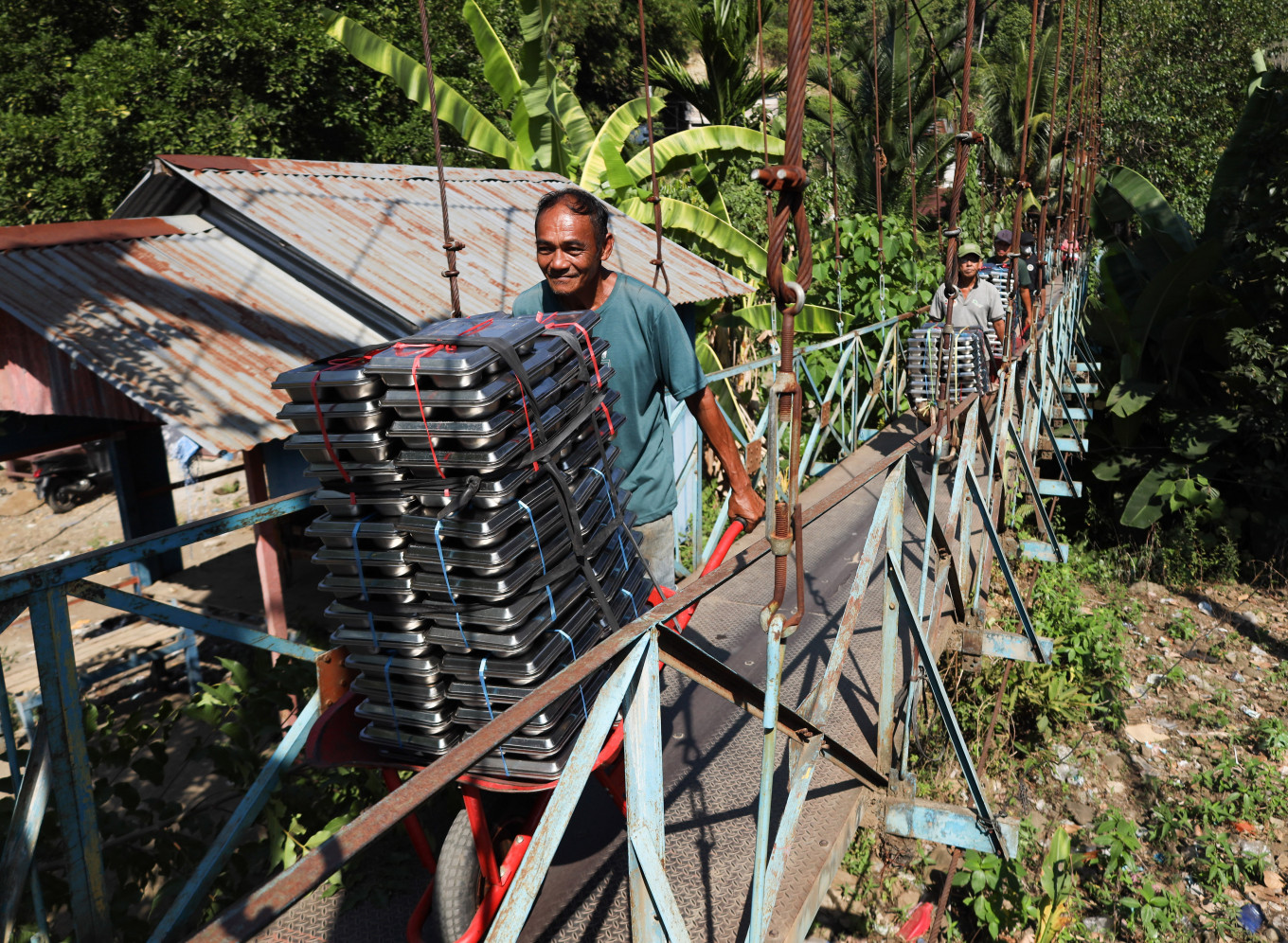 Workers transport meal containers of the free nutritious meal program by cart on Tuesday to schools in Sangkurio, Mamuju, West Sulawesi. The West Sulawesi Regional Office of the Directorate General of Treasury (DJPb) said the province had allocated Rp220 trillion (US$13.7 million) in state funds for the program by mid-2026, reaching 375,922 beneficiaries and supported by 169 Nutrition Fulfillment Service Units (SPPGs) out of a target of 189. (Antara/Akbar Tado)
T
he government’s plan to put expiration dates on free nutritious meal packages has drawn criticism that it could shift responsibility for food poisoning onto beneficiaries while leaving deeper food safety problems unaddressed.
The National Nutrition Agency (BGN), which oversees the flagship initiative of President Prabowo Subianto, said the measure would be implemented in the second week of August in an attempt to address reports of foodborne illnesses related to the program.
Under the new measure, each meal must be consumed within four hours of being prepared at Nutrition Fulfillment Service Units (SPPGs), the kitchens responsible for preparing the meals, BGN head Sudaryono said.
“The food must be consumed within a maximum of four hours after cooking because it contains no preservatives,” he said in a statement last week. “The meals are freshly prepared, not ultra-processed, so there is a specific window in which it is safe to consume them.”
Read also: Food waste issue looms over free meals rollout
The plan has been criticized by the Indonesian Education Monitoring Network (JPPI), which said the labels could shift responsibility for food poisoning onto students and schools that consume meals beyond the designated time, rather than addressing problems with kitchen hygiene and ingredient quality.

“Simply putting a label on the package is not a fundamental solution,” JPPI national coordinator Ubaid Matraji told The Jakarta Post on Monday.